


CHAPTER 10 EN.WIKISOURCE.ORG/…
The problem of capitalist labor-time (Foley figure 3.1) is whether commodities exchange at their labor values.


The motion of money as capital binds the production process to the circulation process, in the means that commodity production becomes a phase or a moment (although the decisive moment for the whole valorisation process) of the total circuit of social capital:
M — C ( = Mp + Lp) [→P→C΄] — M´ users.ntua.gr/…
Kliman:

Keen, Minsky, Money
/media/0e25be804a6bdfb9394cf4db091d0f91https://youtu.be/dsp6Su6hNuo
Money and Macroeconomics from First Principles for Elon Musk and Other Engineers by Stephen Keen (Author), Nick Barbalich (Editor)
Financial instability and debt deflation
Most of Steve Keen’s recent work focuses on modeling Hyman Minsky’s financial instability hypothesis and Irving Fisher’s debt deflation.[4][5] The hypothesis predicts that an overly large private debt to GDP ratio can cause deflation and depression. Here, the falling of the price level results in a continually rising real quantity of outstanding debt. Moreover, the continued deleveraging of outstanding debts increases the rate of deflation. Thus, debt and deflation act on and react to one another, resulting in a debt-deflation spiral. The outcome is a depression.
Debunking Economics
Keen’s full-range critique of neoclassical economics is contained in his book Debunking Economics.[6] Keen presents a wide variety of critiques on neoclassical economic theory. He argues they show neoclassical assumptions which are fundamentally flawed. Keen claims several neoclassical assumptions are empirically unsupported (that is, they are unsupported by observable and repeatable phenomena) nor are they desirable for society at large (that is, they do not necessarily produce either efficiency or equity for the majority). He argues economists’ overall conclusions are very sensitive to small changes in these assumptions.
Keen has attempted to counter Karl Marx’s theory (in his view Marx’s pre-1857 view, specifically) from a post-Keynesian perspective, by arguing machines can add more product-value over their operational lifetime than the total value of depreciation charged “during those asset lives”.
For example, the total value of sausages produced by a sausage machine over its useful life might be greater than the value of the machine. Depreciation, he implies, was the weak point in Marx’s social accounting system all along. Keen argues all factors of production can add new value to outputs. However he gives credit to Marx for contributing to the “financial instability hypothesis” of Hyman Minsky.[7][full citation needed]
Keen’s book closes with a survey of various schools of heterodox economics, concluding “None of these is at present strong enough or complete enough to declare itself a contender for the title of ‘the’ economic theory of the 21st century.” However, he argues neoclassical economics is a degenerative research program, not generating new knowledge. It primarily grows a belt of protective auxiliary hypotheses to shield its core beliefs from critique. There is an accompanying website which provides more detailed mathematical expositions.
Critique of neoclassical theory of the firm
Keen has challenged the core, elementary textbook neoclassical theories of Perfect competition and Monopoly, and in particular the argument that firms in “perfect competition” and monopolies are usefully thought of as representing polar opposites. Keen has referred to this as “the theory of the firm.”
Neoclassical textbooks define a firm acting without any strategic awareness of the effect of its output choice on price as representing “perfect competition” and argue that this condition of “perfect competition” can be represented analytically by a horizontal demand curve facing the firm — the firm acts as if it believes it can sell whatever it produces at the currently prevailing price, but nothing at any higher price; marginal costs for this firm, it is presumed, are rising and the firm does not want to sell more at the current price or a lower price. Something like such a state of affairs, it is sometimes argued, is approached as the number of firms competing in a market approaches infinity and the effect of any one firm’s output decision on the overall market price becomes infinitesimal and can be practically disregarded by the individual firm in its decision-making.
By contrast a firm with strategic awareness that its output decision markedly affects the market price, faces, presumptively, a downward-sloping demand curve: expanding the rate of output sold depresses market price. In general, elementary neoclassical textbook presentations hold that all “profit-maximizing” firms will set marginal revenue equal to marginal cost. For the firm in “perfect competition”, this means price = marginal revenue = marginal cost = average (unit) cost and no profit. For the “monopoly” firm aware that its output choice affects price, the “profit-maximizing” choice is to choose a rate of output where marginal cost = marginal revenue, but in the monopolist’s case, that will mean constraining output to raise price above marginal cost.
Keen challenges the theory and pedagogy of “perfect competition” and “monopoly” as polar opposites from multiple angles, arguing that they are contradictory and incoherent taken as a whole. He shows that the number of firms in a market is practically irrelevant to whether the firm’s output choice affects the overall market price in the simplified (and practically unlikely) case of uniform firm cost structures and a downward-sloping market demand curve. He goes on to explore various scenarios by which many firms might arrive at an “equilibrium” market price and level of output. Keen further notes that cost structures are rarely uniform and that in the presence of significant economies from scale of production, a so-called “monopoly” realizing such economies of scale would be led to higher output and lower price than a large number of competing firms unable to realise such economies of scale. Keen also takes note of empirical evidence that many actual business firms produce a range of output whose marginal cost may be less than average cost and falling, and firms openly desire to produce and sell more at current prices.[8]
Keen’s article on “profit maximisation, industry structure, and competition”[9] has elicited counter-arguments by Paul Anglin.[10] Chris Auld has additionally claimed to show that Keen & Standish’s arguments are inconsistent with standard assumptions used in perfect competition, and their analysis uses calculus improperly.[11]
Climate change
Keen criticises the economics of climate change generally and the 2018 work by Nordhaus in particular: “economists made their own predictions of damages, using three spurious methods: assuming that about 90% of GDP will be unaffected by climate change, because it happens indoors; using the relationship between temperature and GDP today as a proxy for the impact of global warming over time; and using surveys that diluted extreme warnings from scientists with optimistic expectations from economists.”[12][13] For example, indoor activities can be disrupted by extreme weather (e.g. Hurricane Sandy). Keen also argues that regressions of the GSP of states in the US to average temperature are flawed as the states have similar per capita income, that other factors are more important to GSP rather than average temperature, and that assuming the weak correlation found would continue to hold true with further global warming is begging the question.
When specifically speaking about Nordhaus, he says that “Nordhaus has misrepresented the scientific literature to justify the using a smooth function to describe the damage to GDP from climate change. Correcting for these errors makes it feasible that the economic damages from climate change are at least an order of magnitude worse than forecast by economists, and may be so great as to threaten the survival of human civilization.”[12][13]
Politics
In August 2015, Keen endorsed Jeremy Corbyn’s campaign in the Labour Party leadership election.[14] Keen ran as a senate candidate for The New Liberals in New South Wales during the 2022 Australian federal election.[15][16]
Views on the UK’s EU referendum
Keen was in favour of the UK leaving the European Union, stating mainstream economists were over-certain and exaggerating the likely effects following the country’s withdrawal. Keen regards the open-borders free-movement policy of the EU as precipitate and unsustainable in the absence of a common fiscal policy; all the more so, given how migrants impose burdens on public services in destination countries also experiencing austerity.
He also states the Euro is destined to fail, not least because of the way it penalises recession-hit countries unable to pursue expansive fiscal policy, and indeed considers the whole EU project as a failed one destined for[17] collapse.[18]
Criticism
Economist Chris Auld argues that Keen’s criticism of the basic model of perfect competition makes basic mathematical errors.[11]
Matthijs Krul[22] maintains that Keen, while broadly accurate in his criticism of the neoclassical synthesis, generally misrepresents Marx’s views in Debunking Economics and in earlier work when asserting that, in the production of commodities, machinery produces more value than it costs.[23]
/media/77fe5818e7718f0899ad9a97d24dc322
/media/24fd26b001bd5c98b5785a368826c152
definitions of exchange, value, money and capital
“products of labour become commodities, and commodities come to possess value, only as a result of actual exchanges on the market.”
is abstract labour purely an effect of economic exchange.
for Marx, it is not the relations of exchange (the market transactions) that hold society together, but the cooperative relations of production (governed by property rights), that form the economic structure of society.
the movement of history “can be expressed indirectly by time as a dependent variable; as a movement of time, though, it cannot be grasped by static, abstract time”.
in Marx, a sharp decline in the rate of profit is not a prerequisite for a crisis to emerge, if the rate of profit is already low. We argue further, that «financialization» of capital resulted, following the «great stagflation» of the 70s, from a strategy to battle low profitability by suppressing interest rates in order to increase the «rate of profit of enterprise». We show that this policy is, in the end, limited by the «rate of profit» and when the limit is reached the system collapses as it did in 2007…he recurrence of crises is so intense that crises events should be referred to as «white swans» rather than black.
===================
Guglielmo Forges Davanzati & Rosario Patalano (2017) Marx on Public Debt: Fiscal Expropriation and Capital Reproduction, International Journal of Political Economy, 46:1, 50–64, DOI: 10.1080/08911916.2017.1310474 To link to this article: http://dx.doi.org/10.1080/08911916.2017.1310474
Paul A. Baran’s and Paul M. Sweezy’s surplus approach in the social order of monopoly capital (Baran and Sweezy 1966: 196). According to this view, the development of Monopoly Capital requires several specific things of the State:
1. The State provides labor protection by paying some benefits to workers employed (social security, medical costs), and providing a minimum of welfare benefits for those workers unemployed that are a part of the classical Marxian reserve army (unemployment compensation, workers’ compensation);12
2. The State mediates between labor supply and the firms through the provision of mediation services and protection of the labor contract;
3. The State purchases the overproduction through Keynesian-type policies and encourages the accumulation process and formation of social surplus, providing an additional demand with government spending on goods and services. This occurs because capitalist reproduction in a monopolistic environment tends to spontaneously produce underconsumption. Public expenditure is a necessary device in order to keep aggregate demand high, and its “productivity” may be irrelevant (see Magdoff and Sweezy 1987). As a matter of fact, these scholars point out that, with particular reference to the U.S. economy, public expenditure is basically military expenditure, which produces increases in productivity not via the expansion of welfare state but via innovations produced in this sector.
4. The State helps the firms with the largest and most expensive technology developments, raising the productivity of labor (space program, university research programs, direct state investment through business locations support, and many military expenditures on technology development and investment in form).
5. The state maintains the system by responding to social conflicts and political pressures, putting the economic affairs into the political sphere.13
Note that, in the logic of this schema, the increase in public expenditure implies an increase in money profits if the additional production by private firms resulting from the higher productivity equals the additional demand deriving from workers in the public sector, which presupposes an increase in wages and/or employment in the public sector. Note also that if financial rents (deriving from the interest on state bonds) are spent, this increases money profits insofar as it raises money revenues.29
Keen (2011: 217) focuses on Marx’s circuit of capital and stresses that: “In Say’s principle terms, the sum of these, their excess demand, is negative. When the two circuits [the circuit of commodities and the circuit of capital] are added together, the sum of all excess demand in a capitalist economy is likewise negative (prior to the introduction of debt).”
When debt is considered, the following result holds: “Since the change in debt is a major component of aggregate demand, and aggregate demand determines employment, unemployment rises if the rate of change of debt falls (and vice versa)” (Keen 2011: 342). He adds that “Marx also pointed out that this ‘Circuit of capital’ takes time: it involves getting money in the first place, using it to hire workers and buy inputs, combine them in production process, ship the finished good and finally send them to customers. There is thus a time lag between outlaying M and earning DM, which Marx called the ‘period of turnover’” (Keen 2011: 367–68). This is a crucial point, insofar as speculation allows capitalists to obtain profits in a time-saving way, implying that the longer the production process is, the more capitalists find it convenient to allocate their resources in the financial markets.30
— — — —
CONCLUDING REMARKS
This article dealt with an analytical reconstruction of Marx’s view of the effects of the expansion of public debt on profits and economic growth. It has been argued that: (1) an expansion of net public expenditure (and hence of public debt) raises money profits and at the same time encourages speculation, thus redistributing income to the benefit of rentiers; (2) the increase in public debt implies increasing taxation on wages, labeled “fiscal expropriation.” In fact, following Marx, the repayment of public debt requires an increase in taxation that, both directly and indirectly, reduces real wages. Workers can react by increasing their working hours, or it may happen that the decline in wages leads to a deterioration in the quality of the workforce, thus reducing labor productivity. Two further effects have been taken into consideration. First, the increase in public debt can increase employment (via the expansion of the public sector and indirectly via the expansion of public works), involving an increase in wages. Second, the increase in public expenditure can improve welfare services, increasing labor productivity and improving workers’ conditions. Accordingly, by contrast to the dominant interpretations, there is no single answer, for Marx, to the relation between public expenditure, capital reproduction, and income distribution. Finally, it has been shown that a criterion of public debt sustainability can be derived from Marx and that this criterion is political in essence, implying that the expansion of public debt cannot generate a condition where wages are persistently settled below their subsistence level.
— — — — — — — — — — —
The Promissory Self — Credit and Debt Rationalities in the Work and Life of Karl Marx
Mikkel Thorup
Thorup, M. (2017). The Promissory Self — Credit and Debt Rationalities in the Work and Life of Karl Marx. In: Bek-Thomsen, J., Christiansen, C., Gaarsmand Jacobsen, S., Thorup, M. (eds) History of Economic Rationalities. Ethical Economy, vol 54. Springer, Cham. https://doi.org/10.1007/978-3-319-52815-1_10
Credit, Karl Marx writes, is “the economic judgment on the morality of a man.” Possibly more than any other economic issue, debt reveals the interrelations between economic and moral rationalities. This chapter investigates the moral side of debt as revealed in two marginal writings of Karl Marx, namely in his Paris notebooks and in a letter to Friedrich Engels. Both texts grasp with the same moral issues of private indebtedness and shed light on both a theoretical and a personal coming to terms with the condition of indebtedness. Developing out of a close reading of these two texts the chapter provides an entry into more general issue of how debt is always already over-determined by not only its economic, calculable and payable issues, but also with moral issues of settling scores, paying one’s dues and performing in all its dimensions what we can refer to as a “payback morality.”
=================
“The state, or the central bank acting on its behalf, claims a monopoly on the issue of certain forms of money… but in principle, anyone can create money; the problem is to get it accepted.” — Hyman P. Minsky
— — — — — — — –
Since the Great Financial Crisis of 2007–09, Hyman Minsky (1919–96) has been widely recognized as one of the late twentieth century’s most insightful economic theorists. As Thomas I. Palley wrote in Monthly Review in April 2010:
Aside from Keynes, no economist seems to have benefited so much from the financial crisis of 2007–08 as the late Hyman Minsky. The collapse of the sub-prime market in August 2007 has been widely labeled a “Minsky moment,” and many view the subsequent implosion of the financial system and deep recession as confirming Minsky’s “financial instability hypothesis” regarding economic crisis in capitalist economies. For instance, in August 2007, shortly after the sub-prime market collapse, the Wall Street Journal devoted a front-page story to Minsky.
Nevertheless, if Minsky had still been alive at the time of the Great Financial Crisis, there would have been little likelihood that his new-found reputation would have resulted in his receiving the so-called Nobel Prize in Economics (the Bank of Sweden’s Prize in Economic Sciences in Memory of Alfred Nobel) since he was a heterodox and socialist economist and thus an opponent of the dominant neoclassical orthodoxy. It is this topic of Minsky’s heretical views and how these are related to the wider critique of capitalism that Riccardo Bellofiore addresses in the following article.
— The Editors
In 1976, Guido Carli left the Bank of Italy, of which he was the governor, after being appointed chairman of Confindustria. There, he refounded the Centro Studi di Confindustria (CSC), the research department of the Italian Industrial Association. Paolo Savona, who also came from the Bank of Italy, was the first director of the CSC. The think tank was open to international economists of various theoretical orientations, ranging from Monetarists to post-Keynesians. Thanks to the post-Keynesian economist Jan Kregel, who had been hired by the CSC, Hyman Minsky was invited as a visiting scholar starting in 1978. Through Michele Fratianni, who was on the Scientific Committee, Savona was in contact with the Swiss monetarist economist Karl Brunner. Savona and Fratianni encountered Brunner at a Shadow Open Market Committee meeting at Rochester University. Brunner was furious about Minsky and complained that they “had brought home a communist.” Carli and Savona were not very impressed.1
But the question still stands: Was Minsky in fact a communist? Of course not. But, a century after his birth, it is useful to clarify often neglected aspects of his intellectual biography. His intellectual (and political) legacy has been constrained paradoxically by the very financial instability hypothesis on which his reputation stands, which is important but also limiting.
— — — — — —
A Minsky Moment is a sudden collapse in asset values that occurs after a long period of speculative borrowing and rising debt.
Coined by economist Hyman P. Minsky, the term describes the precise tipping point in a financial cycle where:
- Speculation Peaks: Investors have borrowed heavily to buy assets, betting that rising prices will cover their debt costs.
- Cash Flow Fails: Asset prices stop rising (or fall slightly), meaning the income generated by those assets is no longer enough to service the debt.
- Panic Selling: Investors are forced to sell assets to pay down loans, causing prices to plummet further and triggering a cascade of defaults.
Minsky argued that stability itself breeds instability. During “good times,” investors become complacent, moving from hedge finance (safe, income covers debt) to speculative finance (income covers interest only) and finally to Ponzi finance (income covers neither; investors rely on asset price appreciation to survive). The Minsky Moment is when the market realizes the Ponzi schemes are unsustainable, leading to a rapid, often violent, deleveraging.
The term gained widespread popularity after the 2008 Global Financial Crisis, which many economists viewed as a textbook example of a Minsky Moment.
==========
Key Themes in Current Research:
- Post-Pandemic Debt Build-Up
Many economies experienced massive fiscal and monetary stimulus after 2020, leading to elevated private and public debt. Scholars argue this sets the stage for a potential Minsky Moment if interest rates remain high for longer or if asset valuations become detached from fundamentals. - Commercial Real Estate & Regional Banks
A recurring focus is the vulnerability in the commercial real estate (CRE) sector, particularly office buildings, amid remote work trends and rising refinancing costs. Some research suggests this could trigger a chain reaction similar to a Minsky Moment, especially if regional banks face liquidity crunches. - AI and Speculative Bubbles
Recent work has examined whether the AI boom (especially since 2023) represents a new form of speculative mania. Some economists warn that rapid capital inflows into AI startups and tech stocks could mirror past Minsky-style cycles if valuations outpace productivity gains. - Central Bank Policy and Financial Stability
There’s ongoing debate about whether traditional monetary tools can prevent or mitigate a Minsky Moment. Some researchers advocate for macroprudential policies (e.g., loan-to-value caps, counter-cyclical capital buffers) as more effective tools than interest rate adjustments alone. - Global Interconnectedness
Modern financial systems are more globally linked than in Minsky’s time. Recent studies emphasize how a localized shock (e.g., in China’s property market or U.S. CRE) could propagate rapidly, amplifying systemic risk.
Confidence Level:
High — These themes are well-documented in recent academic papers, central bank reports, and economic commentary from 2023–2026.
Minsky Moment 2025 2026 research financial crisis
============
asset valuations become detached from fundamentals through a progression of speculative behavior driven by easy credit and the belief that rising prices will continue indefinitely. This process is central to the concept of a “Minsky Moment.”
Here is how the detachment occurs according to the text:
1. The Shift from Hedge to Ponzi Finance During periods of stability (“good times”), investors become complacent and move through three stages of financing:
- Hedge Finance: Income covers both principal and interest (safe).
- Speculative Finance: Income covers only interest; investors must roll over debt (risky).
- Ponzi Finance: Income covers neither principal nor interest. Investors rely solely on asset price appreciation to service their debt. At the Ponzi stage, the asset’s value is no longer supported by the income it generates (its fundamental value) but purely by the expectation of future price increases.
2. Decoupling via Speculative Borrowing The text notes that “in principle, anyone can create money,” but the problem is getting it accepted. When credit is readily available, investors borrow heavily to buy assets. This massive influx of capital drives prices up, creating a feedback loop where rising prices justify further borrowing, further inflating the bubble.
- The Detachment: The price of the asset rises far above the present value of the cash flows (rents, dividends, profits) it actually produces. The valuation becomes a function of speculation, not fundamentals.
3. The Role of Credit and Endogenous Money The text (referencing Eckhard Hein’s interpretation of Marx) explains that credit is endogenous, meaning the quantity of money expands to meet the demand of borrowers.
- As long as the rate of profit of enterprise (profit after interest) is positive, capitalists continue to borrow and invest.
- If interest rates remain low or if investors believe rates will stay low, they can sustain high debt loads even if the underlying asset yields little income. This allows valuations to drift further from the asset’s productive capacity.
4. The Trigger: When Reality Sets In The detachment ends abruptly in a Minsky Moment:
- Cash Flow Fails: Asset prices stop rising or fall slightly.
- The Realization: Investors in “Ponzi finance” positions realize their assets are not generating enough income to cover debt costs.
- Panic Selling: To pay down loans, investors are forced to sell assets. This causes prices to plummet, revealing that the previous valuations were entirely unsupported by fundamentals.
Current Context (2025–2026) The text highlights specific areas where this detachment is currently being researched:
- Commercial Real Estate (CRE): Remote work trends have reduced the fundamental utility (and rental income) of office buildings, yet valuations may remain high due to legacy debt structures.
- AI Boom: Rapid capital inflows into AI startups may have pushed valuations ahead of actual productivity gains, creating a potential speculative bubble similar to past Minsky-style cycles.
In summary, valuations detach when the market shifts from valuing assets based on their income-generating ability to valuing them based on the expectation of selling them to someone else at a higher price, fueled by an expanding credit system.
Qwen VL 235B
💬
===========
fundamentals refer to the actual income-generating capacity or productive utility of an asset, independent of speculation or market sentiment.
In the context of the “Minsky Moment” and the economic theories discussed (Marx, Minsky, Hein), fundamentals are defined by:
- Cash Flow: The actual income an asset produces, such as rents from real estate, dividends from stocks, or profits from a business.
- Productive Utility: The real-world use or service an asset provides (e.g., the utility of an office building for workers, which has declined due to remote work trends mentioned in the text).
- Present Value: The mathematical calculation of the asset’s worth based on the sum of its future cash flows, discounted to today’s value.
The text explains that asset valuations “detach from fundamentals” when prices are driven not by these income streams, but by speculation — the belief that prices will keep rising and that the asset can be sold to someone else at a higher price.
When the text states that a crisis occurs when “asset valuations become detached from fundamentals,” it means the market price has risen far above the value justified by the asset’s actual ability to generate money or utility.
==========
https://www.investopedia.com/terms/m/minskymoment.asp
- Levy Economics Institute of Bard College. “A Perspective on Minsky Moments: The Core of the Financial Instability Hypothesis in Light of the Subprime Crisis.” Page 2.
- L. Randall Wray. “Minksy Crisis.” In Steven N. Durlauf and Lawrence E. Blume, eds. “The New Palgrave Dictionary of Economics.” Palgrave Publishing, 2018. Pages 8792–8798.
- Hyman Minsky. “Uncertainty and the Institutional Structure of Capitalist Economics.” Journal of Economic Issues. 30.2 (1996). Pages 357–368.
- Hyman Minsky. “John Maynard Keynes.” Springer, 1975.
- Hyman Minsky. “The Essential Characteristics of Post Keynesian Economics.” By Ghislain Deleplace and Edward J. Nell, eds. “Money in Motion: The Post Keynesian and Circulation Approaches.” (Via Google Scholar.) St. Martin’s Press. Pages, 70–88.
- Janet L. Yellen. “A Minsky Meltdown: Lessons for Central Bankers?” In “Conference Proceedings, 18th Annual Hyman P. Minsky Conference on the State of the U.S. and World Economies: Meeting the Challenges of Financial Crisis.” Levy Economics Institute of Bard College. Pages 39–46.
- Hyman Minsky. “Stabilizing an Unstable Economy.” McGraw Hill, 1986. Page 242.
- Independent Commodity Intelligence Services. “China’s ‘Minsky Moment’ and the Global Economy.”
- TW Research Group. “China’s Minsky Moment.”
- People’s Bank of China. “Governor Zhou Xiaochuan Answered Press Questions at the 19th CPC National Congress.”
- International Monetary Fund. “China’s Real Estate Sector: Managing the Medium-Term Slowdown.”
- Forbes. “The Risks China Faces Now That Its Minsky Moment Has Begun.”
- Morningstar. “Is This Another Minsky Moment?”
- International Monetary Fund. “Global Debt Is Returning to Its Rising Trend.”
- FiscalData. “Debt to the Penny.”
- Economist. “Minsky’s Moment.”
=======
Hein, Eckhard (2002) : Money, interest, and capital accumulation in Karl Marx’s economics: A monetary interpretation, WSI-Diskussionspapier, №102, Hans-Böckler-Stiftung, Wirtschafts- und Sozialwissenschaftliches Institut (WSI), Düsseldorf WSI Discussion Paper №102
June 2002

Abstract
Starting from Schumpeter’s important distinction between real analysis and monetary analysis, in this paper it is shown that major elements of Marx’s economic theory fall in the camp of monetary analysis and the implications for Marx’s theory of capital accumulation are derived.
First, Marx’s theory of labour value has to be considered a monetary theory of value because abstract labour as the social substance of value cannot be measured without a social standard of value. Money as a social representative of value, therefore, is introduced at the very beginning of Marxís microeconomics. Marx’s rejection of Ricardo’s interpretation of Say’s Law requires that money as a means of circulation and as a means of payment is nonreproducible and therefore cannot be a commodity.
Second, in the schemes of reproduction it becomes clear, that the realisation of profits for the capitalist class as a whole requires money advances, which have to increase by means of rising credit in a growing economy. Third, the rate of interest in Marx’s economics is conceived of as a monetary category determined by relative powers of financial and industrial capitalists. Therefore, similar to post-Keynesian theories of distribution and growth, the rate of capital accumulation is determined by the expected rate of profit and the exogenous rate of interest. From this it follows, that any real theory of crisis and stagnation, as the falling rate of profit theory of crisis, cannot be sustained within Marx’s monetary analysis.
Introduction
Schumpeter (1954, pp. 277–278) has made the important distinction between real analysis and monetary analysis. In real analysis the equilibrium values of employment, distribution and growth can be determined without any reference to monetary variables.
In monetary analysis, however, monetary variables enter into economic theory at the very beginning and the real equilibrium cannot be determined without reference to money or monetary interest rates.
Marx’s theory of capital accumulation and growth has usually been characterised as real analysis in the categories of Schumpeter.
In Marxian economic theory, money and a monetary interest rate generally do not play a major role.
In the influential introductions into Marx’s economic thinking by Mandel (1978) and Sweezy (1942) money is only considered in so far as a brief summary of Marx’s arguments in Capital, vol. I, is given where money is derived from the succession of the different forms of value and then builds the bridge to capital, the main object of Marxian scientific reasoning.
The attempts by Fritsch (1968) and De Brunhoff (1976) to reconstruct Marx’s theory of money and credit remained without major consequences for Marxian theories of accumulation and crisis.
These theories, therefore, stay in the camp of real analysis: the long run trends of accumulation as well as economic crises are derived from the development of income shares or from the capitalist introduction of technical progress.
Therefore, Marxian debates on crisis theories have focused on underconsumption, profit squeeze or falling rate of profit arguments.1
The effects of money and a monetary interest rate are not considered in the first place but they are rather introduced as modifying aspects after the major trends have been derived from real analysis. Under these conditions, it comes with no surprise that in modern discussions of distribution and growth Marx’s theory is considered to be more similar to Classical real analysis than to post-Keynesian monetary analysis.2
There has been, however, a range of papers since the publication of Keynes’s General Theory which have attempted to show the similarities between Marx’s and Keynes’s analysis in the fields of money, effective demand and interest rates.3
From this perspective, Marx’s economics should rather be considered as monetary analysis.
Starting from these observations, in this paper we will take issue with the interpretation of Marx’s economic theory as real analysis. We will show in a systematic way that major elements of Marx’s economic theory rather fall in the camp of monetary analysis and will derive the implications for a Marxian theory of capital accumulation and crisis.
In the second part of the paper we will show that Marx’s theory of labour value has to be considered a monetary theory of value because abstract labour as the social substance of value cannot be measured without a social standard of value. Money as a social representative of value, therefore, is introduced at the very beginning of Marx’s microeconomics, although Marx himself does not draw the full conclusions from this implication, because he still considers the monetary system to be based on a specific money commodity (gold).
This, however, does not follow strictly from his own analysis.
Marx’s rejection of Ricardo’s interpretation of Say’s Law also requires that money as a means of circulation and as a means of payment is non-reproducible and therefore cannot be a commodity.
From Marx’s schemes of reproduction it becomes clear that the realization of profits for the capitalist class as a whole requires money advances, which have to increase in a growing economy.
Rising real savings cannot be considered a precondition for growth but are rather a result of increasing monetary expenditures of capitalists.
The independence of capitalists’ expenditures from savings requires the existence of a credit system in order to finance capitalist money advances.
We will show that the price of credit, the rate of interest, in Marx’s economics is conceived of as a monetary category determined by relative powers of financial and functioning capitalists.
There is no natural rate of interest determined by productivity and thrift as in Classical or Neoclassical economics.
The rates of interest and profit differ also in the long run.
Therefore, Marx’s production price model contains two degrees of freedom with respect to distribution.
There is an inverse relation between the real wage rate and the rate of profit and also between the rate of interest and the rate of profit of enterprise.
This monetary interpretation of Marx’s economics has major implications for a Marxian theory of distribution and accumulation, as will be discussed in the third part of the paper.
Capital accumulation requires rising money advances.
The quantity of credit is therefore an endogenous variable, whereas the rate of interest is exogenous for investment and accumulation.
Income shares are determined by relative powers of capital and labour, by the degree of competition in the goods market and/or by the pace of accumulation of capital.
Under certain conditions, there may also be effects of interest rate variations on distribution between capital and labour.
The rate of capital accumulation is determined by the expected rate of profit and the exogenous rate of interest.
Monetary interest rates and effective demand exert a major influence on the accumulation path.
From this it follows, that any real theory of crisis and stagnation, as the falling rate of profit theory of crisis, cannot be sustained within Marx’s monetary analysis.
A monetary interpretation of Marx’s theory of accumulation and crisis rather reveals broad similarities to monetary extensions of post-Keynesian theories of distribution and growth in the tradition of Joan Robinson, Nicholas Kaldor and Michal Kalecki.
2. Money, interest and credit in Marx’s economics
2.1 Marx’s theory of value as a “monetary theory of value”
The interpretation of Marx’s theory of value as a monetary theory of value follows the early work by Rubin (1973) and the more recent publications by Heinrich (1991), Reuten (1988, 1995), Matthews (1996) and Williams (2000), among others.
In these papers and books it is shown that the category of value in Marx’s theory necessarily includes the category of money.
The theory of value, therefore, also has to contain a theory of money.
From this it follows that Marx’s theory of value cannot be seen as a labour embodied theory of value and his theory of money need not be interpreted as a commodity theory of money.
Instead, Marx’s theory of value has to be interpreted as a monetary theory of value and his theory of money as a token or credit theory of money.
As is well known, Marx’s analysis of capitalist reproduction in Capital, vol. I, starts with the analysis of the commodity as the elementary form of wealth in bourgeois society (Marx, 1867, pp. 43–75).
The products of individual labour in capitalist market economies, characterised by the social division of labour, assume the form of commodities.
The coordination of the social division of labour through the exchange of commodities takes place in the single social sphere of capitalist economies, in the market sphere.
In this sphere, private individual labour expended has to prove that it is a necessary part of the social expenditure of labour.
Private labour has to prove to be socially necessary labour.
The result of private expenditure of labour, the individual commodity, has to be related to the total expenditure of labour in society, to the totality of commodities (Marx, 1867, p. 104).4
If the exchange of commodities is considered to be a socially and historically specific form of the mediation of the social division of labour, the substance and the magnitude of value defining the exchange relations of commodities cannot be determined by socially and historically unspecific categories, as the expenditure of concrete physical magnitudes of labour.
For the substance of value in Marx’s economics, we rather get abstract labour which is constituted by exchange and which does not exist prior to the circulation of commodities (Reuten, 1988, p. 127).
The magnitude of value can therefore only be expressed in a social category in which the product of the individual labour is allotted a certain portion of social labour.
The socialisation of private labour in a capitalist market economy, therefore, requires the existence of a universal equivalent as representative of abstract labour and social value to which individual labour can be related.
The value magnitude of each commodity is hence determined in the process of exchange in which individual products of labour are related to the universal equivalent.
The formation of price and of abstract labour as the substance of value take place simultaneously.
The universal equivalent to which each commodity is related in exchange may now be termed money: (…) money is the concrete expression of abstract labor ñ and, neglecting temporary surrogates, money is even the one and only expression of abstract labor (Reuten, 1995, p. 109).
In this sense, Marx’s theory of value can be considered to contain simultaneously a theory of money.
In the development of the money form from the succession of the elementary or accidental form of value, the ìtotal or expanded form of value and the general form of value in Capital, vol. I, Marx (1867, pp. 54–75) demonstrates the necessity of a universal equivalent for capitalist reproduction.
Money as the result of the development of the value form is not considered to be a device facilitating the exchange of commodities in a barter economy, as in Classical economics, but is an indispensable condition for commodity production and exchange in capitalist economies (Williams, 2000).
The development of the value form should, therefore, not be considered to expose the historical development of commodity production from barter over simple commodity production to capitalist commodity production, but should rather be seen as a logical development of the necessity of a universal equivalent in capitalist commodity production.
Marx takes the development of the value form, however, one step further and claims that only a commodity (gold) which incorporates value itself can assume the money form and hence become the universal equivalent (Marx, 1867, p. 75).
But as Heinrich (1991), Lipietz (1982), Matthews (1996), Reuten (1988, 1995) and Williams (1992, 2000) have convincingly made clear, the necessity of a money commodity cannot be sustained within the monetary theory of value sketched above.
On the most abstract level it is rather dubious why a physical thing, the product of concrete labour, should represent a social form, abstract labour (Williams, 2000).
As the universal equivalent is a social construction, there is no need for it to be a commodity. What is needed is a socially accepted representative of the universal equivalent, money, and its guarantee by social institutions.
Gold may therefore be money, but not because it is a commodity but because it is a socially accepted representative or token of value. Gold as a money commodity is, therefore, historically contingent but not theoretically necessary.
From this it follows, that there is no theoretical metallism in Marx’s theory of money (Matthews, 1996).5
As we will show below, a reproducible money commodity would also contradict some major hypotheses of Marx’s economics, i.e. the rejection of Say’s law.
An understanding of money as socially accepted token of value is perfectly compatible with the modern credit-money system which can be described as a hierarchy of promises to pay with increasing social validity and liquidity from the bottom to the top (Evans, 1997).
Payment between two parties takes place by means of a promise to pay of a third party with higher social validity and liquidity (Foley, 1987).
The ultimate means of payment on the national level is of course the promise to pay of the social institution central bank, central bank money.
On the international level, it is central bank money issued by the central bank of the key currency.
There is therefore also no reason to assume, as Marx (1867, pp. 141–144) does, that universal money, money for international transactions, has to be a commodity.
2.2 The determination of the level of prices, the rejection of Say’s law and the endogeneity of money supply in Marx’s “monetary theory of value”
The consequences of our interpretation of Marx’s theory of value as a monetary theory of value for the functions and effects of money in capitalist reproduction have now to be examined.6
The first function of money is that of a measure of value and the standard of price (Marx, 1867, pp. 97–106).
Prices are measured in monetary units. According to Marx’s commodity theory of money, the level of prices is measured in units of the money commodity and is therefore given by the ratio of the weighted average labour value of the commodities in circulation to the labour value of a unit of the money commodity.
If the necessity of a money commodity is rejected, however, the level of prices has to be determined in a different way.
As Foley (1983) has proposed, the level of prices and the value of money can be seen as given by entrepreneurial pricing which itself depends on the trend of accumulation and on the distribution struggle between capital and labour.7
The money wage rate may therefore assume a prominent role in the determination of the price level (Matthews, 1996). Also in a money token system, the level of prices has nothing to do with the supply of money, as supposed by the quantity theory of money, but is determined by non-monetary forces.8
The second function of money is that of a means of circulation (Marx, 1867, pp. 106- 130). Commodities ( C ) have to be traded for money (M) in a capitalist economy. Money may hence interrupt the succession of sales (C-M) and purchases (M-C) in the circuit C-M-C.
This function of money provides Marx with the first argument to reject Ricardo’s version of Say’s law in his Theories of Surplus Value. 9
Money as a means of circulation constitutes Marx’s possibility theory of crisis, because it may interrupt the circuit C-M-C (Marx, 1861–63, pp. 499–508).10
As money also has the potential to function as a store of value (hoarding), a role of money subsumed under the third function of money as money by Marx (1867, pp. 130- 134) in Capital, vol. I,11 an increase in the willingness to hoard causes a lack of aggregate demand for the economy as whole and may therefore trigger a general crisis.
A general glut can, 12 however, only occur if the demand for money as a store of value does not constitute a demand for production.
If money is a reproducible commodity, an increase in demand for that commodity may cause a partial crisis due to a disturbance of the proportions of demand which, however, is conceded by the proponents of Say’s law, but will not cause a general crisis due to insufficient aggregate demand.
A lack of aggregate demand may only arise, if there are no resources devoted to the production of money.
Therefore, money has to be noncommodity money to sustain the critique of Say’s law and to pose the problem of effective demand to capitalist economies. This has been made clear by Keynes (1933, p. 86) in the drafts preceding the publication of the General Theory: Perhaps anything in terms of which the factors of production contract to be remunerated, which is not and cannot be a part of current output and is capable of being used otherwise than to purchase current output, is, in a sense, money. If so, but not otherwise, the use of money is a necessary condition for fluctuations in effective demand.
For Marx, a second argument against Say’s law derives from the function of money as a means of payment (Marx, 1861–63, p. 511), a function Marx subsumed under money as money in Capital, vol. I (Marx, 1867, pp. 134–141).
Money functions as a means of payment when the sale of a commodity and the realization of its price are separated. The seller becomes a creditor, the buyer a debtor and money is the standard and the subject of a creditor-debtor-contract. Money as a means of payment, therefore, leads to a modern credit-money system as sketched above.
In such a system, on the one hand, the demand for commodities is no longer limited by income created in production. Investment is therefore not limited by savings. The crucial nexus of income with expenditure and savings with investment in Ricardo’s version of Sayís law is therefore relaxed.
On the other hand, money as a means of payment increases the vulnerability and fragility of the system. Capitalists do not only have to find appropriate demand for their produced commodities, but they have to find it within a certain period of time in order to be able to meet their payment commitments.
If there are unanticipated changes in market prices for final products in the interval between the purchase of a commodity as an input for production and the sale of the final product, capitalists may be unable to meet their payment commitments. Default of individual capitals may interrupt credit chains and cause a general crisis.13
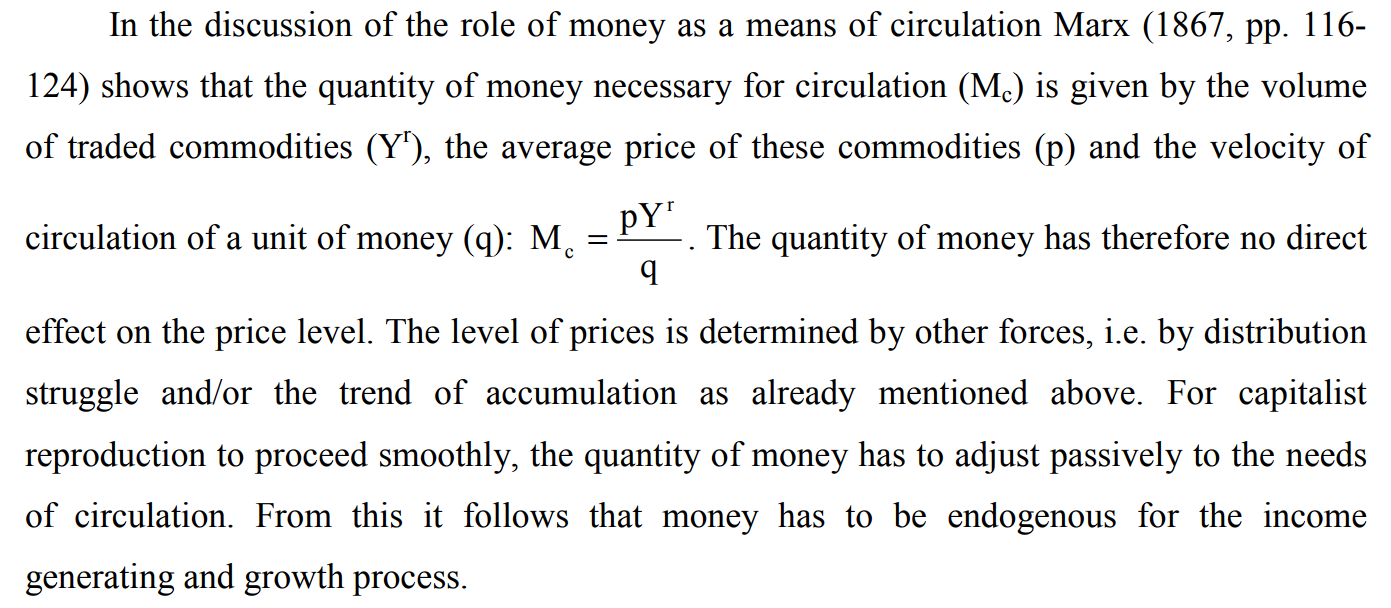
In the discussion of the role of money as a means of circulation Marx (1867, pp. 116- 124) shows that the quantity of money necessary for circulation (Mc) is given by the volume of traded commodities (Yr ), the average price of these commodities (p) and the velocity of circulation of a unit of money (q): q pY M r c = . The quantity of money has therefore no direct effect on the price level. The level of prices is determined by other forces, i.e. by distribution struggle and/or the trend of accumulation as already mentioned above. For capitalist reproduction to proceed smoothly, the quantity of money has to adjust passively to the needs of circulation. From this it follows that money has to be endogenous for the income generating and growth process.
— — — — — — — — — — — —
Kalecki’s (1968) interpretation of Marx’s schemes of reproduction arises: As capitalists cannot determine their sales and their profits but can only decide about their expenditures on net investment and consumption goods, these expenditures have to ensure that profits produced will be realized.
The expenditures of the capitalist class as a whole determine realized profits.
Therefore, net investment determines savings in Marx’s schemes of reproduction. A realization failure, the inability to sell commodities at predetermined prices is therefore due to insufficient investment or consumption demand by capitalists.
The determinants of these major components of effective demand should therefore have been analysed in the next step of the investigation.
There is, however, no theory of investment demand in Marxís schemes of reproduction and hence no determination of the level of output or the rate of growth of the economy (Kalecki, 1968; Sebastiani, 1991).
But Marx was well aware of the problem of effective demand, also when discussing the effects of a falling rate of profit due to a rising organic composition of capital in Capital, vol. III:
The conditions of direct exploitation, and those of realizing it, are not identical. They diverge not only in place and time, but also logically. The first are only limited by the productive power of society, the latter by the proportional relation of the various branches of production and the consumer power of society (Marx, 1894, p. 244).
Capitalists’ expenditures as the causal force of income and profits require that these expenditures can be financed independently of current income.
There has to be the potential that investment can be financed independently of current savings.
Capitalists need access to money in order to get the process of reproduction started.
In the schemes of reproduction, there can be found a detailed treatment of related monetary flows as well. Marx (1885, pp. 329–354, 415–426) shows that also for simple reproduction the circulation of commodities requires money advances by capitalists. After a given period of production capitalists enter circulation with the produced commodities and with an amount of money necessary for circulation.
So far as the entire capitalist class is concerned, the proposition that it must itself throw into circulation the money required for the realization of its surplus-value (correspondingly also for the circulation of its capital, constant and variable) not only fails to appear paradoxical, but stands forth as a necessary condition of the entire mechanism.
For there are only two classes: the working class disposing only of its labour-power, and the capitalist class, which has a monopoly of the social means of production and moneyî (Marx, 1885, p. 425).
Of course, the necessary amount of money to be advanced by capitalists is determined by the volume of commodities to be traded, the average price of the commodities and the velocity of circulation of a unit of money, as mentioned above. After the successful circulation of commodities the money flows back to capitalists and stands ready to be advanced again in the next period.
In a growing economy with the price of commodities taken as given for the sake of simplicity, the quantity of money to be advanced by capitalists has to increase. As potential sources for additional money advances and hence for money’s endogeneity, Marx (1885, pp. 349–350) discusses the transfer of money from hoards and an increasing velocity of money in circulation.16
But these sources can only temporarily facilitate economic expansion. In the long run, the quantity of the money stock has to increase by means of increasing the production of the money commodity, according to Marx (1885, pp. 350, 494–495).17
As there is no necessity of a money commodity in Marxís economics and as the creation of money in modern economies is not limited by the availability of the money commodity gold, we can conceive of the adjustment of the quantity of money to the rate of expansion of the capitalist economy by means of creation and destruction of credit-money.
Or as Foley (1986a, p. 89) puts it: The sustainable rate of growth of the system obviously depends on the level of such new borrowing: the higher the total borrowing, the faster the rate of expanded reproduction that can be achieved by the system.
As capitalist expansion presupposes the expansion of credit, the conditions of credit are crucial for capital accumulation and economic growth. The availability and the price of credit may have an important impact on effective demand, especially on capitalist investment. This is implicit in the circuit of capital already discussed by Marx (1867, pp. 145–153) in Capital, vol. I.
Capitalists advance money (M) in order to buy commodities ( C), means of production and labour power, which are combined in the production process (P), the result being a bundle of commodities (C‘) which has to be sold for a higher amount of money (M’): M − C…P…C’−M’ .
The difference between M’ and M is of course money profit (Π).
In a growing economy in which at least parts of money advances have to be financed by means of credit, capitalists will only advance money if expected money profits will be sufficient to cover credit costs.
As money advances by the capitalist class as a whole are of utmost importance for the realization of produced profits, realized profits will depend on the relation between expected profits and credit costs or on the relation between the expected profit rate and the rate of interest.
This relation will therefore be of utmost importance for the formulation of a Marxian theory of effective demand, growth and economic crisis. It will, therefore, be examined in more detail in the following chapter.
2.3 Credit, rate of interest and rate of profit in Marx’s theory
According to Marx, credit derives from money in its function as a means of payment. In the interval between the sale of a commodity and the payment of its price a credit relation is established.
Marx (1894, pp. 400–413) distinguishes between commercial credit and bank credit.
Bank credit may increase if commercial banks discount commercial credit (bills of exchange) or if additional credit is granted. Marx does not suppose that credit supply of commercial banks is limited by private savings but assumes that commercial banks can, in principle, create credit without limits which will then circulate as credit-money (De Brunhoff, 1976, pp. 93–99; Reuten, 1988):18
The credit given by a banker may assume various forms, such as bills of exchange on other banks, cheques on them, credit accounts of the same kind, and finally, if the bank is entitled to issue notes ñ bank notes on the bank itself. A bank-note is nothing but a draft upon the banker, payable at any time to the bearer, and given by the banker in place of private drafts. This last form of credit appears particularly important and striking to the layman, first, because this form of credit-money breaks out of the confines of mere commercial circulation into general circulation, and serves there as money; and because in most countries the principal banks issuing notes, being a particular mixture of national and private banks, actually have the national credit to back them, and their notes are more or less legal tender; because it is apparent here that the banker deals in credit itself, a bank-note being merely a circulating token of credit. (Marx, 1894, pp. 404–405).
The quantity of credit-money is therefore endogenous for capitalist reproduction and is determined by credit demand of capitalists, as we have already claimed above:19
The quantity of circulation notes is regulated by the turnover requirements, and every superfluous note wends its way back immediately to the issuer (Marx, 1894, p. 524).
The evolution of the contract- and credit-system includes the establishment of interest bearing capital with the interest rate as a claim on a part of surplus value produced by productive labourers.
As the capitalist production process requires monetary advances, each sum of money may assume the role of interest-bearing capital which can be sold for interest (Marx, 1894, pp. 338–357).

According to the different functions in the extended circuit of capital, the capitalist class can be distinguished into money capitalists and functioning capitalists.
Both functions, however, may be assumed by the same person or the same enterprise.
Functioning capitalists are ready to borrow from money capitalists and to pay interest because money has the potential to generate money profits, if it is used to initiate a process of production in which the expenditure of labour power generates surplus value. Interest is therefore the part of surplus value produced under the supervision of functioning capitalist which is received by money capitalists.
As also own capital?
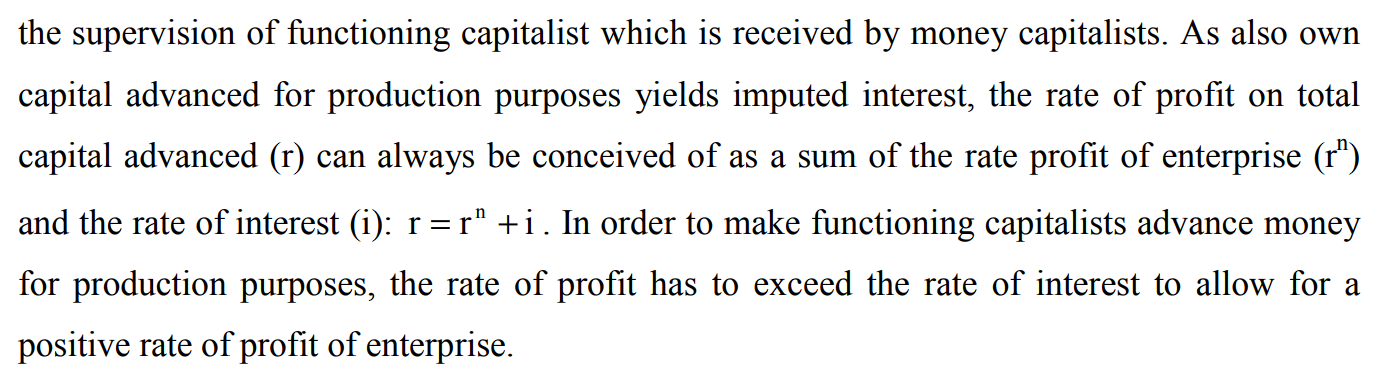
In order to make functioning capitalists advance money for production purposes, the rate of profit has to exceed the rate of interest to allow for a positive rate of profit of enterprise.
According to Marx, there is an inverse relation between interest and profits of enterprise. Variations in interest rates do not affect the value or the price of commodities but only have an effect on the distribution of surplus value or total profits between money capitalists and functioning capitalists.
Variations in the rate of interest have no influence on the rate of profits but affect the rate of profit of enterprise inversely:
(…) assuming the average profit to be given, the rate of the profit of enterprise is not determined by wages, but by the rate of interest. It is high or low in inverse proportion to it (Marx, 1894, p. 379).20
From this it follows that Marx’s determination of income shares takes place in two stages.
In the first stage, Marx considers the rate of profit to be determined by the distribution conflict between capital and labour. With the technical conditions of production given, the rate of profit is therefore determined by the real wage rate.
In the second stage, the rate of interest then exerts an influence on the distribution conflict between money capitalists and functioning capitalists and makes the rate of profit of enterprise a residual variable.
In these two steps the two degrees of freedom of Marx’s production price model are closed.
Although the rate of profit of enterprise in Marx’s economics can also be considered as remuneration for the risks and troubles of real investment, Marx’s view must be distinguished from the Classical views of Smith and Ricardo who consider the rate of interest and the rate of profit of enterprise to be independent variables which do not affect each other and which therefore can be summed up to derive the rate of profit (Pivetti, 1987).
The recent attempts by Panico (1985) and Pivetti (1985, 1987, 1991) to close the degree of freedom of the classical production price model by Sraffa (1960) by means of an exogenous rate of interest which determines the rate of total profits and makes the real wage rate the residual variable can therefore not be applied to Marx’s theory.21
As this procedure has to assume a constant rate of profit of enterprise when the interest rate varies, it ignores the distribution conflict between money capital and industrial capital (Argitis, 2001).
This conflict is, however, essential for Marx’s theory.
In Marx’s economics the rate of interest can therefore not be taken to determine the rate of profit.
In Marx’s two stage determination of income shares, the rate of interest is assumed to be an exogenous variable for production and growth. The rate of interest is determined in the market for money capital, but there is no ‘natural rate’ as centre of gravity for actual rates (Marx, 1894, pp. 358–369).
Instead, the rate of interest is given by concrete historical, institutional and political factors which reflect the relative powers of money capital and industrial capital.
There is, however, a long run upper bound for the rate of interest given by the rate of profit as long as the latter, as in Marx, is assumed to be independent of the former.
Increasing interest rates approaching or exceeding the rate of profit will induce industrial capitalists to prefer financial investment instead of real investment.
This will increase the supply of money capital and bring down the rate of interest to a reasonable level below the rate of profit again (Marx, 1894, p 378).
Only in the sense of setting a long run maximum limit can the rate of profit be considered to determine the rate of interest (Marx, 1894, p. 360).
Summing up, the interest rate in Marx’s system can be seen as a monetary category determined by the relative powers of industrial and money capital.22
With these power relations given the rate of interest is an exogenous variable for income determination, distribution, accumulation and growth, whereas the quantities of credit and money are endogenous, as shown above.
This view is compatible with the main features of modern monetary systems as seen in post-Keynesian monetary theory:23
The rate of interest is a distribution parameter determined by the central bank’s monetary policies as well as by liquidity preference and risk aversion of monetary wealth holders. The quantities of credit and money are determined by that part of credit demand which meets the standards of the central bankís discount policy, the creditworthy credit demand. The quantity of credit supply passively adjusts to the level of credit demand at the rate of interest given by the central bank’s base rate and a mark-up of commercial banks determined by risk and liquidity premia.24
In a Marxian monetary approach the central bank may be interpreted as an institution which can be used as an instrument in the distribution struggle between social classes. As Epstein (1992) has shown in a political economy model of central banking, central bank policies may depend on relative powers and alliances of classes.
Following this model, the direction of central bank policies depends on the relation between capital and labour, on the relation between finance capital and industrial capital, on the degree of political and economic independence of the central bank and on the position of the national currency in the international currency system.
In a Marxian monetary approach, as the one sketched in the present paper, it is also not clear whether labour income shares ñ or the real wage rate when technical conditions of production are constant ñ should remain unaffected by interest rate variations initiated by central banks or monetary wealth holders.
In a monetary economy the real wage rate and — with constant technical conditions of production — the rate of profit can no longer be determined solely by relative powers of capital and labour in the labour market.
In the labour market the commodity labour power is traded for money and the nominal wage rate is established in this market. The real wage rate, however, is influenced by entrepreneurial pricing in the goods market as well. Here interest rate variations may have direct and indirect effects which should be taken into account
The resulting model should therefore contain Marxian and neo-Ricardian effects of interest rate variation on distribution (Argitis, 2001). Labour income shares are likely to be affected by interest rate hikes and hence rising interest costs for industrial capital, when these hikes are considered to be permanent and when industrial capitalists are in a position to pass on higher costs to prices or to compensate rising interest costs by decreasing labour costs through increasing productivity.
The ability to increase prices in the goods market and to reduce real wages or labour income shares will depend on the degree of competition in the goods market and on the power of labour in the labour market to demand higher nominal wages when prices or productivity are increasing.
Temporary increases in interest rates, however, may not induce industrial capital to increase prices and may therefore have no effects on the real wage rate. A high degree of competition in the goods market may also prevent goods prices from rising when interest rates increase permanently. A permanent redistribution at the expense of labour may also be impossible if labour unions are powerful enough to increase money wages when prices increase. In this case rising interest rates will cause accelerating inflation rates. These potential distribution effects of interest rate variation will be considered in the discussion of the implications of Marx’s monetary analysis for the theory of capital accumulation and crisis in the following section.
3. Implications for the theory of accumulation and crisis: the similarities to post-Keynesian theories of distribution and growth
In its orthodox variants based on real analysis, Marxian theories of capital accumulation assume that the development of the technical conditions of production and the development of distribution determine the accumulation path (Shaikh, 1978, 1983). Realization problems may only occur in the short run but do not exert any influence on the long run trend of growth.
— — — — — — — — -
The first cause for falling profitability and economic crisis has been elaborated in the profit squeeze-approach, the second cause in the falling-rate-of-profit-due-to-rising-organic-composition-of-capital theories.26 Of course, these approaches have solid foundations in Marx’s own work. In Capital, vol. I, especially in chapter 25 ‘The General Law of Capitalist Accumulation’, Marx (1867, pp. 574–582) elaborates on the interaction of distribution and capital accumulation. In Capital, vol. III, in part III ‘The Law of the Tendency of the Rate of Profit to Fall’, Marx (1894, pp. 211–266) analyses the effects of the development of the forces of production on the rate of profit. In each of these chapters he abstracts from monetary elements and assumes Say’s law to hold in order to derive the pure effects of income distribution and technical change on the rate of profit and on capital accumulation. As has already been remarked by Shoul (1957), these passages cannot be considered to deliver complete theories of accumulation and crisis but should rather be seen as focussing on particular elements of economic crisis.
From our analysis of Marx’s monetary theory, we have to reject the impression that the real variants of Marx’s accumulation and crisis theory sketched above could be the only possible interpretations.
In a Marxian model of accumulation based on monetary analysis neither the determination of distribution can take place in real terms in the labour market nor can capital accumulation be determined by capitalist savings.
Contrary to a real exchange economy in which Say’s law might hold, we have to analyse a monetary economy in which capital accumulation is independent of capitalist savings.
As we have elaborated above, in a growing economy, capitalists need to have access to means of finance irrespective of current profits or savings.
According to Marx, the credit system has the potential to supply these means of finance in the form of credit at a given rate of interest — provided that capitalists meet the credit standards defined by the central bank we should add.
The rate of interest is the exogenous variable for production and growth, the quantities of credit and money are endogenous variables in Marx’s monetary theory.
Taken together, investment is the causal force which determines income and savings in this Marxian framework of accumulation and growth. This Marxian framework shows broad similarities to post-Keynesian theories of growth and distribution in the tradition of Nicholas Kaldor (1955/56, 1957, 1961), Joan Robinson (1962) and Michal Kalecki (1954).27
Whether variations in investment will generate the adequate savings by means of redistribution, as in the Kaldor/Robinson version of the post-Keynesian model, or by means of variation in the degree of capacity utilisation, as in Kalecki’s model, depends on the degree of capacity utilisation in the initial equilibrium. If the equilibrium degree of capacity utilisation is allowed to deviate from full capacity utilisation, as in the Kaleckian model, variations in the rate of accumulation can be adapted by variations in capacity utilisation and will have no effect on distribution.
Income shares are then rather determined by firms’ mark-up pricing on unit labour costs in incomplete goods markets with the mark-up being determined by the degree of competition in the goods market and by relative powers of capital and labour in the labour market. If, however, there is full capacity utilisation in equilibrium, as in the Kaldor/Robinson version of the post-Keynesian model,28 variations in the rate of capital accumulation are supposed to affect income shares in order to establish an investment-savings-equilibrium.29 To achieve appropriate redistribution when accumulation rates change, in the long run prices in the goods market have to be more flexible than nominal wages in the labour market.
There may, however, be major obstacles for the supposed adjustment processes. In the case of increasing accumulation rates under the conditions of full utilisation of the capital stock and low unemployment or even full employment, workers may resist redistribution in favour of profits. Increasing prices in the goods market might trigger rising nominal wages and cumulative inflation may result, so that the system is characterised by an inflation barrier. In the case of decreasing accumulation rates, some price rigidities in the goods market may prevent the necessary redistribution in favour of wages which then may cause decreasing production and capacity utilisation with negative feedbacks on investment.
Although the case of full utilisation and the potentials for instability should not be neglected in a Marxian theory of effective demand and accumulation, full capacity utilisation should not be considered the normal state of affairs in a capitalist monetary economy. According to Marx (1867, p. 424), advanced capitalism displays a high degree of elasticity of production so that increasing demand can be supplied without major disturbances for prices and distribution caused by capacity constraints (Kurz, 1987)
— — — — — — — —
This very simple and restrictive model which, however, contains some essentials of Marx’s monetary economics has shown that monetary variables have a crucial impact on the accumulation path. Variations in this path may be due to changing monetary policies, its impacts on distribution and changing reaction coefficients in the savings and investment functions.
From this it follows, that a monetary interpretation of Marx’s theory precludes the determination of a unique accumulation path from real factors. Therefore, also crises of accumulation and economic stagnation cannot be explained by ‘real forces’ alone, as in profit squeeze and falling-rate-of-profit-approaches, but need to take into account the interaction of ìmonetaryî and real forces in a concrete historical analysis.31
— — — — — — — — — — — — — — -
4. Conclusions
Starting from Schumpeter’s definitions of ‘real’ and monetary analysis we have shown in this paper that Marx’s economic analysis provides a coherent framework for monetary analysis. Money appears at the very beginning of Marxís analysis in his monetary theory of value.
This theory presupposes a universal equivalent, a representative of abstract labour as social category, to which commodities can be related in exchange.
There is no convincing argument in Marx’s economics that money as the universal equivalent has to be a commodity.
Marx’s monetary theory of value is therefore perfectly consistent with a credit-theory of money as in post-Keynesian monetary economics.
The roles of money as means of circulation, hoarding, and payment make Marx reject Ricardo’s version of Say’s law and replace it with the possibility theory of crisis which also requires money to be a non-commodity.
The rejection of Say’s law leads to a Marxian principle of effective demand for which the schemes of reproduction provide a basic framework. For simple as well as for expanded reproduction it has to be presupposed that capitalists are able to make monetary advances in order get produced profits realized.
Therefore, capitalist expenditure generates profits and investment determines savings also in Marx’s theory of capital accumulation and growth which therefore should be based on the principle of effective demand.
The Marxian approach presented here insofar resembles the post-Keynesian theories of distribution and growth in the tradition of Nicholas Kaldor, Joan Robinson and Michal Kalecki. In a growing economy monetary advances by capitalists have to increase from period to period. Only the creation of credit can be considered as a generally unlimited source of finance for capitalist expansion. The conditions of credit are therefore of crucial importance for capital accumulation and growth also in Marxís economics. Marx regards the quantity of credit to be endogenous for capital accumulation and to be determined by credit demand whereas the interest rate is exogenously determined by historical, institutional and political factors reflecting the relative powers of money capitalists and functioning capitalists. If we regard central bank policies as an instrument in distribution struggle, Marxís view on this aspect is also compatible with modern post-Keynesian theories on endogenous credit-money and exogenous interest rates which are determined by central bank policies as well as by liquidity and risk considerations of monetary wealth holders. According to Marxís two stage determination of distribution, the rate of profit is determined together with the real wage rate by capital labour conflict in the labour market. Distribution conflict between money capitalists and functioning capitalists then determines the rate of interest and makes the rate of profit of enterprise the residual variable. Within Marx’s monetary framework, however, it cannot be precluded that interest rate hikes reduce the real wage rate and the wage share, because capital labour conflict only determines the nominal wage rate in the labour market. The real wage rate also depends on entrepreneursí pricing in the goods market on which interest rate hikes under certain conditions may have an effect. If rising interest rates are considered to be permanent and if the degree of competition in the goods markets as well as relative powers of capital and labour allow for rising prices without triggering rising nominal wages, increasing interest rates may cause falling real wages. The main elements of our monetary interpretation of Marxís economics have finally been integrated into a simple model of monetary interest rates, distribution and accumulation in which equilibrium growth may deviate from full capacity growth. It was shown that the equilibrium growth path is determined by the exogenous interest rate, its effects on distribution and by the parameters in the investment and savings functions. Variations in the interest rate have a profound impact on equilibrium growth through different channels: there is a direct effect on investment and there are indirect effects via distribution and consumption demand. The overall direction of influence of interest rate variations on the growth path is not unique but depends on the reaction of distribution and on the values of the parameters in the 23 accumulation and savings function. From this it follows, that neither the equilibrium growth path can be determined from ìreal analysisî of distribution and technical change, as in orthodox Marxian theory, nor can a crisis of accumulation solely be derived from ìreal analysisî, as in profit-squeeze and falling-rate-of-profit-due-to-rising-organic-compositionsof-capital-theories. According to our interpretation, Marxian theories of accumulation and crisis cannot be based on ìreal forcesî alone, but need to take into account the interaction of ìmonetaryî and ìrealî forces in a concrete historical analysis. Within this kind of analysis, it will be impossible to derive ìgeneral laws of accumulationî irrespectively of concrete historical circumstances of capital accumulation.
— — — — — — — –
4 According to Marx, Ñsocially necessary labourì is defined twofold. First, it is labour performed under the average technical conditions of production and with average skills and intensity (Marx, 1867, p. 47). Second, it requires that the product can be sold in the market sphere (Marx 1867, p. 109). There has to be effective demand for the results of individual labour in order to make it a component of social labour. From this it follows that Ñsocially necessary labourì can neither directly be expended in a specific production process nor be measured by the expenditure of concrete labour. Whether individual labour is socially necessary in the double sense mentioned above, can only be examined in the sphere of exchange.
5 There is, however, no agreement on this point of view in Marxian economics. De Brunhoff (1976), Crotty (1987), Evans (1997), Foley (1983, 1986a) and Weeks (1981) hold that Marxís commodity theory of money is a correct albeit historically restricted starting point for the analysis of money and therefore not applicable to modern economies. Lapavitsas (2000) and Lapavitsas & Saad-Filho (2000) do not only consider commodity money to be an appropriate starting point for Marxís theory of money and credit but also argue that anchoring the monetary system on a money commodity would stabilize capitalist reproduction, also in modern times. Graziani (1997), on the contrary, argues that the capital labour relation requires credit money because the purchase of labour power is logically prior to the production of commodities and hence also to the production of the money commodity. For a more extensive treatment of some aspects of the Marxian debates see Hein (1997, pp. 34–42). 6 According to our analysis, the functions of money discussed below are all related to capitalist commodity production. Different functions cannot be assigned to different stages in the development of commodity production as Lapavitsas (1994) assumes. He holds that money as a measure of value and a standard of price applies to elementary and accidental commodity exchange, money as means of circulation to general commodity production and only ìmoney as moneyî to capitalist commodity production.
7 In their ìnew solutionî to the transformation problem Foley (1982) and Lipietz (1982a) define the ìvalue of moneyî — also for money token — as the ratio of the expenditure of direct and indirect labour power to nominal value added: ìThe value of money expresses the social equivalence of money and labour time which is inherent in commodity production, and would be meaningfully defined even if money were an abstract unit of accountî (Foley, 1982, p. 39). This concept, however, does not yet contain a determination of the price level.
8 In Marx’s commodity money system, however, there seems to arise an effect of the quantity of money on the level of prices as soon as the money commodity in circulation is replaced by paper money (Marx, 1867, pp. 125- 130). An increase in the supply of paper money should increase the level of prices measured in units of paper money because a unit of paper money now represents less units of the money commodity in circulation. This quantity theory relation, however, can only be sustained, if the representative of the money commodity is only used for circulation purposes. But this need not be the case. According to Marx (1867, p. 130), the role of money as money which includes the function of money as a store of value (hoard) may also be assumed by the money representative. Hence, there need not be a strict relation between the quantity of paper money and the price level, because the amount of paper money in hoards may be variable.
9 On the differences between Ricardoís version of Sayís law and the neoclassical version see Garegnani (1978, 1979).
10 On Marxís rejection of Sayís law in the formulation of Ricardo and the ìpossibiltiy theory of crisisî as opposed to a theory of the actual crisis see more explicitly Kenway (1980), Sardoni (1987, pp. 26–36) and Hein (1997, pp. 51–59).
11 The third function of ìmoney as moneyî also includes the functions of money as a means of payment and of money as universal money which have already been mentioned above.
12 See Sowell (1972) for an overview of the Ñgeneral glutì-controversy.
13 The role of credit in economic crisis is explored in more detail by Marx in Capital, vol. III (Marx, 1894, pp. 476–519) where he shows that the credit system may exacerbate economic crisis caused by the effect of ìreal factorsî on the profit rate. As Arnon (1994), Crotty (1986) and Pollin (1994) have observed, Marxís theory displays broad similarities to Minskyís ìfinancial instability hypothesisî (Minsky 1975, 1977). There is, however, a major difference between Marxís and Minskyís theories, because Minsky sees economic crisis caused in the financial sector whereas Marx views economic crisis to be caused by real factors and only exacerbated by financial relations. On Marxís and post-Keynesian financial crisis theories see the more extensive treatment in Hein (1997, pp. 252–276).
14 For a more extensive treatment of the schemes of reproduction see Kenway (1987) and Hein (1997, pp. 136- 155).
16 In Capital, vol. I, Marx (1867, p. 134) also relates the endogeneity of the quantitiy of money in circulation to hoarding and dishoarding.
17 See also De Brunhoff (1976, pp. 60–72) and Foley (1986a, pp. 86–89). Lapavitsas (2000) and Mollo (1999), however, do not seem to be aware that hoarding and dishoarding of a money commodity can only play a limited role for money endogeneity in a growing economy
18 We therefore disagree with Lapavitsas (1997, 2000a) and Lapavitsas & Saad-Filho (2000) who consider the credit system in Marxís theory to be mainly a mechanism for the internal reallocation of idle funds among industrial and commercial capitalists
19 In this respect Marx agrees with the banking point of view in the Ñbanking-currency-controversyì (Lapavitsas, 1994; Mollo, 1999).
20 See also Argitis (2001), Pivetti (1987) and Hein (1997, pp. 63–69) on the relation between profits of enterprise and interest in Marxís theory.
21 This objection can of course also be applied to Panicos (1980) attempt to reformulate Marxís approach in a production price model.
22 See Argitis (2001), Panico (1980, 1988) and Pivetti (1987) for similar results with respect to Marxís theory of the rate of interest.
23 See for instance Cottrell (1994), Hewitson (1995), Kaldor (1970), Lavoie (1984, 1992, pp. 149–216), Moore (1989) on post-Keynesian monetary theory. For a broader survey of post-Keynesian economics see Arestis (1996). The compatibility of Marxís theory of interest, money and credit with the post-Keynesian ìhorizontalistî approach does, however, not imply that Marxís approach agrees with some post-Keynesian views on the origin and the role of money. In Marxís theory, money and credit are not considered to be means to overcome uncertainty as ahistorical characteristics of human life as such, as in Davidson (1994). Marx rather considers money and credit to be historically specific social institutions mediating the social division of labour which itself cause uncertainty and instability as main characteristics of capitalist reproduction (see also Lapavitsas & SaadFilho 2000).
24 It should be noted that the position sketched here differs from those post-Keynesian views which assume that a decreasing liquidity position of commercial banks and rising lenderís and borrowerís risk finally lead to rising interest rates when the quantity of credit is expanding in the accumulation process (Minsky, 1986; Palley, 1996; Rousseas, 1998; Wray, 1990). If an accommodating policy of the central bank is supposed, however, there will be no decreasing liquidity position of commercial banks when credit is expanding. If we further suppose that commercial banks only supply credit to creditworthy borrowers, there will also be no increasing borrowerís or lenderís risk when credit is increasing. For the economic system as a whole, increasing credit means increasing expenditures and hence increasing revenues from which credit can be repaid. There is therefore good reason to assume that the interest rate is the exogenous variable of the accumulation process and that the quantities of money and credit are endogenous variables. If interest rates are rising when the quantity of credit is expanding this is due to restrictive monetary policies chosen by the central bank (Lavoie, 1996).
25 There may be of course feedbacks from accumulation to distribution in those models. See Amadeo (1986) and Marglin (1984) for more specific formulations.
26 For the short run version of the profit-squeeze approach explaining trade cycles see the seminal paper by Goodwin (1967), for the long run version explaining economic stagnation see Glyn & Sutcliffe (1972) and the more recent work in the ìSocial-Structure-of-Accumulationî-approach, i.e. Gordon, Weisskopf & Bowles (1987). For the falling-rate-of-profit-due-to-rising-organic-composition-of-capital theories see Catephores (1989, pp. 166–187) and Shaikh (1978, 1978a, 1983a, 1987). For a critique of the necessity of a falling rate of profit due to technical change in a model with prices of production instead of labour values see Van Parijs (1980).
27 See Amadeo (1986) and Marglin (1984) for comparisons of the orthodox Marxian model with post-Keynesian models. For a more detailed discussion of post-Keynesian models of growth and distribution see Lavoie (1992, pp. 282–347). In Hein (1997, pp. 155–219) an extensive discussion of the orthodox Marxian model, a modified Marxian model, the models by Kaldor and Robinson as well as different variants of the Kaleckian model is provided. 31 For a preliminary attempt towards such an analysis see Hein & Ochsen (2000). 22
Economic Manuscripts: The Value-Form by Karl Marx
Works of Karl Marx 1867 Published: First published in German in 1867 and in English in 1978; Source: Capital and Class…www.marxists.org
social form of tradeable things as units of value
VALUE-FORM
Value-form explained
The value-form or form of value (German: Wertform)[1] is an important concept in Karl Marx’s critique of political economy, discussed in the first three chapters of Capital, Volume 1 (a book first published in 1867).[2]
It refers to the social form of tradeable things as units of value, which contrast with their tangible features, as objects which can satisfy human needs and wants or serve a useful purpose.[3]
The physical appearance or the price tag of a traded object may be directly observable, but the meaning of its social form (as an object of value) is not.[4]
Marx intended to correct errors made by the classical economists in their definitions of exchange, value, money and capital, by showing more precisely how these economic categories evolved out of the development of trading relations themselves.
Playfully narrating the “metaphysical subtleties and theological niceties” of ordinary things when they become instruments of trade,[5] Marx provides a brief social morphology of economic value — what its substance really is, the forms which this substance takes, and how its magnitude is determined or expressed. He analyzes the evolution of the form of value in the first instance by considering the meaning of the simple value-relationship that exists between two quantities of traded objects.[6] He then shows how, as the exchange process develops, it gives rise to the money-form of value — which facilitates trade, by providing standard units of exchange value.
Once money exists, all quantities of products, services and assets can conveniently be expressed as money-prices, for trading purposes. Lastly, Marx shows how the trade of commodities for money gives rise to investment capital. Tradeable wares, money and capital are historical preconditions for the emergence of the factory system[7] (discussed in subsequent chapters of Capital, Volume I).[8] With the aid of wage labour, money can be converted into production capital, which creates new value that pays wages and generates profits, when the output of production is sold in markets.
The value-form concept has been the subject of numerous theoretical controversies among academics working in the Marxian tradition,[9] giving rise to many different interpretations (see Criticism of value-form theory). Especially from the late 1960s[10] and since the rediscovery and translation of Isaac Rubin’s Essays on Marx’s theory of value,[11] the theory of the value-form has been appraised by many Western Marxist scholars[12] as well as by Frankfurt School theorists[13] and Post-Marxist theorists.[14] There has also been considerable discussion about the value-form concept by Japanese Marxian scholars.[15]
The academic debates about Marx’s value-form idea often seem obscure, complicated or hyper-abstract. Nevertheless, they continue to have a theoretical importance for the foundations of economic theory and its critique. What position is taken on the issues involved, influences how the relationships of value, prices, money, labour and capital are understood. It will also influence how the historical evolution of trading systems is perceived, and how the reifying effects associated with commerce are interpreted.[16]
Basic explanation
When the concept of the form of value is introduced in the first chapter of Capital, Volume I,[17] Marx clarifies that economic value becomes manifest in an objectified way (as a separate “thing”) only through the form of value established by the exchange of products.
People know very well that any product represents a value, i.e. that there is a normal economic cost of supply (an average current replacement cost) for the product — some people have to work to produce and supply it, so that others can use it.
But according to Marx, various further questions arise about that simple insight, such as: how much value is that, exactly? How does that value exist, or what really determines that value? What is the source of that value? How can value be expressed or measured? What explains differences in value? How does value change? Answering these sorts of questions convincingly turns out to be more challenging than one might think at first sight.
Value relation
What something is economically “worth” can be expressed only relatively, by relating, weighing, comparing and equating it[18] to amounts of other tradeable objects (or to the labour effort, resources or sum of money those objects represent).[19] The value of products is expressed by their “exchange-value”:[20] what they can trade for. That exchange-value can be expressed in many different ways (it can be equated to a quantity of a currency or a financial claim, a quantity of goods, a quantity of labour, a quantity of services etc.). Since exchange-value is most often expressed by a “money-price”, it then seems that “exchange value”, “value”, “price” and “money” are really all the same thing. But Marx argues they are not the same things at all.[21]
For Marx, this point is absolutely vital for a scientifically adequate understanding of economic value and markets. Precisely because the political economists kept conflating and confusing the most basic economic categories, Marx argued, they were unable to provide a fully consistent, integral theory of the economy. One might be able to quantify and measure economic phenomena, but that does not necessarily mean that they are measured in a way that they are fully understood.[22]
In a preface to the first edition of Capital, Volume I, Marx stated:
Marx gives various reasons for this ancient puzzle.
The main obstacle seems to be that trading relations refer to social relations which are not directly observable.
What these social relations are, has to be conceptualized with abstract ideas. The trading ratios between commodities and money are certainly observable, via prices and transaction data. Yet how exactly the things being traded get the value they have, is not observable. It seems like “the market” does that, but what the market is, and how that happens, remains rather vague.
This story does not get much further than the idea, that things have value, because people want to have them, and are prepared to pay money for them.
Marx’s comment clarifies, that according to Marx the value-form of commodities is not simply a feature of industrial capitalism. It is associated with the whole history of commodity trade (“more than 2,000 years”).[23] Marx claimed that the origin of the money-form of value had never before been explained by bourgeois economics, and that “the mystery of money will immediately disappear” once the evolution of value-relations has been traced out from its simplest beginnings.[24]
This was probably a vain hope; even today economists and economic historians cannot agree about what is the correct theory of money.
Wolfgang Streeck states that “money is easily the most unpredictable and least governable human institution we have ever known”.[25]
Put another way, the possibilities for arranging any type of trade or deal are extremely diverse; the only operative requirement is that the trading partners agree to the terms of the arrangement, however simple or complicated it may be. It follows that, what specific role money has in the given arrangement, can vary greatly.[26]
In addition, new kinds of credit instruments and types of money-tokens keep emerging that were previously unheard of (such as securitization techniques, asset tokenization and cryptocurrencies).
[CONTRACT]
Only when market production and its corresponding legal system are highly developed, does it becomes possible to understand what “economic value” actually means in a comprehensive and theoretically consistent way, separate from other sorts of value (like aesthetic value or moral value).
The reason is that, to a large extent, the different kinds of value have become practically separated in reality and become increasingly universal in their applications.
When Marx considers “value” as such or in itself, as a general social form in the economic history of humans, i.e. “the form of value as such”, he is abstracting from all the particular expressions it might have.
Marx admitted that the form of value was a somewhat difficult notion, but he assumed “a reader who is willing to learn something new and therefore to think for himself.”[27] In a preface to the second edition of Capital, Volume I, Marx claimed that he had “completely revised” his treatment, because his friend Dr. Louis Kugelmann had convinced him that a “more didactic exposition of the form of value” was needed.[28] Usually Marx-scholars refer to both versions anyhow, because each of them provides some extra information which does not occur in the other version.[29]
Hans-Georg Backhaus however distinguishes between no less than four different versions of Marx’s story about the value-form:
(i) the first version in Marx’s A contribution to the critique of political economy (1859),[30]
(ii) the second version in the first chapter of the first edition of Capital, Volume 1 (1867a),[31]
(iii) the third version in a special appendix added to the first edition of Capital, Volume 1 (1867b),[32] and
(iv) the fourth revised version in the first chapter of the second edition of Capital, Volume 1 (1873), where the appendix of the first edition was scrapped (Backhaus disregards Marx’s discussion of the form of value in Marx’s Grundrisse and Theories of Surplus Value).[33]
Evolution of forms
Marx calls commodities, as a basic form of value, “the economic cell-form of bourgeois society”, meaning that commodities are the simplest economic units out of which the “body” of West European capitalist civilization was developed and built up, across many centuries.[34]
Wares trade for money, money trades for wares, more and more money is made from this trade, and the markets reach more and more areas — transforming society into the world of business, where products and people originating from everywhere are brought together to create buildings, tools, facilities, clothing, foodstuffs, weapons etc. (see also simple commodity production).[35] In this way, Marx explains how, in specific historical conditions, (1) capital originated and expanded in society, (2) eventually conquered most of economic life, and (3) transformed the whole of society according to the laws and logic of capital accumulation. This developmental process occurred across many centuries, both through gradual and incremental evolutionary changes, and through huge social upheavals, crises, wars and revolutions.
The capitalist mode of production is viewed by Marx as “generalized” (or universalized) commodity production,[36] i.e. the production of commodities by means of commodities, in a circular self-reproducing flow of actions and transactions (money is exchanged for commodities (including the commodity labour power), used to produce new commodities exchanged for more money, financing more production and consumption).[37] Already in his Grundrisse manuscript of 1858, Marx worked out his insight that “The first category in which bourgeois wealth presents itself is that of the commodity”[38] and that became the opening statement of his 1859 Critique and the first volume of Capital (1867). In their pathbreaking treatises on political economy, both Adam Smith and David Ricardo had started out from an analysis of the value of traded commodities produced by human labour.[39]
The “forms of value” of commodities are only the first of a series of social forms which Marx analyzes in Das Kapital, such as the forms of money, the forms of capital, the forms of wages, and the forms of profit.[40] All of these are different forms of value, normally expressed by prices, yet they all presuppose the exchange of tradeable wares. In Marx’s dialectical story,[41] each of these forms is shown to grow out of (or “transform” into)[42] other forms, and so all the forms are connected with each other, step by step, logically and historically.[43]
Each form is expressed with categories, the content of which evolves or mutates to some degree in response to new distinctions or circumstances.[44] At the end of the story, all the forms appear seamlessly integrated with each other in a self-reproducing, constantly expanding capitalist system, of which the distant historical origin has become hidden and obscure; the fully developed system appears other than it really is, and does not transparently disclose its real nature.
If the workings of the capitalist system were perfectly obvious and transparent, Marx argues, then there would be no need for any special economic “science”; one would just be stating platitudes.[45] They prompt further inquiry, because they turn out to be not as obvious as they seem, and indeed become rather puzzling or even mindboggling, on further reflection. Economists are constantly trying to “second-guess” what the market will do, and what the overall effects might be of transaction patterns, but in truth they often don’t succeed any better than astrologers.[46] A critical re-examination is then called for, of precisely those ordinary phenomena which were previously taken for granted.
After his first cryptic attempt at telling the story (in 168 pages) flopped when he published it in Germany,[47] Marx resolved to tell it another time, in a much more interesting, intriguing and elaborate way, so that people would really grasp the significance of it — beginning from exactly the same starting point. That became Das Kapital (1867–1894), which is still being read and discussed today.[48]
Marx initially defines a product of human labour that has become a commodity (in German: Kaufware, i.e., merchandise, ware for sale) as being simultaneously:
- A useful object that can satisfy a want or need (a use value); this is the object valued from the point of view of consuming or using it, referring to its observable material form, i.e., the tangible, observable characteristics it has that make it useful, and therefore valued by people, even if the use is only symbolic.
- An object of economic value generally; this is the value of the object considered from the point of view of its supply cost, commercial value, or “what you can get for it”. The reference here is to the social form of the product, which is not directly observable.
The “form of value” (also a reference to phenomenology in the classical philosophical sense used by Hegel)[49] then refers to the specific ways of relating through which “what a commodity is worth” happens to be socially expressed in trading processes, when different products and assets are compared with each other.
Practically speaking, Marx argues that the product values cannot be directly observed and can become observably manifest only as exchange-values, i.e., as relative expressions, by comparing their worth to other goods they can be traded for (usually via money prices). This causes people to think value and exchange-value are the same thing, but Marx argues they are not; the content, magnitude and form of value must be distinguished, and according to the law of value, the exchange value of products being traded is determined and regulated by their value. His argument is, that the market prices of a commodity will oscillate around its value, and that its value is the outcome of the average, normal labour requirements to produce it.
Metamorphosis
Marx argues that the forms of value are not “static” or “fixed once and for all”, but rather, that they develop logically and historically[50] in trading processes from very simple, primitive expressions to very complicated or sophisticated expressions. Subsequently, he also examines the various forms taken by capital, the forms of wages, the forms of profit and so forth. In each case, the form denotes how a specific social or economic relationship among people is expressed or symbolized with a category or several categories.[51]
In the process of circulation, production, distribution, and consumption, value metamorphoses from one form to another.[52] Different forms of value — currencies, commodities and capitals — all trade for each other, where buyers and sellers convert money into goods, and goods into money, or convert one type of capital asset into another type of capital asset, in markets where prices fluctuate all the time.
According to Marx, the individual acts of exchange in themselves cannot alter the underlying value of goods and assets, at least not in the ordinary situation.[53] One reason is that value is ordinarily conserved with living labour through successive acts of exchange (a “conservation principle”) even although the forms that value takes can change. If goods and assets did not at least hold their value upon exchange, then warehousing, freighting and commercial trade itself would very likely break down. That insight existed already in ancient times.[54] Another reason is that the value of goods and assets really refers not to the labour they “embody”, but to their average current replacement cost in labour time (a social reproduction cost).[55] In speculative activity, the principle of value conservation is, however, not always true.[56]
Primitive exchange
Initially, in primitive exchange,[57] the form that economic value takes does not involve any prices, since what something is “worth” is very simply expressed in (a quantity of) some other good (an occasional barter relationship).[58] Some scholars, such as Hans-Georg Backhaus, argue that for this reason value simply did not exist in societies where money was not used, or where it played only a marginal role.[59] The old Friedrich Engels claimed that “in primitive communism value was unknown”, because there was no regular commodity trade.[60]
Marx, though, acknowledged that product-values “of a sort” did exist in primitive economies, although value did not exist as a separate “thing” in such communities. Establishing how much products were worth, he says, followed “customary practices”, rather than purely a comparison with the value of other products, or reckoning with money; thus, the valuation of products was expressed in a different way (see also archaeology of trade). An “economy of labour-time” existed, although no supremely exact measures were available for work effort, time, storage and energy.[61] All the time, that is, people knew quite well that their products had value, because it cost work-effort to replace them, and, consequently, they also valued their products. They could hardly afford to trade products on very unfavourable terms, because that would take them beyond the limits of their own available work-time; that mattered, because average labour productivity was low — it took a lot of time to produce food, clothing, shelter, tools and weapons. Whatever the trading custom was, it had to be at least compatible with survival requirements. If not, the custom would die out — because people died out.[62]
- In the most primitive (simplest) situation, people acquire objects for which they have a use by borrowing, trading or bartering, in exchange for other goods that they don’t particularly have a need for themselves. They value things directly because of their useful qualities and because it takes work-time to get them (their own work and/or the work of others). In the process, customary norms develop for what counts as a normal, balanced exchange. There isn’t just one way to trade a good, goods could be traded on all kinds of terms, but to pick the appropriate method, all kinds of factors might have to be taken in consideration.[63] If a good was traded in the wrong way, for example because cultural conventions were not respected, it might have consequences that the traders were not really looking for.
- At the most abstract, developed level though, the value form is only a purely monetary relationship between objects, or an abstract earnings potential or credit provision, based on some assumptions, which may not even refer to any tangible object of trade anymore at all. There is, for example, only a number on a computer screen. At that point, it appears that the value of an asset is simply determined by the amount of capital (the outlay + net profit) that could be obtained if the asset were traded under certain conditions, and within a given time interval.
Social relations
By analyzing the forms of value, Marx shows that when people bring their products into relation with each other in market trade, they are also socially related in specific ways (whether they like it or not, and whether they are aware of it or not), and that this fact very strongly influences the very way in which they think about how they are related.[64] It influences how they will view the whole human interactive process of giving and receiving, taking and procuring, sharing and relinquishing, accepting and rejecting — and how to balance all that (see also Norm of reciprocity).[65]
Some social relations we choose and make ourselves. They are voluntary social relations. For example, we choose a friend, a job, a home or participation in a social network. But we are also socially related simply by being part of a community, a market-system and a nation (or part of a family, a neighborhood, a tribe, an organization, a business etc.), whether we like that or not. These are non-voluntary social relations. Some social relations are partly voluntary and partly non-voluntary, and some shift from the one to the other, so there’s a continuum or sliding scale of possibilities).
- In trading roles, people have to deal with both of these kinds of social relations — simultaneously competing to get the best deal, and co-operating to obtain what they want.[66]
- The trading process has both a voluntary aspect (freedoms about what to buy and sell, things to choose) and an involuntary aspect (constraints, things that have to be worked with to make a deal).
- To make the trade, buyers and sellers must respect each other’s right to their own property, and their right to do with their own property what they want, within the framework of laws, customs and norms (Marx discusses the formal equality of market actors in exchange more in chapter 2 of Capital, Volume I[67] and in the Grundrisse).[68]
- If the market actors simply grabbed stuff from others, that would not be trade, but robbery or theft (which would not qualify as civilized conduct, and carries a reputational risk as well as being subject to legal sanctions). Bourgeois civil society (bürgerliche Gesellschaft) requires that citizens obey the rule of law and that criminality (including illegal trade) can be contained within tolerable limits.[69] Otherwise the social order breaks down.
The forms of value of products do not merely refer to a “trading valuation of objects”; they refer also to a certain way of relating or interacting, and a mentality,[70] among human subjects who internalize the forms of value, so that the manifestations of economic value become regarded as completely normal, natural and self-evident in human interactions (a “market culture,”[71] which is also reflected in language use).[72] Marx himself refers surrealistically to “the language of commodities”,[73] the talk and signals they send and receive in the topsy-turvy world (in German: verkehrte Welt, literally “the world turned upside down” or “inverted world”)[74] of trading processes, and he adds satirically in a footnote that “in a certain sense, people are in the same situation as commodities…”.[75] The suggestion is that, by analogy, the recognition of a person’s identity, status and worth occurs only through contact with other people, and that one person becomes the species-model for another, just as commodities need to relate to each other and to money to establish what the magnitude of their value is.
Marx’s description of what goes on in commodity exchanges highlights not only that value relationships appear to exist between commodities quite independently of the valuers, but also that people accept that these relationships exist, even although they do not understand exactly what they are, or why they exist at all.[76] We know that a particular market exists, if there are buyers and sellers. With experience, we can identify them, and estimate a normal sales turnover. However, the totality of interactions and transactions in all markets combined simultaneously, can easily appear as an unfathomable abstraction.[77]
Genesis of the forms of value
Marx distinguishes between four successive steps in the process of trading products, i.e., in the circulation of commodities, through which fairly stable and objective value proportionalities (Wertverhältnisse in German) are formed that express “what products are worth”. These steps are:
- The simple form of value, an expression that contains the duality of relative value and equivalent value.
- The expanded or total form of value, a quantitative “chaining together” of the simple forms of expressing value.
- The general form of value, i.e., the expression of the worth of all products reckoned in a general equivalent which functions as a standard of value.
- The money-form of value, which is a general equivalent used in trading (a medium of exchange) that is in principle universally exchangeable.
These forms are different ways of symbolizing and representing what goods are worth, to facilitate trade and cost/benefit calculations. The simple form of value does not (or not necessarily) involve a money-referent at all, and the expanded and general forms are intermediary expressions between a non-monetary and a monetary expression of economic value.
The four steps are an abstract summary of what essentially happens to the trading relationship when the trade in products grows and develops beyond incidental barter.[78] There is some similarity here with the concept of the “double coincidence of wants” later formulated by Stanley Jevons in Money and the Mechanism of Exchange (1875),[79] but the intention of Marx’s idea is different.[80]
Simple form of value
The value relationship in Marx’s economic sense (which in the first instance concerns reproducible commodities, i.e. commodities of which large quantities can be produced) begins to emerge, when we are able to state that one bundle of use-values is “worth the same” as another bundle of (different) use-values.[81] That happens when the bundles of products are regularly traded for each other, and thus are regarded as instruments of trade. It is a quantitative relationship between quantities, implicitly expressed in the same unit of measurement. The simplest expression of the form of value can be stated as the following equation:
where the value of X is expressed relatively, as being equal to a certain quantity of B, meaning that X is the relative form of value and Y the equivalent form of value, so that B is effectively the value-form of (expresses the value of) A. To find and express the value of A, A is related to its equivalent B. If we ask “how much is X quantity of commodity A worth?” the answer is “Y quantity of commodity B”.
This simple equation, expressing a simple value proportion between products, however permits several possibilities of differences in valuation emerging within the circulation of products:
- the absolute value of X changes, but the absolute value of Y stays constant; in this case, the change in the relative value of X depends only on a change in the absolute value of A (The absolute value, Marx argues, is the total labour cost on average implicated in making a commodity).
- the absolute value of X stays constant, but the absolute value of Y changes; in this case, the relative value of X fluctuates in inverse relation to changes in the absolute value of B, meaning that if Y goes down then X goes up, while if Y goes up then X goes down.
- the values of X and Y both change in the same direction and in the same proportion. In this case, the equation still holds, but the change in absolute value is noticeable only if X and Y are compared with a commodity C, where C’s value stays constant. If all commodities increase or decrease in value by the same amount, then their relative values all remain exactly the same.
- the values of X and Y change in the same direction, but not by the same amount, or vary in opposite directions.
These possible changes in valuation enable us to understand already that what any particular product will trade for is delimited by what other products will trade for, quite independently of how much the buyer would like to pay, or how much the seller would like to get in return.
Value should not be confused with price here, however, because products can be traded at prices above or below what they are worth (implying value-price deviations; this complicates the picture and is elaborated only in the third volume of Das Kapital, where Marx shows how product-values regulate product prices). There are “value-structures” and “price-structures” which can converge and diverge when prices are above and below values.[82] For simplicity’s sake, Marx assumes initially that the money-price of a commodity will be equal to its value (ordinarily, price-value deviations would not be very great); but in Capital, Volume III it becomes clear that the sale of goods above or below their value has a crucial effect on aggregate profits. For example, depending on market conditions, the profit from selling a lot of goods very fast below their value can be higher than the profit from selling a few goods above their value in the same time interval. Across longer intervals of time, the price level is however likely to approximate a normal, average value, under the pressure of business competition.[83] At this average price level, sellers can profitably continue to supply goods, and buyers can afford to buy them.
The main implications of the simple relative form of value are that:
- The value of an individual commodity can change relative to other commodities, although the real cost in labour of that particular commodity stays constant, and vice versa, the real labour cost of that particular commodity can vary, although its relative value remains the same; this means that goods can be devalued or revalued depending on what happens elsewhere in the trading system and on changes in the conditions of producing them elsewhere. It would therefore be wrong to claim, as some Marxists (Mandel, Ollman, Carchedi)[84] argue, that for Marx “economic value is labour”; rather, the economic value of products really refers to the current social valuation of average labour effort implicated in products.
- That the absolute and relative values of commodities can change constantly, in proportions which do not exactly compensate each other, or cancel each other out, via haphazard adjustments to new production and demand conditions.[85]
Marx also argues that, at the same time, such an economic equation accomplishes two other things:
- the value of specific labour activities is implicitly related in proportion to the value of labour in general, and
- private labour activities, carried out independently of each other, are socially recognized as being a fraction of society’s total labour.
Effectively, a social nexus (a societal connection or bond)[86] is established and affirmed via the value-comparisons in the marketplace, which makes relative labour costs (the expenditures of human work energy) the real substance of product-value. Obviously, some assets are not produced by human labour at all, but how they are valued commercially will nevertheless refer, explicitly or implicitly, directly or indirectly, to the comparative cost structure of related assets that are labour-products.
A tree in the middle of the Amazon Rain Forest has no commercial value where it stands. We can estimate its value only by estimating what it would cost to cut it down, what it would sell for in markets, or what income we could currently get from it — or how much we could charge people to look at it. Imputing an “acceptable price” to the tree, assumes that there already exists a market in timber, or in forests, that tells us what the tree would normally be worth.[87]
Expanded form of value
In the expanded form of value, the equation process between quantities of different commodities is simply continued serially, so that their values relative to each other are established, and they can all be expressed in some or other commodity-equivalent. The expanded value-form expression really represents only an extension of the simple value form, where products alternate as relative and equivalent forms in order to be equated to each other.
Marx argues that, as such, the expanded form of value is practically inadequate, because to express what any commodity is worth might now require the calculation of a whole “chain” of comparisons, i.e.
What this means is, that if A is normally traded for B, and B is normally traded for C, then to find out how much A is worth in terms of C, we first have to convert the amounts into B (and maybe many more intermediate steps). This is obviously inefficient if many goods are traded at the same time.
General form of value
The practical solution in trade is therefore the emergence of a general form of value, in which the values of all kinds of bundles of commodities can be expressed in amounts of one standard commodity (or just a few standards) which function as a general equivalent. The general equivalent has itself no relative form of value in common with other commodities; instead its value is expressed only in a myriad of other commodities.
\begin{bmatrix} either&A&amount&of&commodity&B\\ or,&C&amount&of&commodity&D\\ or,&E&amount&of&commodity&F\\ or,&G&amount&of&commodity&H\\ or,&J&amount&of&commodity&K\\ \end{bmatrix}
=
\begin{bmatrix} X&amount&of&commodity&Y\end{bmatrix}
In ancient civilizations where considerable market trade occurred, there were usually a few types of goods that could function as a general standard of value. This standard served for value comparisons; it did not necessarily mean that goods were actually traded for the standard commodity.[88] This rather cumbersome approach is solved with the introduction of money — the owner of a product can sell it for money, and buy another product he wants with money, without worrying anymore about whether the thing offered in exchange for his own product is indeed the product that he wants himself. Now, the only limit to trade is the development and growth rate of the market.
Money-form of value
Just because quantities of goods can be expressed in amounts of a general equivalent, which acts as a referent, this does not mean that they can necessarily all be traded for that equivalent.[89] The general equivalent may only be a sort of yardstick used to compare what goods are worth. Hence, the general equivalent form in practice gives way to the money-commodity, which is a universal equivalent, meaning that (provided people are willing to trade) it possesses the characteristic of direct and universal exchangeability in precisely measured quantities.
\begin{bmatrix} either&A&amount&of&commodity&B\\ or,&C&amount&of&commodity&D\\ or,&E&amount&of&commodity&F\\ or,&G&amount&of&commodity&H\\ or,&J&amount&of&commodity&K\\ \end{bmatrix}
=
\begin{bmatrix} X&amount&of&money\end{bmatrix}
But for most of the history of human civilization, currencies were not universally used as means of exchange, because (1) the prevailing systems of property rights and cultural custom did not allow many goods to be sold for money, (2) many products were distributed and traded without using money through forms of barter or reciprocal obligations, and (3) several different currencies were often used side by side. Marx himself believed that nomadic peoples were the first to develop the money-form of value (in the sense of a universal equivalent in trade) because all their possessions were mobile, and because they were regularly in contact with different communities, which encouraged the exchange of products.[90]
When money is generally used in trade, money becomes the general expression of the form of value of goods being traded; usually this is associated with the emergence of a state authority issuing legal currency (coinage). At that point the form of value appears to have acquired a fully independent, separate existence from any particular traded object (behind this autonomy, however, is the power of state authorities or private agencies to regulate trade, enforce financial claims, and control currency issues). Money then functions simultaneously as (1) the tangible form of appearance of value, (2) the primary means for the social recognition of value, and (3) the universal equivalent mediating commodity trade.
Marx concludes about the money-form of value that:
He adds that:
As soon as a stable currency exists that is generally used, it really looks like (1) that it is money which renders commodities commensurable in exchange, and (2) that commodities have value because they have a money-price. It looks like everything that can be priced has a value. The more the money-form of value develops and expands, the more the historical origin of the money-form of value disappears from view. According to Marx, money originated as a standard commodity that functions as a currency. But when fiat money replaces a commodity-currency, the exchange process appears completely regulated by money prices which rise and fall according to the forces of supply and demand. The origin of value is henceforth explained by the origin of money, as a better alternative to bartering. The classical idea that price-levels and cost-prices for products are regulated by labour-values no longer seems credible, because these labour-values are not directly visible, while money-prices are directly visible as transaction data. The very idea, that behind visible commodity-prices there exist labour-expenditures that regulate price-levels looks implausible, because labour-values cannot be directly observed. For Marx, erroneous perceptions about trade do not emerge primarily from “false theories about trade”, but out of the real development of trading practices and trading relations themselves. Trading is not necessarily a transparent process (and this might actually facilitate trade).
Credit money
Once the money-commodity (e.g., gold, silver, bronze) is securely established as a stable medium of exchange and standard of value, symbolic money-tokens (e.g., bank notes and debt claims issued by the state, trading houses or corporations) can in principle substitute for the “real thing” on a regular basis.
At first, these “paper claims” (legal tender) are by law convertible on demand into quantities of gold, silver etc., and they circulate alongside precious metals. But gradually currencies come into use that are not so convertible, i.e., “fiduciary money” or fiat money which relies on social trust that people will honor their transactional obligations. These kinds of fiduciary money rely not on the value of money-tokens themselves (as in commodity money), but on the ability to enforce financial claims and contracts, principally by means of the power and laws of the state, but also by other institutional methods. Eventually, as Marx already anticipated in 1844, precious metals play very little role anymore in the monetary system.[91]
Alongside fiat money, credit money also develops more and more. Credit money, although expressed in currency units, usually does not consist of money tokens. It consists rather of financial claims, including of all kinds of debt certificates (promissory notes) which entitle the holder to future income under contractually specified conditions. These claims can themselves be traded for profit. Credit arrangements existed already in the ancient world,[92] but there was no very large-scale trade in debt obligations. In the modern world, the majority of money no longer consists of money tokens, but of credit money.[93] Marx was quite aware of the role of credit money, but he did not analyze it in depth in Capital. His concern was only with how the credit system directly impacted on the capitalist production process.[94]
The ultimate universal equivalent according to Marx is “world money”, i.e., financial instruments that are accepted and usable for trading purposes everywhere, such as bullion.[95] In the world market, the value of commodities is expressed by a universal standard, so that their “independent value-form” appears to traders as “universal money”.[96] Nowadays the US dollar,[97] the European Euro, the Japanese Yen and the Chinese Renminbi are widely used as “world currencies” providing a near-universal standard and measure of value. They are used as a means of exchange worldwide, and consequently most countries have significant reserves or claims to these currencies.
Implications
Marx’s four steps in the development of the form of value are mainly an analytical or logical progression, which may not always conform to the actual historical processes by which objects begin to acquire a relatively stable value and are traded as commodities.[98] Three reasons are:
- Various different methods of trade (including counter-trade) may always exist and persist side by side.[99] Thus, simpler and more developed expressions of value may be used in trade at the same time, or combined (for example, in order to fix a rate of exchange, traders may have to reckon how much of commodity B can be acquired, if commodity A is traded).
- Market and non-market methods of allocating resources may combine, and they can combine in rather unusual ways. The act of sale, for example, may not only give the new owner of a good possession of it, but also grant or deny access to other goods. The actual distinction between selling and barter may not be so easy to draw, and all kinds of “deals” can be done in which the trade of one thing has consequences for the possession of other things.
- Objects that previously had no socially accepted value at all, may acquire it in a situation where money is already used, simply by imputing or attaching a money-price to them. In this way, objects can acquire the form of value “all at once” — they are suddenly integrated in an already existing market (the only prerequisite is, that somebody owns the trading rights for those objects). Bertram Schefold notes that in medieval Japan, the Empress Genmei simply decreed the introduction of minted coinage one day in 708 CE (the so-called wadōkaichin), to “lighten the burden of carrying around commodity equivalents” such as arrowheads, rice and gold.[100]
It is just that, typically, what the socially accepted value of a wholly new kind of object will be, requires the practical “test” of a regular trading process, assuming a regular supply by producers and a regular demand for it, which establishes a trading “norm” consistent with production costs. A new object that wasn’t traded previously may be traded far above or below its real value, until the supply and demand for it stabilizes, and its exchange-value fluctuates only within relatively narrow margins (in orthodox economics, this process is acknowledged as a form of price discovery).[101]
The development of the form of value through the growth of trading processes involves a continuous dual equalization & relativization process (this is sometimes referred to as a type of “market adjustment”):
- the worth of products and assets relative to each other is established with increasingly precise equations, creating a structure of relative values;
- the comparative labour efforts required to make the products are also valued in an increasingly standardized way at the same time. For almost any particular type of labour, it can then be specified, fairly accurately, how much money it would take, on average, to employ that labour and get the use out of that labour. To get any type of job done, there is then a normal price tag for the labour involved.[102]
Six main effects of this are:
- The process of market-expansion, involving the circulation of more and more goods, services and money, leads to the development of the form of value of products, which includes and transforms more and more aspects of human life, until almost everything is structured by the forms of value;[103]
- That it increasingly seems as though economic value (“what things are worth”) is a natural, intrinsic characteristic of products and assets (just like the characteristics that make them useful) rather than a social effect created by labour-cooperation and human effort;
- What any particular kind of labour is worth, becomes largely determined by the value of the tradeable product or the useful effect of the labour, and labour becomes socially organized according to the value it produces.
- The development of markets leads to the capitalization of money, products and services: the trade of money for goods, and goods for money, leads directly to the use of the trading process purely to “make money” from it (a practice known in classical Greece as “chrematistics”). This is what Marx regards as the true origin of capital, long before capital’s conquest of the whole of production.[104]
- Labour power that creates no commodity value or does not have the potential to do so, has no value for commercial purposes, and is therefore usually not highly valued economically, except insofar as it reduces costs that would otherwise be incurred.
- The diffusion of value relations eradicates traditional social relations and corrodes all social relations not compatible with commerce; the valuation that becomes of prime importance is what something will trade for. The result is the emergence of the trading circuit M-C…P…C’-M’, which indicates that production has become a means for the process of making money (that is, Money [=M] buys commodities [=C] which are transformed through production [=P] into new commodities [=C’], and, upon sale, result in more money [=M’] than existed at the start).
Generalized commodity production
Capital existed in the form of trading capital already thousands of years before mechanized capitalist factories emerged in the towns;[105] its owners (whether rentiers, merchants, religious functionaries or state officials) often functioned as intermediaries between commodity producers. They facilitated exchange, for a price — they made money from trade.[106] However, the ancient economy was not dominated by commodity trade, and production for the market occurred alongside subsistence production.[107] Marx defines the capitalist mode of production as “generalized (or universalized) commodity production”, meaning that most goods and services are produced primarily for commercial purposes, for profitable market sale in a universal market.[108]
This has the consequence, that both the inputs and the outputs of production (including labour power) become tradeable objects with prices, and that the whole of production is reorganized according to commercial principles. Whereas originally commercial trade occurred episodically at the boundaries of different communities, Marx argues,[109] eventually commerce engulfs and reshapes the whole production process of those communities.[110] This involves the transformation of a large part of the labour force into wage-labour (the sale of labour power as a commodity), and the capitalization of labour employed (surplus labour creates surplus value).
In turn, this means what whether or not a product will be produced, and how it will be produced, depends not simply on whether it is physically possible to produce it or on whether people need it, but on its financial cost of production, whether a sufficient amount can be sold, and whether its production yields sufficient profit income. That is also why Marx regarded the individual commodity, which simultaneously represents value and use-value as the “cell” (or the “cell-form”) in the “body” of capitalism. The seller primarily wants money for his product and is not really concerned with its consumption or use (other than from the point of view of making sales); the consumer wants to use or consume the product, and money is the means to acquire it from any convenient source.
Thus the seller does not necessarily aim directly to satisfy the need of the buyer, nor does the buyer aim to enrich the seller. Rather, the buyer and the seller are the means for each other to acquire money or goods.[111] As a corollary, production may become less and less a creative activity to satisfy human needs, but simply a means to make money or acquire access to goods and services. Richard Sennett provides a eulogy for the vanishing art of craftsmanship in capitalist industrial society.[112] As against that, products obviously could not be sold unless people need them, and unless that need is practically acknowledged. The social effect is that the motives for trading may be hidden to some or other extent, or appear somewhat differently from what they really are (in this sense, Marx uses the concept of “character masks”). One response is the emergence of a post-industrial “neo-craft economy” with an emphasis on supplying authentic, quality products and services.[113]
Reification
See main article: Reification (Marxism). The concept of the form of value shows how, with the development of commodity trade, anything with a utility for people can be transformed into an abstract value, objectively expressible as a sum of money; but, also, how this transformation changes the organization of labour to maximize its value-creating capacity, how it changes social interactions and the very way people are aware of their interactions.
However, the quantification of objects and the manipulation of quantities ineluctably leads to distortions (reifications) of their qualitative properties. For the sake of obtaining a measure of magnitude, it is frequently assumed that objects are quantifiable, but in the process of quantification, various qualitative aspects are conveniently ignored or abstracted away from.[114] Obviously the expression of everything in money prices is not the only valuation that can, or should, be made.[115] Mathematics is enormously important for economic analysis, but it is, potentially, also a formidable source of ultimate reification (reducing an economic phenomenon to an abstract number might disregard almost everything necessary to understand the economic phenomenon).[116]
Essentially, Marx argues that if the values of things are to express social relations, then, in trading activity, people necessarily have to “act” symbolically in a way that inverts the relations among objects and subjects, whether they are aware of that or not. They have to treat a relationship as if it is a thing in its own right. In an advertisement, a financial institution might for example say “with us, your money works for you”, but money does not “work”, people do. A relationship gets treated as a thing, and a relationship between people is expressed as a relationship between things.
Marketisation
See main article: Commodification. The total implications of the development of the forms of value are much more far reaching than can be described in this article, since (1) the processes by which the things people use are transformed into objects of trade (often called commodification, commercialization or marketization) and (2) the social effects of these processes, are both extremely diverse.[117] A very large literature exists about the growth of business relationships in all sorts of areas, highlighting both progress, and destruction of traditional ways.
For capitalism to exist, markets must grow, but market growth requires changes in the way people relate socially, and changes in property rights. This is often a problem-fraught and conflict-ridden process, as Marx describes in his story about primitive accumulation. During the 20th century, there was hardly a year without wars occurring somewhere in the world.[118] As the global expansion of business competition broke up the traditional social structures and traditional property rights everywhere, it caused political instability and continual conflicts between social classes, ethnic groups, religions and nations, in different places, as well as a series of revolutions and coups d’état (analyzed e.g. by sociologists like Theda Skocpol and Charles Tilly). Almost all socialist countries that appeared in the 20th century arose out of wars.
Wars are generally bad for business (except for the military industry and its suppliers, or war profiteers), nobody likes them,[119] and governments try to prevent them,[120] but in reality the marketisation of the world has often been a very aggressive, violent process. Typically, therefore, the advocates of peaceful market trade blame “everything but the market” for the explosions of mass violence that occur, with the promise that, if people would just sit down and negotiate a deal, they wouldn’t have to use force to get what they want. This assumes that market trade is something quite separate from political power, because it is market-trade, i.e. a free negotiation between trading partners who are equals in the marketplace.[121]
Value-form and price-form
In his story, Marx defines the magnitude of “value” simply as the ratio of a physical quantity of product to a quantity of average labour-time, which is equal to a quantity of gold-money (in other words, a scalar):
X quantity of product = Y quantity of average labour hours = Z quantity of gold-money
He admits early on, that the assumption of gold-money is a theoretical simplification.[122] The buying power of money tokens can vary due to causes that have nothing to do with the production system.[123] Within certain limits, X, Y and Z can vary independently of each other. Nevertheless, the simplifying assumption was useful to reveal the structure of economic relationships involved in the capitalist mode of production, as a prologue to analyzing the motion of the system as a whole. Marx believed that variations in the buying power of money did not alter the economic structure at all, insofar as the working population was forced to produce in order to survive, and in so doing entered into societal relations of production independent of their will. Whether products and labour were traded for a higher or a lower price did not alter the basic system of property rights.
As any banker or speculator knows, however, the expression of the value of something as a quantity of money-units is by no means the “final and ultimate expression of value”.
- At the simplest level, the reason is that different “monies” (commodities, currencies or money tokens) may be used side by side in the trading process, meaning that “what something is worth” may require expressing one currency in another currency and that one currency is traded against another, where currency exchange rates fluctuate all the time. Thus, money itself can take many different forms.[124]
- In more sophisticated trade, moreover, what is traded is not money itself, but rather claims to money (“financial claims” and counter-claims, for example debt obligations, borrowing facilities or stocks that provide the holder with an income). The trading value of a capital asset today may be strongly influenced by what it is likely to be worth in the future.
- In even more sophisticated trade, what is traded is the insurance of financial claims against the risk of possible monetary loss.[125] In turn, money can be made just from the knowledge about the probability that a financial trend or risk will occur, or will not occur (see prediction market).
Eventually financial trade becomes so complex, that what a financial asset is worth is often no longer expressible in any exact quantity of money (a “cash value”) without all sorts of qualifications, and that its worth becomes entirely conditional on its expected earnings potential.[126]
In Capital Volume 3, which he drafted before publishing Volume I, Marx shows he was well aware of this. He distinguished not only between “real capital” (physical, tangible capital assets) and “money capital”,[127] but also noted the existence of “fictitious capital”[128] and pseudo-commodities that strictly speaking have only symbolic value.[129] Marx believed that a failure to theorize the forms of value correctly led to “the strangest and most contradictory ideas about money,” which emerged sharply when the political economists discoursed about banking, “where the commonplace definitions of money will no longer hold water”.[130]
Price-form
Consistent with this, Marx explicitly introduced a distinction between the form of value and the price-form early on in Capital, Volume I.[131] Simply put, the price-form is a mediator of trade that is separate and distinct from the forms of value that products have.[132] Prices express specific exchange-values in units of money.[133] A price is a “sign” that conveys information about either a possible or a realized transaction (or both at the same time). The information may be true or false; it may refer to observables or unobservables; it may be estimated, assumed or probable. However, because prices are also numbers, it is easy to treat them as manipulable “things” in their own right, in abstraction from their appropriate context. As Viktor Mayer-Schönberger puts it, “…in the process of distilling information down to price, many details get lost.”[134] Frequently the expression of an exchange value as a price is conflated with the real quantity of money which the price represents.
Latin root
The ambiguity of the modern concept of “price” already existed in the Latin root meaning of the word, in Roman times. It has persisted in modern times. Thus, for example, in 1912, the Austrian economist Frank Fetter gathered 117 different definitions of “price” used by economists, which he grouped under three categories: objective exchange-value, subjective value, and ratio of exchange.[135] The words pris or prix (French), prisen (Norwegian), pris (Danish and Swedish), prijs (Dutch), Preis (German), prezzo (Italian), preţ (Romanian), precio (Spanish), preço (Portuguese) and price (English) were all derived, directly or via-via, from the Latin equivalent pretium or precium (which was possibly a contraction of Latin: per itium or Latin: pre itium, i.e., what goes across from buyer to seller, in an exchange). The Latin verb itio means “going, travelling”, as in “itinerary”, and the Latin derivation pretiosus means “valuable or costly”.
“Pretium”, the Latin word for price, had no less than ten discrete sorts of meanings, depending on the context:
- what something is worth: the value, the valuation, the (sum of) money represented, or the potential exchange-value of something.
- the actual purchase (or acquisition) cost, or the expense incurred.
- the proposed amount of a bid, a bet, an offer, or an estimate.
- a compensation, a requital, an obligatory or agreed payment for something, or a return for a service rendered.
- the worth, yield, or benefit of a thing or an activity, in terms of what is gained (as compared to cost or effort).
- a reward, an honour, a grant or a prize awarded.
- an incentive or a stimulus.
- the wage of a hireling, the payment for a slave or a harlot, the rent for a hired good.
- the penalty, punishment, indemnity or retribution for a mistake, for a failure, or for a crime.
- the amount of a bribe, a graft payment, or a ransom deal.[136]
Each of these ten sorts of price ideas referred to different social relations. Each social relationship, in turn, involves some kind of transaction — an exchange, an investment, an award, a grant, a fine, a disbursement or transfer, a compensation payment etc. The word “transaction” is itself derived from the Latin transactionem, meaning an “agreement”, “an accomplishment”, “a done deal”. The Latin word transactor refers to the mediator, the “go-between” or intermediary operative in some kind of deal, and transactus means “pierced”, “penetrated”, or “stuck through” (many Roman coins had holes through them, for storage on a string, or decorative purposes).
The word pretium, or a price number, do not make all that explicit. Nevertheless, the classical concept of price already clearly displayed both an economic or instrumental dimension, and a moral dimension (some prices are appropriate and just, others aren’t). According to Stephen Gudeman, one aspect of the fetish of prices can manifest itself, when “prices only refer to themselves”.[137] Prices refer only to themselves, when they are lifted out of the transactional and social context from which they originated, and acquire an independent reality, where price numbers only relate to other price numbers. In that sense, the price numbers might hide as much as they reveal. While people are focused on the numbers, they forget about the real context that gives rise to the numbers. By the time that price numbers decide how people will be relating, prices have acquired a tremendous power in human affairs.
The price resulting from a calculation may be regarded as symbolizing (representing) one transaction, or many transactions at once, but the validity of this “price abstraction” all depends on whether the computational procedure and valuation method are accepted. The modern notion of “the price of something” is often applied to sums of money denoting various quite different financial categories (e.g. a purchase or sale cost, the amount of a liability, the amount of a compensation, an asset value, an asset yield, an interest rate etc.). It can be difficult to work out, even for an economist, what a price really means, and price information can be deceptive.
A (simple) price is transparent, if (1) it expresses clearly how much money has to be paid to acquire a product, asset or service, and if (2) its meaning is understood in the same way by all concerned. Things get more complicated, if many prices have to be added, subtracted, divided and multiplied in order to value something (an aggregated total price). Here, a method of price calculation is involved which assumes conventions, definitions and concepts which could vary to some or other extent. In order to understand this price, it is necessary to understand how it is arrived at, and whether the method is acceptable or correct.
Value vs. price
According to Marx, the price-form is the idealized (symbolic) expression of the money-form of value that is used in trading things, calculating costs and benefits, and assessing what things are worth. As such, it is not a “further development” of the form of value itself, and exists independently of the latter,[138] for five reasons:
- The (simple) price equates a quantity of one specific type of use-value to a quantity of money, whereas the meaning of “money form of value” is, that a given quantity of money is exchangeable for a quantity of any of the different kinds of use-values which the money can buy. So, the “money form of value” is not the same as a “price”, in the first instance because the money form of value refers to an indeterminate variety of N commodities that are all equivalents for a given quantity of money. If we want to know “the price of fish”, we need specific information about the kind of fish which are currently on offer. At best one could say, that the money form of value is an “index of monetized exchangeability”.
- As Marx notes,[139] prices may be attached to almost anything at all (“the price of owning, using, leasing or borrowing something”), and therefore need not express product-values at all. The price form expressing a type of transaction does not have to express a form of product-value. Prices do not necessarily have anything to do with the production or consumption of tangible wealth, although they might facilitate claims to it. The prices of some types of assets are not formed by any product-values at all. This point becomes especially important when we leave the sphere of production and the distribution of products altogether, and enter other sectors of economic life.
- Each of Marx’s four forms of value which mark successive developmental phases in the trading process can alternatively also be reckoned in terms of money prices, once a generally accepted currency exists. Money-prices can exist, even although stable product-values have not (yet) been formed through regular production and trade.
- Insofar as the price of a commodity does express its value accurately, this does not necessarily mean that it will actually trade at this price; products can trade at prices above or below what the goods are really worth, or fail to be traded at any price.
- Although as a rule there will be a strong positive correlation between product-prices and product-values, they may change completely independently of each other for all kinds of reasons. When things are bought or sold, they may be over-valued or under-valued due to all kinds of circumstances.
In Marx’s theory of the capitalist mode of production, not just anything has a value in the economic sense, even if things can be priced.[140] Only the products of human labour have the property of value, and their “value” is the currently average labour cost of supplying them. Financial assets are regarded as tradeable claims to value, which can be exchanged for tangible assets. The “value” of a financial asset is defined by what and how much the owner can buy, if the asset is traded/sold.
Value relationships among physical products or labour-services and physical assets — as proportions of current labour effort involved in making them — exist according to Marx quite independently from price information, and prices can oscillate in all sorts of ways around economic values, or indeed quite independently of them. However, the expression of product-value by prices in money-units in most cases does not diverge very greatly from the actual value; if there was a very big difference, people would not be able to sell them (insufficient income), or they would not buy them (too expensive, relative to other options).
If prices for products rise, hours worked may rise, and if prices fall, hours worked may fall (sometimes the reverse may also occur, to the extent that extra hours are worked, to compensate for lower income resulting from lower prices, or if more sales occur because prices are lowered). In that sense, it is certainly true that product-prices and product-values mutually influence each other. It is just that, according to Marx, product-values are not determined by the labor-efforts of any particular enterprise, but by the combined result of all of them.[141]
Real prices and ideal prices
See main article: Real prices and ideal prices. In discussing the form of prices in various draft manuscripts and in Das Kapital, Marx drew an essential distinction between actual prices charged and paid, i.e., prices that express how much money really changed hands, and various “ideal prices” (imaginary or notional prices).[142]
Because prices are symbols or indicators in more or less the same way as traffic lights are, they can symbolize something that really exists (e.g., hard cash) but they can also symbolize something that doesn’t exist, or symbolize other symbols.[143] The concept of price is often used in a very loose sense to refer to all kinds of transactional possibilities. That can make the forms of prices highly variegated, flexible and complex to understand, but also potentially very deceptive, disguising the real relationships involved. If justabout anything can be priced, and prices can be attached or imputed to anything, money-prices become the universal measure of value. Any other measure of value is erased from economic analysis (including from national accounts).
Modern economics is largely a “price science” (a science of “price behaviour”), in which economists attempt to analyze, explain and predict the relationships between different kinds of prices — using the laws of supply and demand as a guiding principle.[144] These prices are mostly just numbers, where the numbers are believed to represent real prices, in some way, as an idealization. Mathematics then provides a logical language, to talk about what these prices might do, and to calculate pricing effects. This however was not Marx’s primary concern; he focused rather on the structure and dynamics of the capitalism as a social system. His concern was with the overall results that market activity would lead to in human society.
In what Marx called “vulgar economics”, the complexity of the concept of prices is ignored however, because, Marx claimed in Theories of Surplus Value and other writings, the vulgar economists assumed that:
- Since they all express a quantity of money, all prices belong to the same object class (they are qualitatively the same, and differ only quantitatively, irrespective of the type of transaction with which they are associated, or the valuation principles used).
- For theoretical purposes, there is no substantive difference between price idealizations and prices which are actually charged.
- “Price” is just another word for “value”, i.e., value and price are identical expressions, since the value relationship simply expresses a relationship between a quantity of money and a quantity of some economic good.
- Prices are always exact, in the same way that numbers are exact (disregarding price estimation, valuation changes and accounting error).
- Price information is always objective (i.e., it is never influenced by how people regard that information).
- People always have equal access to information about prices (in which case swindles are merely an aberration from the normal functioning of markets, rather than an integral feature of them, which requires continual policing).
- The price for any particular type of good is always determined in exactly the same way everywhere, according to the same economic laws, regardless of the given social set-up.
In his critique of political economy, Marx denied that any of these assumptions were scientifically true (see further real prices and ideal prices). He distinguished carefully between the values, exchange values, market values, market prices and prices of production of commodities.[145]
However, he did not analyze all the different forms that prices can take (for example, market-driven prices, administered prices, accounting prices, negotiated and fixed prices, estimated prices, nominal prices, transfer prices or inflation-adjusted prices) focusing mainly on the value proportions he thought to be central to the functioning of the capitalist mode of production as a social system. The effect of this omission was that debates about the relevance of Marx’s value theory became confused, and that Marxists repeated the same ideas which Marx himself had rejected as “vulgar economics”. In other words, they accepted a vulgar concept of price.[146] Koray Çalışkan comments: “A mysterious certainty dominates our lives in late capitalist modernity: the price. Not a single day passes without learning, making, and taking it. Yet despite prices’ widespread presence around us, we do not know much about them.”[147]
Fluctuating price signals serve to adjust product-values and labour efforts to each other, in an approximate way; prices are mediators in this sense. But that which mediates should not be confused with what is mediated. Thus, if the observable price-relationships are simply taken at face value, they might at best create a distorted picture, and at worst a totally false picture of the economic activity to which they refer. At the surface, price aggregations might quantitatively express an economic relationship in the simplest way, but in the process of aggregation they might abstract away from other features of the economic relationship that are also very essential to know (see also aggregation problem).[148] Indeed, that is another important reason why Marx’s analysis of economic value largely disregards the intricacies of price fluctuations; it seeks to discover the real economic movement behind the price fluctuations.
Marx’s sources
Aristotle and Samuel Bailey
Marx borrowed the idea of the form of value from the Greek philosopher Aristotle (circa 384–322 BC), who pondered the nature of exchange value in chapter 5 of Book 5 in his Nicomachean Ethics.[149] Aristotle distinguished clearly between the concepts of use-value and exchange-value (a distinction taken over by Adam Smith[150]). Aristotle also developed a fairly sophisticated theory of money. In chapter 9 of Book 1 of his Politics, he describes the circuits of commodity trade C-M-C’ (oekonomia, or “selling in order to buy”, exchange of equivalents) and M-C-M’ (chrematistikon, or “buying in order to sell”, trading for profit).[151] However, Marx criticized and developed Aristotle’s ideas in an original way.[152]
According to Marx, Aristotle already described the basics of the form of value when he argued[153] that an expression such as “5 beds = 1 house” does not differ from “5 beds = such and such an amount of money”, but according to Marx, Aristotle’s analysis “suffered shipwreck” because he lacked a clear concept of value. By this Marx meant that Aristotle was unable to clarify the substance of value, i.e., what exactly was being equated in the value-comparisons when the relative worth of different goods is valued, or what was the common denominator commensurating a plethora of different goods for trading purposes.[154] Aristotle thought the common factor must simply be the demand or need for goods, since without demand for goods that could satisfy some need or want, they would not be exchanged. Aristotle reaches the conclusion that:
At first sight, Aristotle’s monetary theory of value seems eminently plausible. However, it leaves a puzzle: if the value of goods is the money they will exchange for, and if the value of money is the goods it will exchange for, what then is the original source or substance of value? Either value must originate from the exchange process itself (it exists, simply because there is exchange and trade), or, the source of the value of both money and goods is something else that they have in common. The first answer entails that value is created by supply and demand in the marketplace, where buyers and sellers place values on commodities. The second answer could be a standard of value external to the market, or perhaps that value exists because the values of money and goods are both creations of social labour (i.e. value is the expression of socially necessary labour-time, via exchange-value). For Marx, this puzzle can be resolved rationally only if “value” and “exchange-value” are clearly distinguished as different things, so that value is the regulator of exchange-value.
Marx was also influenced by, and responding to, the “classical” political economy discourse about the economic laws governing commodity values and money,[155] in Europe beginning (in Marx’s view) with William Petty’s Quantulumcunque Concerning Money (1682),[156] reaching a high point in Adam Smith’s An Inquiry into the Nature and Causes of the Wealth of Nations (1776) and culminating with David Ricardo’s Principles of Political Economy and Taxation (1817).[157] For most of the classical political economists, the stability and structure of relative prices for goods was explained by the relative quantities of labour that it normally took to supply the goods: as a general rule, the higher the labour costs, the higher the prices, and the lower the labour costs, the lower the prices (the exceptions would be unusual scarcity driving up prices, and market gluts lowering prices).
In particular, Marx’s ideas about the forms of value were influenced by Samuel Bailey’s criticism of Ricardo’s theory of value.[158] In Capital, Volume I, Marx stated that Bailey was one of the few political economists who had concerned themselves with the analysis of the form of value.[159] Yet, Marx said, none of the political economists (including Bailey) had understood its meaning, because they confused “the form of value” with “value itself”, and because they only paid attention to the quantitative side of the phenomenon, not to the qualitative side.[160] In Capital, Volume II, Marx criticizes Bailey again for “his general misunderstanding, according to which exchange-value equals value, the form of value is value itself”, leading to the mistaken belief that “commodity values cease to be comparable once they no longer actively function as exchange-values, and cannot actually be exchanged for one another”.[161]
According to Marx, the substance and regulator of relative product-values is human labour-time in general, labour-in-the-abstract or “abstract labour”. This value (an average current replacement cost in labour-time, based on the normal productivity of producers existing at the time) exists as an attribute of the products of human labour quite independently of the particular forms that exchange may take, though obviously value is always expressed in some form or other. It is perhaps not a very interesting insight if we consider only one commodity, but it is of much more interest when we face a huge variety of commodities which are all being traded, at the same time.[162]
Preparatory writings
Marx’s value-form idea can be traced back to his 1857 Grundrisse manuscript,[163] where he contrasted communal production with production for exchange.[164] Some humanist Marxists think the origin of the idea really goes further back in time,[165] to Marx’s 1844 Paris manuscripts, specifically the section on “the power of money”[166] where Marx analyzes excerpts on money in Goethe’s play Faust and Shakespeare’s play Timon of Athens.[167]
Marx felt that the playwrights had expressed the social meaning of money very well, and he discusses the magical power of money: why money can create a “topsy-turvy world” (verkehrte Welt) which unites opposites, fools people, or turns things into their contrary. However this textual interpretation is rejected by Althusserian Marxist-Leninists, because of their separation of the first stage of the “unscientific Young Marx” (1818–1845, from birth to age 27) from the second stage of the “scientific Mature Marx” (1846–1883, from age 28 to age 65). According to Althusserian Marxism–Leninism, these playwrights have nothing to do with value theory, because they belong only to the unscientific stage, and not to socialist realism or scientific socialism.
The form of value is also mentioned in Marx’s 1859 book A Contribution to the Critique of Political Economy.[168] It is clearly evident in his manuscript of Theories of Surplus Value (1861–63).[169] In correspondence with Friedrich Engels in June 1867, Marx provided a first outline of his text on the form of value.[170] Marx first elaborated the concept in detail in an appendix to the first (1867) edition of Capital, Volume I,[171] but this appendix was dropped in a second edition, where the first chapter was rewritten (rather hurriedly) to include a special section on the form of value at the end. There also exists a 55-page manuscript by Marx for planned revisions in the new 2nd German edition of Capital, Volume 1 (1873). He wrote it in December 1871-January 1872. It deals mostly with Section 3 of Chapter 1 of Capital, Volume 1, and was first published in the Marx-Engels Gesamtausgabe (MEGA2), Volume II/6.[172]
Engels, Dühring, and the Soviet Union
The first “value-form theorist” who interpreted the significance of Marx’s idea was his friend Friedrich Engels, who argued in his Anti-Dühring polemic of 1878 (when Marx was still alive) that “The value form of products… already contains in embryo the whole capitalist form of production, the antagonism between capitalists and wage-workers, the industrial reserve army, crises…”[173] Discussing the concept, origin and development of the form of value, Engels intended to demonstrate that real socialism involved the abolition of commodity production and the law of value, rather than their conscious integration in the economic system of a socialist commune, as Eugen Dühring proposed.[174]
In the first few years of the Russian Revolution, the Bolsheviks and their theoreticians took that idea very literally.[175] It was shelved during Lenin’s New Economic Policy, but subsequently the CPSU set about eliminating almost all private enterprise and bringing almost all trade under state control. In a moral sense, commercial activity came to be seen as intrinsically bad, alienating, exploitative and oppressive, because it enabled some people to get rich from other people’s work. The idea was, that once commerce was got rid of, this whole problem would no longer exist; the state would prevent all private accumulation, or at least it would be tolerated only on a very modest scale.
State-directed production seemed efficient and effective to the communist modernizers, especially in backward Russia. If infrastructure needed to be built, the state ordered it to be built, whether it made a profit or not. Business would never have built it, unless it made a sufficient profit at the end of a year. The central problem for the communists then was, that they had to get workers to cooperate and make sacrifices, to get things built, with promises of a better life in the future. The Party conceptualized this primarily as a matter of authority, education, ideological staunchness,[176] exemplary practice, incentives,[177] and penalties.
If workers did not cooperate, because they thought it was against their self-interest (for whatever reason), they were forced to do so, in peace-time as well as in war-time.[178] Since workers resented this, producing things often became much less efficient, and output quality suffered. This caused endless management problems, and massive “policing” was required to ensure that things got done (as documented by Western historians like R. W. Davies and Donald A. Filtzer). Despite never-ending reforms and policy changes, the cooperation problem was never truly solved. There was a lot of cynicism about that in Soviet society,[179] even when life gradually got better and living standards improved.[180] On 30 October 2007, Russian President Vladimir Putin paid his respects to all the people killed under Stalin’s dictatorship in the days of the Great Terror. Putin stated: “Hundreds of thousands, millions of people were killed and sent to camps, shot and tortured. These were people with their own ideas, which they were unafraid to speak out about. They were the cream of the nation.”[181]
The theoretical conflict between Engels and Dühring in the 1870s, about the role of value in socialism, resurfaced in the Soviet Union in the 1940s and 1950s. Until the 1930s, the Russian communists had generally expected that the categories of value and the law of value would disappear under socialism. Given that Joseph Stalin declared in 1936 that, with full state control over the whole economy, socialism had been achieved,[182] it was logical to think that commodity production and the law of value no longer existed either. However, from 1941 this idea was in dispute.[183]
Some Russian economists denied the existence of the law of value in the Soviet socialist republics, others affirmed its existence, and yet others said that the law existed in a “transformed” way. In 1951, Stalin settled the matter by affirming officially that commodity production and the law of value did exist under socialism, with the implication, that the planning authorities should account properly for true labour costs, as the basis for correct pricing of products, assets and salaries.[184] In that sense, Stalin in the end implicitly sided with Dühring against Engels (although many public services and facilities continued to be provided free of charge or at very low (subsidized) cost, alongside consumer goods and services for sale).
Issues of interpretation
Common difficulties
Marxist academics have often had difficulties with Marx’s own texts about the concept of value. One important reason is that “value” can refer to many different sorts of things, not just to one thing:[185]
- The concept of value, like the concept of money prices, can be applied or linked to anything and everything,[186] from the most abstract to the most specific phenomena, and so the talk about “value” can go anywhere, with an unlimited range, depending on what one has in mind. What Marx had in mind, were the thinkers he was arguing with (Aristotle, Smith, Ricardo, Bailey, Proudhon, Hegel etc.), but the 21st century reader is often not familiar with those.[187]
- Value has both quantitative and qualitative dimensions, which can be discussed separately, or combined in a measure.[188] It often happens, that one knows definitely that something has a value, without being able to verify how much value it is.
- The quantitative dimensions of value can be stated according to both absolute criteria (“the quantity of units of a quality X”) and relative criteria (“the quantity of X which is equal to a quantity of Y”). Many different types of measures and measurement methodologies are possible; what the correct or relevant measures are, is often in dispute.
- Value itself can be expressed as (1) a subjective orientation, priority or preference (2) a relationship, ratio or proportional magnitude (3) a characteristic attributed to an object or subject, (4) an object or subject in its own right, or (5) a fluctuating movement in a temporal sequence or in a space (the value of a good that exists at point A can change, if it is transferred to point B).[189] The value of something can exist simultaneously as an objective and subjective phenomenon, and value can change quickly in changing circumstances (for example, the use-value of an umbrella increases when it starts raining, and typically its average price-level is higher through the monsoon season).
- The concept of value assumes principles which define or explain how we know that there exists (i) comparable value, (ii) value equivalence, (iii) value increase, (iv) value decrease, (v) transferred value, (vi) conserved value, (vii) negative value, (viii) positive value, (ix) value destroyed, and (x) newly created value.[190] For economists all this may be “self-evident”, but for statisticians, accountants, valuers and auditors it certainly is not. The value of the same object can be measured or estimated in different ways, with different methods and/or assumptions.
- Value can refer to an actual value manifested in a real transaction, property right or transfer, or it can refer to an ideal value (a derived measure or a theoretical construct which is perhaps extrapolated from observations about the actual values of assets and transactions). It could refer to the actual value realized in a transaction, or to the value that could be realized under certain conditions or circumstances.
- Values and prices, as actual or theoretical magnitudes, may not be so easy to distinguish from each other. For example, an ordinary accounting category such as “value-added” in fact consists of a sum of prices calculated according to assumed standard conditions (a uniform valuation).[191]
- If goods are said to be “overvalued” or “undervalued”, this assumes that one can reliably and accurately identify what the “true value” is. Yet the true value may only be hypothetical, since its definition is influenced by changeable production and market conditions, and on the particular vantage point (or assumptions) adopted. Often the calculated cost-structure of a product is only an estimate within a certain time-frame.
- The concept of value, like the concept of prices, is often used in a rather “loose” sense — referring to a cost or expense, a compensation, a yield or return, or a valuation (of a product, an asset, a service, a lease etc.). The language of trade often does not make the social, legal and economic relations involved in trade very explicit.
- In the course of Marx’s dialectical story in Das Kapital, the meaning of the category of value itself evolves and develops, with increasingly finer distinctions, and the concept is used in somewhat different senses in different places. Since Marx did not finish a large part of his manuscript for publication, it is not always exactly clear from the text what he intends. The English translations may not get it exactly right.
So from the use of the expression “value” it may therefore not be immediately obvious what kind of valuation or expression is being referred to, it depends on the theoretical context.[192] Ladislaus von Bortkiewicz, the originator of the famous “transformation problem” controversy, claimed confidently that in Marx’s text, “the context always reveals clearly which value is meant”.[193] Nevertheless, there have been very lengthy academic debates about what Marx really did mean in particular passages.[194] Rigorously investigated, the concept of “value” turns out not to be a “neat-and-tidy accounting concept” that can be manipulated with mathematical precision; it can be manipulated with mathematical precision only if a series of definitions are already fixed and assumed (it is a fuzzy concept).
At the end of his life, David Ricardo had to “conclude, rather sadly, that ‘there is no such thing in nature as a perfect measure of value’… there is no such thing as an invariable standard of value”.[195] In Marx’s Capital, it is understood from the start that there cannot be an invariable standard of value even in principle (this logically follows from the analysis of the form of value). Although there are absolute limits to the formation of value, value is in essence a relative magnitude, which has no absolute constant in time and space. If a standard of value such as gold is adopted (which Marx does), this is done only for the sake of argument, and for the sake of simplicity of exposition or reckoning (in the era in which Marx lived, there was very little price inflation).
Orthodox economics typically takes it for granted, that the exchange processes on which markets are based already exist and will occur, and that prices already exist, or can be imputed. This is often called the “gross substitution axiom” by economists: the implication of this theorem is that all products are, in principle, mutually interchangeable and exchangeable with all other products, and therefore the “price mechanism” can allocate resources in such a way, that market equilibria are assured by the laws of supply and demand.[196] This assumption is overturned only in special cases, where markets still must be brought into being and a process of “price discovery” takes place. In modern economics, the “value” of something is defined either as a money-price, or as a personal (subjective) valuation. The exchangeability of products as such presents no special problem, and does not merit any special inquiry. In the real world, of course, it is not strictly true that any good can be traded for any other good, for legal, pricing, logistical and technical reasons.
In conventional economics, money serves as a medium of exchange to minimize the transaction costs of barter among utility-maximizing individuals. Such an approach is very different from Marx’s historical interpretation of the formation of value. In Marx’s theory, the “value” of a product is something separate and distinct from the “price” it happens to fetch (goods can sell for more or less than they are worth, i.e., they are not necessarily worth what they happen to sell for).[197]
Problematic
Marx’s value-form analysis intends to answer three main questions:
- how the value-relationships of products are expressed in ways that acquire an objective existence in their own right (ultimately as relationships between quantities of money, or money-prices).[198]
- What the modalities and forms of expression of these relationships are in commodity trade.[199]
- How these product-values can change, independently of the valuers who trade in them.[200]
Marx argued that neither the classical political economists nor the vulgar economists who succeeded them were able to explain satisfactorily how that worked, resulting in serious theoretical errors.[201]
The political economists sought in vain for an invariable standard of value, and proposed theories of money which were hardly plausible. The reason behind the errors was — according to Marx — that, as market trade developed, the economic relationship between commodity-values and money increasingly appeared in an inverted, reified way. In reality, economic value symbolizes a social relationship between human subjects, as reflected by a thing or expressed by the relationship between things. Yet it often seems more like value is the thing which creates the social relationship.[202] To understand the real causal relationships, not just economic calculation, but also a historical and sociological understanding of the subject was needed.[203]
In vulgar Marxist economics, the commodity is simply a combination of use-value and exchange-value. That is not Marx’s own argument.[204] As he explains in Capital, Volume III, in an overall sense business competition among producers centres precisely on the discrepancies between the socially established values of commodities in production and their particular exchange-values manifested in the marketplace.[205] Goods could be traded above or below their value, and that mattered for profits.[206] Marx believed that correctly distinguishing between the form and content of value was essential for the logical coherence of a labour theory of product-value,[207] and he criticized Adam Smith specifically because Smith:
Smith had affirmed that labour is “the real measure of the exchangeable value of all commodities”, but, as David Ricardo subsequently argued, Smith’s definition confused the labour embodied in a commodity when it was produced, with the labour commanded by the commodity when it was exchanged.[208] Marx believed that Smith and Ricardo were certainly right to identify labour as the substance of commodity value, but Marx realized early on that the definitions of both these political economists could not be correct. The fundamental reason for that was, that both economists mixed up “value” with “exchange value” and with “price” (and also mixed up actual prices with theoretical prices). That is, they mixed up the forms and substance of value, because they failed to distinguish correctly between them as qualitatively different things.
The labour theory of product-value could, Marx argued, be made coherent and consistent, only when it was understood that product-values, prices of production and the market prices of commodities could vary independently of each other.[209] Product-values did not necessarily have anything to do in a direct way with the relationship between cost-prices and sale-prices determining the actual profitability of enterprises, because both inputs and outputs could be profitably traded at prices above or below their value, depending on the amount of sales turnover and the state of the market in a given time interval. It was more that the normal labour requirements for supplying products in the end set limits to the price-range and the terms on which the products could be commercially traded.
Althusserian interpretation
The form of value is often regarded as a difficult, obscure or even esoteric idea by scholars (the “holy grail” of Marxism[210]). Simon Clarke commented in 1989 that “the value debates of the last few years have become ever-more esoteric.”[211] John Weeks likewise referred in 2010 to the “essentially esoteric nature of Marx’s scientific investigation of value”, meaning talk about unobservables.[212] Following Hans-Georg Backhaus,[213] Robert Kurz distinguished between an “exoteric Marx” concerned with capitalist economic growth and an “esoteric Marx” concerned with the categorical critique of capitalism.[214] There has been considerable debate about the real theoretical significance of the value-form concept.[215]
Marx himself started off the controversy when he emphasized that Capital, Volume I was not difficult to understand, “with the exception of the section on the form of value.”[216] In his “Preface to Capital Vol. 1,” the French philosopher Louis Althusser mimicked Marx, and pronounced that:
Althusser’s suggestions were taken up by many New Left Marxists, which meant that Marx’s theory of the form of value and its significance was rarely taught.[217] Paresh Chattopadhyay states that “very few writers in the Anglo-American tradition of Marx studies have paid attention to Marx’s crucial analysis of value form”.[218] However, Marx very deliberately and explicitly made an effort to state his interpretation of commodity trade with absolute clarity in his first chapters. Marx aims to demonstrate that the “labour theory of value” that guided the classical political economists in interpreting the economy cannot be correct, because the concept of economic value itself was misconstrued.[219]
Marx never referred to his own theory of value as a “labour theory of value” even once,[220] knowing very well (as indicated by his analysis of bank credit) that the value of many assets is not determined by labour-time, at least not directly.[221] The ideas of the political economists had to be modified very considerably, before the theory of value could truly make sense. However, when the modifications were carried out, the previous understanding of capitalist economic life was also overturned. Hence Marx’s own theory showed at the same time both continuities with the classical tradition, and radical discontinuities. This has been the cause of numerous controversies about the extent to which Marx broke with, or accepted, the previous theories of the political economists about economic value.[222]
Fetishism
See main article: Commodity fetishism. The theory of the forms of value is the basis for Marx’s concept of commercial fetishism or economic reification.[223] This is about how the independent powers acquired by the value of tradeable objects (and by market relationships) are reflected back into human thought, and more specifically into the theories of the political economists about the market economy.[224] Marx himself never used the expression “commodity fetishism” as a general category (Warenfetishismus), rather he referred to the fetish(-ism) of commodities, money and capital.[225] All kinds of objects of value could be “fetishized”.
In Althusserian theory, however, this meaning is unknown, because Althusserian theory detaches the concept of “fetishism” from the concept of the form of value.[226] In the Marxist–Leninist tradition of positivist science, Althusser regarded Marx’s dramatic, theatrical and theological metaphors as “unscientific” coquetry, lacking objectivity. Almost none of the New Left discussions of commodity fetishism refer to Marx’s value-form analysis in any analytical depth.[227]
In the reified perception of the political economists and the vulgar Marxists, products have value because they are expressible in money-prices, but Marx argues[228] that in reality it is just the other way round: because commodities have value, i.e. because they are all products with an average current replacement cost of social labour,[229] their values can be expressed by generally accepted money-prices, accurately or not.
The true relationship can, according to Marx, be traced out only when the historical evolution of economic exchange is considered from its most simple beginnings to its most developed forms. The end-result of market development is a fully monetized economy (a “cash economy”, although bankcards nowadays replace banknotes and coins), but how its workings appear to the individual at the micro-level, is often different or the inverse of its causal dynamic at the macro-level. According to Marx, this creates a lot of confusions in economic theorizing.[230]
One aim of Marx’s theory is to explain how the nature of the market economy itself shapes the way that people will perceive it. The secret of the form of value is, that the form in which the value of products is expressed (as a relationship between traded objects), simultaneously obscures and hides the substance of the value of products. It obscures how the value of products is formed, and the social relations between people that exist behind the relationship between things.
Knowing what the social substance of value is, in fact, completely unnecessary for the purpose of trade. All that is required to navigate the market, is knowledge of cost prices, sale prices, price averages and whether prices are going up or down. The conflation of value with exchange value, with price and with money grows spontaneously out of the relations of commodity trade themselves.
In Capital, Volume 1, Marx remarked that “In bourgeois society the legal fiction prevails that each person, as a buyer, has an encyclopedic knowledge of commodities”.[231] From 2017 onward, however, the world’s consumers can use the Google Lens app on their mobile phone, to scan any object in order to find out information and prices for that object (or a very similar object). According to a survey by financial services firm Empower, Americans nowadays spend an average of 2.5 hours a day, or 873 hours per year, on “dreamscrolling” (i.e. digital window shopping and gazing at dream purchases).[232]
Criticism
See main article: Criticism of value-form theory.
Ecology
The ecological Marxist Paul Burkett has tried to create a “value-form approach” to understanding the relationship between capitalism and nature. He argues that:
By contrast, Elmar Altvater argued that an ecological critique of political economy “hinges on an analysis of use-value”.[233]
Focusing on the human metabolism with nature, Kohei Saito argued in 2017 that:
John Bellamy Foster stated in 2018 that:
Harry Rothman stated in his 1972 book Murderous Providence that:
Women’s studies
In chapter 8 of her radical 1977 critique of Freudian theory, This sex which is not one,[234] Luce Irigaray examined in some detail the relationship between Marx’s story about the form of value of commodities, phallocracy and kinship systems. She argued that “Marx’s analysis of commodities as the elementary form of capitalist wealth can… [also] be understood as an interpretation of the status of woman in so-called patriarchal societies.”[235] Specifically, “all the systems of exchange that organize patriarchal societies and all the modalities of productive work that are recognized, valued, and rewarded in these societies are men’s business.”[236] When women are managed, farmed out and traded by men, women’s bodies can become a manipulable abstraction.[237] As commodities, Irigaray argued, women become “utilitarian objects and bearers of value”. A mother becomes a use value; a virgin becomes an exchange value; and a prostitute becomes both a use-value and exchange value. The issues are about freedom, human dignity, social valuations, exploitation and oppression.[238]
Irigaray did not necessarily mean that all women literally are commodities, but that (1) they are often de facto treated “as if” they are tradeable wares, (2) women are frequently subjected to all kinds of informal trade-offs, to obtain what they need, (3) the commodity form sinks deeply into the human psyche and intimate relations, creating a transactional mentality which is oppressive. Irigaray raised the question, of what would become of the social order, without the exploitation of women. People would be “socializing in a different way in relation to nature, matter, the body, language, and desire”.[239]
Though Irigaray’s story had impact when it was first published, its appeal did not last. Among other things, her story is too grim and somber. The psychoanalytic model of human nature is no longer widely accepted. Women generally are not regarded just as commodities or victims, they have legal rights, and they have considerable power and control, individually and collectively. Although a “battle of the sexes” continues (competition), men and women also need each other and depend on each other (cooperation). So, in the real world (in contrast to the academic imaginary), “male domination” has definite limits, and women do fight back.[240]
Most of all, it was rather unclear from Irigaray’s story, what exactly would be the most effective methods to create better human relations, and how men and women could successfully work together to put them into practice. Often Irigaray seemed to be writing more at a spiritual level, and readers could take out of it what they liked. A postmodern Marxist reading of the form of value is offered by Katja Diefenbach.[241] In her critical analysis of Islamic hijab in Iran, Professor Rebecca Ruth Gould claims that “The exchange value dimension to the commodity form crucially structures the hijab-as-commodity”.[242]
Marxist women and men have often argued that women’s housework, shopping work, child-raising and volunteer work is neither highly valued economically nor very visible in bourgeois ideology, precisely because it is itself not paid and charged for, as a job.[243] The so-called “non-market” activity of women does not even register in national accounts, although its imputed market value (estimated from time-use surveys and occupational data) is very large.[244] The values and valuations involved in women’s “non-market” work are often quite different from commercial values. So capitalist market value and women’s own valuations can clash, in various settings. Kathi Weeks and Kristin Ghodsee provide an overview of the modern debates.[245]
The general implication is, that if a lot of what women do is not very highly valued (because it does not really make money, etc.), then women’s social status also suffers — they aren’t equals with men in the real world. In principle or in theory, capitalism is quite compatible with complete equality between men and women, with acknowledgement of essential differences between women and men. Indeed, formally speaking, all citizens in the West have the same rights in the marketplace, and equal status under the justice system. But in practice, capitalist society is a class society, structured by a market competition between unequally-positioned market actors. Faced by competitors, people will focus on where they are strongest themselves, and they will attack rivals precisely where rivals are the weakest and most vulnerable.
The usual overall effect is, that those who are already in the weakest position, will lose out the most; those in the strongest position can use their strength, to get even stronger. This general result is mitigated only by love and desire (including mimetic desire), charity, philanthropy, government provisions, trade unions, credit unions, and social justice advocacy groups (or political parties). Individual cases can contradict the statistical patterns of inequality, but the statistical patterns of inequality for whole populations are quite persistent.[246] This is very important to women, not just because they want to have the same civil rights as men, but because socio-economic inequality has very bad effects on bearing and raising children.[247]
Erosion of the value-form and energy
After the 2008 financial crisis, more Western Marxist theorists and post-Marxists are discussing the spectre of the break-up and supersession of the value-form.[248] Peter Kennedy claims that a “transition in social labour” and an “erosion of the value form” is occurring.[249] Simply put, the theory[250] of the “breaking up of the forms of value” means that:
- The new digital capitalism,[251] artificial intelligence, the network society, cryptocurrencies[252] and platform trading,[253] which are gradually replacing or displacing traditional forms of market organization, involve entirely new business models, earning models, transaction concepts,[254] payment systems,[255] work techniques and work relations. Pricing digital services is often unrelated to labour costs.[256] Once they have been designed and are ready for use, digital products can often be reproduced, transmitted and sold quickly on a huge scale, at near-zero cost — earning a lot of revenue and profit and defying conventional economic theories of scarcity and value. Computer programmes now exist, which can adjust pricing flexibly based on predictions from big data of what most customers would be “willing to pay” for a product or service (see dynamic pricing). Increasingly AI models can personalize prices down to the individual (so-called “personalized pricing”). Examples are Delta Air Lines ticket pricing, Uber ridesharing, Amazon.com e-commerce, Airbnb smart pricing, Marriott International and Starwood Hotels and Resorts hotelroom pricing, and Stripe, Inc. payment platforms.[257] American officials are now talking seriously about “surveillance pricing”, a business model where the known digital traces or digital footprint of a person will determine the personalized prices s/he will be offered (or not offered) for relevant goods and services. It raises new questions about the meaning of “fair trade”.[258]
- All kinds of traditional markets can no longer function as they should (they become dysfunctional, inefficient and ineffective from the point of view of supplying what people need or want).[259] Therefore, they give rise to non-market methods to obtain resources.
- In practice, the terms on which market trade can take place, are more and more strongly shaped by non-market influences at work in business competition, gaining access to resources, and deal-making. If you are an “insider”, you can be a winner. If you are an “outsider” you are likely to be a loser. This tends to erode market freedoms, because market access is open to insiders and not to outsiders (unless certain conditions are met). A striking example in October 2025 was US president Trump’s 10% increase in tariffs levied on Canadian imports, because Mr Trump did not like a TV advertisement screened by the Government of Ontario (the ad featured a clip that showed Ronald Reagan advising that tariffs are disastrous for the economy.[260] Another example is how CEO Lip-Bu Tan persuaded president Trump to buy a nearly 10% stake in Intel Corporation stock for the US government.[261]
- Pricing goods, services and assets no longer reflects true supply costs in money terms — exchanges of products, services and assets begin to occur more and more on all kinds of different terms, and not simply cash value. Therefore, monetary valuations no longer express the real valuations being made; non-monetary considerations are involved as well. A discrepancy is created, between the formal appearance of a transaction, and what really occurs informally.
The general result would be, that the market allocation of resources by standardized prices is displaced, combined, or replaced with non-market allocation principles — all kinds of “deals” can be organized, in which money is only one consideration, among many.[262]
Gaining access to resources is, in that case, no longer simply a matter of having sufficient money in one’s pocket to buy them. Money alone can no longer guarantee access to resources. It all depends on what kind of cooperation one can get, to clinch some kind of deal. If, for any reason, people do not cooperate, there is no deal. Successful trading then depends more and more on what kind of human (or political) relations there are between people who want to obtain something, and people who offer to supply something.
In the history of trade, markets have of course broken down plenty of times. So this phenomenon is not at all new.[263] But the argument is, that the phenomenon is inevitably happening globally on a larger and larger scale in the long term, so that the whole functioning of capitalism is altered in a structural way. Economists might compute all kinds of complex price calculations for their econometric models, but, it is argued, those calculations can no longer adequately explain the way in which resources are really allocated in the economy. Money-prices may have less and less to do with that. At the global level, Prime Minister Mark Carney of Canada complained in a 2026 Davos speech that:
Ten broad trends can be mentioned that point in the direction of an erosion of the forms of value.
Market corrosion
The British post-Marxist journalist Paul Mason claimed in The Guardian that “Without us noticing, we are entering the postcapitalist era”.[264] Part of that shift, he claimed, is that “information is corroding the market’s ability to form prices correctly… because markets are based on scarcity while information is abundant. (…) whole swaths of economic life are beginning to move to a different rhythm.”[264] Dave Elder-Vass states that “…vast swathes of the economy, including the gift, collaborative and hybrid forms… coexist with more conventional capitalism in the new digital economy.”[265] Jeremy Rifkin states that the internet of things can facilitate an economic shift from markets to a collaborative commons, with near-zero marginal costs of production.[266]
There is a lot of “free stuff” available these days that people can get hold of very fast — if they know their way around information. They can often share it very quickly too, all around the world — bypassing markets, money and laws. When information is shared, givers and receivers both have the information,[267] unlike the ownership transfer of an alienable commodity. If people can get a lot of goods for free, it is going to be more difficult to sell things to them. In turn, that disturbs ordinary commercial trading, pricing and market functioning, so that “information corrodes value.”[268]
By contrast, however, the Hayekian Viktor Mayer-Schönberger is optimistic about the potential for “information-rich” markets.[269] Not only can the internet of things link people and commodities very accurately and quickly.[270] The new technology can also police people’s property rights, and their market behaviour, creating the possibility of responding to it in real time.[271] New rules, such as the Directive on Copyright in the Digital Single Market in the European Union, could block the “free stuff”. Businessmen can also protect their private ownership of information to a considerable extent, by not disclosing it except in a specific lockable form and only to paying customers (for example, a pay wall).
Harvard philosopher Michael Sandel stated that “Without being fully aware of the shift, Americans have drifted from having a market economy to becoming a market society … where almost everything is up for sale … a way of life where market values seep into almost every sphere of life and sometimes crowd out or corrode important values, nonmarket values.”[272] In this case, market values are not corroded by non-market values, but non-market values are corroded by market values.
The economist Kenneth Arrow explained, that markets require human trust to operate effectively, but that this trust may not be spontaneously generated by market activity itself:
If it is accepted, that non-market values are corroded by market values, as Sandel claims, then a “social structure” inspired by healthy moral virtues and just laws[273] is also corroded. In turn, that would then increase the scope of opportunism and corruption in trading activity, thereby reducing the trust that is vital for efficient market trade. International trust levels are nowadays surveyed by StrategyOne’s Edelman Trust Barometer.[274] John Authers, a senior investment columnist and editor with the Financial Times and Bloomberg News, stated in 2018 that:
The counterargument is, that trade on the basis of some deceit or dishonesty creates reputational risk. Dubious deals can mean that people go elsewhere to buy and sell stuff (if they have that choice), leaving shady traders without customers or suppliers. Honest trade and dishonest trade have always co-existed, despite policing by the state, but the gloomy point is, that it has become uncertain which of the two is likely to prevail in the future.
Loss of value
Since the 2008 financial crisis, there is growing concern about whether there are any types of assets left in the world, which can reliably hold their value. A gold standard for currencies is gone. Currency exchange rates can fluctuate very considerably, altering local prices.[275] Global indebtedness continues to grow at a much faster rate than global value-added, accompanied by a sequence of financial bubbles that cause economic havoc and devalue assets when they burst. For the period 1970–2011, IMF researchers identified 147 systemic banking crises, 211 currency crises and 55 sovereign debt crises.[276] At the Cato Institute, Steve H. Hanke leads a special research project on “troubled currencies”.[277]
Very low interest rates hurt bank profits; but at interest rates below the rate of price inflation, bank clients lose money just by keeping it in the bank. In the US, Robinhood co-CEO Baiju Bhatt stated: “It’s more expensive to have less money in this country. We think that’s wrong.”[278] Although people become reluctant to do anything with their savings, from a financial point of view they should keep trading, to maintain value, or increase it.
In mid-2016, Fitch Ratings estimated that, although the global economy had recovered, there were now $11.7 trillion worth of investments in bonds carrying negative interest rates in real terms, the equivalent of almost half of all sovereign bonds issued in developed countries.[279] In November 2018, Bloomberg News commented about a “brutal global market”: The financial press spoke of a “credit rout”: credit markets had scored “the worst year since the global financial crisis” with yields on stocks, bonds and commodities all in retreat, often turning negative.[280] High-yield and investment-grade notes were headed “for losses in both euros and dollars”, the first time all four asset classes “posted negative total returns since 2008, based on Bloomberg Barclays indexes”. U.S. investment-grade bonds “posted negative total returns of 3.71 percent in 2018”.[281] Morgan Stanley calculated that, for the first time since the 1970s, the yields for 21 major asset classes were negative for 2018 across the world, in real terms.[282] Morgan Stanley judged that cash (meaning bank deposits and very short term bonds) was the best-performing asset class in 2018.[283]
Michael Hudson noted that in mid-2018 US Treasury notes[284] were approaching an inverted yield curve — the yields for short-term US Treasury bills almost outstripped long-term ones.[285] Hudson said, that investors increasingly had no confidence in the economy, and just wanted “to park their money safely”. The real economy wasn’t growing, the only thing that was growing was debts.[286] JP Morgan data showed that the global yield curve for bonds had already inverted (the difference in yields for bonds with 1 to 3 year maturities and those with 7 to 10 year maturities reduced to zero).[287] The Financial Times stated that “global quantitative easing has created a seemingly insatiable demand for five- to 10-year Treasuries, pushing down yields”.[288] Others argued that the yield curve was not yet inverted, just flat.[289] Morgan Stanley data showed that, in 2018, foreign institutions were putting US$100 billion into Chinese government bonds.[290] The first true inversion in the US was observed in December 2018, when the yield on five-year US Treasury notes fell below that on two-year ones.[291] A short time later, the difference in yield between 2-year and 10-year Treasury notes (the definitive indicator) dropped below ten basis points.[292] The Wall Street Journal advised investors explicitly not to panic, because the phenomenon could just be a “temporary kink” which had “no predictive power”[293]
The broader question which Michael Hudson raised, was about why this weird thing could happen at all, and what it says about the condition that the major part of US business is in, the mentality of investors, etc. In the US, recessions and depressions since World War II (so far 11 downturns in total, on average occurring every 6.6 years)[294] are usually preceded by an inverted yield curve for Treasury notes (within an average time-frame of 21 months). Billionaire investor Stan Druckenmiller stated, in September 2018, that the next financial crisis would likely be worse than the last one, because of skyrocketing debt loads. “We have this massive debt problem. We tripled down on what caused the [last] crisis. And we tripled down on it globally.”[295] Following this type of expectation, many investors put their money into government bonds, even if the real yield on the bonds was close to zero, or negative. According to a mid-2024 estimate, “About 25–30 percent of all investment grade debt in the world now trades at negative rates”.[296]
In the crash of 2007–2009, the property values of US homes dropped by about 30% on average, and around one in every five mortgaged homes was suddenly “under water” (where the loaned amount was at least 25% higher, than the estimated market value of the home — in the “normal” situation, at most 1 out of 50 mortgaged homes would be “underwater”). Between 2007 and 2016 there were 7.8 million foreclosures of mortgaged homes in the US, where households under financial pressure were forced out.[297] This was equivalent to around one quarter of all mortgaged homes. Subsequently, the housing market recovered. Yet ten years later, more than 5 million American mortgaged homes (around one in ten owner-occupied mortgaged homes) were still seriously “underwater”.[298]
New School researchers found that, between the spring of 2009 and the fall of 2011, about 45 percent of the US workers they studied saw their retirement account-balances decrease by thousands of dollars. For many workers, renewed gains in pension funds after the 2008 financial crisis could only partly offset the losses.[299] In the old capitalism, working people were rewarded for saving money, but in the new financialized capitalism, they are often punished for saving.[300] There is no certainty anymore what exactly their savings will be worth, when they retire. What is certain is that the current generation of US pensioners is the first one since World War II which is financially worse off than the preceding generation.[301] The situation in Europe and Japan is much the same.[302]
Larry Fink, the CEO and chairman of the giant BlackRock corporation, summarized the US and global retirement situation as follows:
A 2024 report by US senator Bernie Sanders provides more details on the finances of US seniors.[303] In August 2025, Newsweek magazine reported[304] that according to a survey by the Transamerica Center for Retirement Studies (TCRS), the top two retirement fears of Americans are “declining health that would require long-term care” (39%) and “Social Security being reduced or ceasing to exist in the future” (37%). The latest Social Security Trustees report had stated that if the OASI Trust Fund and the DI Trust Fund projections were combined, the resulting projected fund (designated OASDI) would be able to pay out full benefits only until 2034, when continuing total fund income would be sufficient to pay only 81% of scheduled benefits.[305]
Price volatility
Price volatility can be a boon to speculators (if the trend goes their way), but to many business people it is a pain — as became clear, for example, in the controversies about Brexit and the Trump tariffs. Much of global production is now subject to intellectual property rights (IPRs), yet the commercial value of knowledge, data and information can be volatile. IPRs are often difficult to defend against raiders, when people’s privacy is destroyed. Knowledge and information can not only spike in value, but also quickly become worthless. Many financial products now exist, such as level 3 assets[306] and cryptocurrencies, of which the exact value is unknown or highly variable. Global market volatility can rapidly wipe out trillions of dollars of value.[307] Financial Times editor Gillian Tett reported in 2016 that:
Stock market volatility is measured by the VIX (the CBOE Volatility Index), colloquially known as the “fear index” or the “fear gauge”. The financial community and the political class try to do their best to maintain the stability of society, but they cannot fully control what all the people and all the markets are going to do. For example, a majority of Brits unexpectedly voted for a Brexit, throwing a spanner in the works. After 28 January 2018, about $4 trillion worth of stock value in stock markets disappeared in little more than a week, although the stock markets subsequently recovered.[308]
In July 2025, financial journalist Rana Foroohar[309] highlighted concerns that in the future a severe cryptocurrency crash could both trigger and worsen a new credit crisis, prompting a new depression — because a fast-growing mass of volatile crypto assets is used as collateral for credit, part of it backed with government safety guarantees (in economic jargon, crypto gradually becomes “embedded” in the ordinary financial system).[310] On 13 december 2025, Reuters reported that “Concerns have grown over the sustainability of crypto treasury companies, whose shares have proved extremely sensitive to bitcoin’s gyrations.”[311] Many crypto trades lack transparency, making them ideal tools for money laundering, which leads to more calls for government supervision.[312]
The value of Bitcoin reached an all-time high of US$124,000 — US$126,000 on 5–7 October 2025. Then it skidded downwards, losing a third of its value by 21 November 2025 (the stock markets were also down in November). Bitcoin represents more than half the value of the cryptocurrency market. CoinGecko data suggested that the market value of all cryptocurrencies combined dropped by 20% in just one month (from nearly US$4.4 trillion on 6 October 2025 to about $3.5 trillion on 7 November).[313] The initial “trigger” was a wave of sell-offs in response to Mr Trump’s announcement of a 100% tariff on Chinese imports. This was followed by an extreme $19 billion liquidation of highly-leveraged crypto positions in just one day (involving mostly perpetual futures). That was the worst liquidation event in crypto history so far. It demonstrated how fast the crypto market responds to critical events, such as major government policy announcements and stock market falls, and how big the damage can get.[314] Mr Owen Gunden, believed to have been one of the richest crypto billionaires, reportedly sold all his Bitcoins for US$1.3 billion in November 2025.[315] The Bloomberg Billionaires Index estimated that the Trump family’s fortune fell from a peak of US$7.7 billion in September 2025 to US$6.7 billion in November, a decline largely tied to their crypto ventures (including World Liberty Financial, publicly traded American Bitcoin and the Trump memecoin).[316]
The 2025 crypto crash did not trigger a generalized economic crisis, although it wiped out a lot of potential buying power and contributed to market volatility. Precise statistics on Bitcoin ownership do not exist, but four aspects of the situation were that: (1) the total market value of Bitcoin issued is still very small, compared to the size of global holdings of financial assets and physical assets; (2) the majority of Bitcoins is still held off-balance-sheet, by “crypto-native” actors (exchanges, custodial wallets, funds, private “whales” and individual smallholders), while most financial institutions do not yet have very large exposure to Bitcoin assets in their investment portfolio’s; (3) a very small group of Bitcoin holders, including wealthy individuals, government and corporates, owns a very large share of the total Bitcoins in circulation, while millions of individuals own just a few Bitcoins each; (4) while a world recession was thought to be in the making from around April 2025,when the new tariff policies of the Trump II administration fueled uncertainty,[317] a recession was not imminent in the US and Europe at the time of the crypto crash. Many small investors may have lost a substantial part of their savings in the crypto crash, and some wealthy investors suffered huge losses. But the impact of the crypto crash on the business sector as a whole was limited. At the end of 2025, one Bitcoin was expected to be worth circa $87,474.2, i.e. about 6% less than its trading value at the start of the year[318] (i.e. term investors would have made more money for the year, if they had kept their money in the bank — preferably in euro’s, Swiss francs, or gold bars).
For well-insured rich people, it may not be so devastating if they lose part of their capital (they can often recover it within a few years, using the capital they still have),[319] but the worry is what sudden, very large losses can do to the world economy. If there are no sales, there is no market; if there is no market, there is no income; if there is no income, unemployment rises, the value of assets and property falls and debts cannot be repaid, leading to insolvency, bankruptcies and business closures. The magnitude and negative impact of price volatility on trade (including foreign exchange rates) is usually greater in less developed (poorer) countries, because they lack a sophisticated financial system, hedging facilities to reduce currency risks, and financial buffers to cope with sudden, major changes in prices.[320]
Thomas Hobbes, writing his Leviathan in the 17th century, remarked that:
In a digitalized, globalized 21st century world, buzzing with possibilities to connect or disconnect, people may start to regard themselves — seriously or surrealistically — as a kind of “stock” in the social marketplace, with a rather volatile value, which goes up and down all the time — whether they like that, or not. Depending on the public or private perceptions of what they do or don’t do with themselves, their value goes up, or it goes down, and it can do so more or less instantly.[321] The value of a person who is an outlier could go up and down like a yoyo, because the process of price discovery is difficult. This can become a challenge, causing uncertainty, discomfort or ambivalence, if it is difficult to control or evade.[322] It creates pressures to “manage” the impressions that other people have (see also impression management). It could affect the way people dress, where they go, who they connect with, and so on, all of which could influence perceptions of their “worth”, and consequently whether they get endorsements or rejections.[323]
All these forms of “price volatility” suggest, that there is a dimension of “value” now gaining prominence, which is to an important extent unpredictable, capricious, uncontrollable and elusive, tricking even the most powerful government institutions at times. The sociologist Zygmunt Bauman refers to a new era of “liquid modernity”, which alters the whole way in which individuals see themselves, and their relationship with others and the world.[324]
Unreliable valuations
To defeat competitors, dodge taxes and please investors, businesses increasingly fiddle their accounts and hide parts of their operations. Aided by multiple subsidiary or associated companies — often sited in different countries — company holdings, earnings and operations can be “tweaked”: liabilities can be turned into assets, assets into liabilities; incomes can be turned into costs, and costs into incomes; and operating cash flows can be altered — according to the kind of accounting method that is most favourable for the business group (see also creative accounting). In 2004, Trevor S. Harris, a chief accounting analyst at Morgan Stanley stated that “The financial reporting system is completely broken.”[325] This begins to upset the traditional economic rationality of costs and benefits in market activity (in particular, it becomes legally possible to get rich through debt leverage which indebts other people — if the business goes bust, the state bails it out, and the taxpayers pick up the tab for a higher public debt).
If the value of a company to investors is defined as the present value of future cash flows, it is not primarily what the company has achieved financially in the present that is important, but what that achievement is “likely” to be worth in the future. This motivates companies to present attractive numbers to investors. In Australia, the Financial Review reported in 2016 that 40% of ASX top-500 companies use “non-standard” financial measures such as “underlying profit” and “underlying earnings”, calling into question the very purpose of having uniform accounting standards.[326] KPMG researchers found that many ASX200 companies were not fully complying with government guidelines for reporting financial data to investors.[327] Similar stories can be found in most other countries. The Financial Times quoted a boardmember of an auditing firm as saying that “The problem with fair value accounting is that it’s very hard to differentiate between mark-to-market, mark-to-model and mark-to-myth.”[328]
Through stock buybacks a company can drive up its share price, and deliver earnings to shareholders without any change in company performance — if corporate officers get paid in stocks and stock options, they get a pay rise every time the stock’s value rises.[329] In February 2018, the US Senate Democrats released a special report which stated that a sample of just 33 corporations were planning $209 billion worth of buybacks in 2018, while at the same time laying off large numbers of workers.[330] According to Goldman Sachs, US companies authorized $1 trillion worth of stock buybacks in 2018,[331] while Europe, Canada, Japan and industrialized East Asian countries also got into the act with a combined $248 billion of buyouts in the first half of 2018.[332] The global equity market was “shrinking at the fastest pace in at least two decades” although its total value was still increasing, partly due to buybacks pushing up stock prices.[333] The Financial Times raised the spectre of the “slow death of public stock markets”’:
The general effect is, that the true economic value or benefit of what business does, becomes more difficult to know; transparency is lacking. Shareholders are encouraged to have faith in a company, although there may in truth exist no reliable valuation of company operations. In October 2010, the EU dropped the idea of a financial transactions tax (a Tobin tax or Robin Hood tax), citing among its reasons the bewildering complexity of international transactions, which makes implementing and enforcing the tax far too difficult and costly.[334]
The commons
The ordinary capitalist logic fails to provide any agreed standard valuation, or property right, for new kinds of “semi-public” goods that are considered to have a lot of economic value, such as social networks, collective intellectual and cultural assets, eco-systems, and stocks of non-renewable natural resources. These resources are often called “the commons” (nobody owns them, or everybody owns them, so therefore somebody can take them).[335]
Realistic pricing by business presumes that things can be privately owned and sold (or leased, rented, hired etc. from an owner). If resources can be obtained and used at a very low unit cost (because they are “free goods”), they are more likely to be plundered or wasted.[336] For example, in the Pacific Ocean, there are a lot of fish in the open sea, nobody owns them, and they are harvested using industrial fishing techniques with giant dragnets. The result is, that fish stocks are decreasing very fast (see also Fishing down the food web).[337] The feasibility of generating new fish populations depends on whether the food chain on which the fish depend is still there.[338]
The invention of an ingenious system of global carbon emissions trading, which priced carbon emissions, and promoted trade in pollution allowances to reduce pollution in the air that we breathe, failed to reach its goal.[339] For the year 2015, health experts estimated conservatively that 9 million premature deaths in the world (that is 16% of all the deaths that occur in the world per year, i.e. 4 deaths out of every 25 deaths per year) were attributable to pollution, with air pollution being the biggest killer. The biggest numbers of pollution deaths occur in Africa, China, India, Pakistan and Bangladesh. Only around 155,000 Americans die from pollution per year (out of 2.7 million deaths per year, i.e. about 1 pollution death in every 17 deaths per year) — in the West, the pollution problem “dropped off the radar”, as the focus was on global warming.[340]
Network sites such as Facebook and LinkedIn do not make their money directly from having access to other people’s friendships, but from selling information, advertising, broadcasting, games, sponsorships and access privileges. The Facebook–Cambridge Analytica data scandal indicated that the for-profit, legalized robbery and exploitation of information about people’s known personal networks — amongst other things to dupe them into voting for right-wing politicians — has become a big business internationally. Gigantic data thefts nowadays occur every year, but the victims may never know that their data and work was stolen, or who stole it.[341] In 2016, it was reported that an estimated 4 billion data records were stolen by hackers.[342] However, when people sign up for accounts with Google, Amazon, Facebook, Microsoft etc. they have no idea of what their personal data (trillions of records) are going to be used for. People often don’t even know how to protect their own data or their own privacy, other than not to use their computer. Corporations can legally “scrape” gigantic amounts of personal information, and do with it what they like — people will probably never know what happened, and they cannot find out what happened, even if they tried.[343]
Misvaluation of work
The rewards and valuations for effort, often vary drastically and have unclear correlations.[344]
- A US study published in May 2018 by Minnesota’s Democratic US congressman Keith Ellison found that the average CEO-to-worker pay ratio had reached 339 to 1, with the highest pay gap approaching 5,000 to 1 (for every dollar an ordinary worker earns, a CEO on average gets $339 and can earn close to $5,000).[345]
- According to Martin A. Sullivan, chief economist with Tax Analysts, “The way you get rich in this world is not by working hard. It’s by owning large amounts of assets and having those things appreciate in value.”[346] The argument is here not that CEO’s “do not work hard”, but that they and other wealthy people could never accumulate all the wealth that they do, simply from their own salary. The wealth accumulates faster, through wealth managers leveraging and trading personal assets for profit and capital gain. “Little of Jeff Bezos’ and Bill Gates’s wealth, for instance, came from wages, salaries, and benefits… It came from owning stock”.[347] Martin Wolf stated in 2018 that “If the natural tendency of our economies is towards ever-rising rent extraction and inequality, with all its dire social and political results, we need to respond in a thoughtful and determined way. That is the great challenge.”[348]
- Kevin Bales reports that “for the first time in human history, there is an absolute glut of potential slaves… with so many possible slaves, their value has plummeted. Slaves are now so cheap, that they have become cost-effective in many new kinds of work. (…) Slaveholders get all the work they can out of their slaves, and then throw them away.”[349] In 2017, the ILO estimated conservatively that across 2011–2016, 89 million people (roughly equal to the population of Germany or the Democratic Republic of Congo) were enslaved worldwide for shorter or longer intervals of time, 25 million were permanently subject to forced labour, 15 million females were enslaved in a forced marriage, and 152 million children aged between 5 and 17 were subjected to child labour. There were estimated to be about 1,091,000 slaves in the United States in 2025.[350] Of all slaves in the world, two out of three are female (see also Global Slavery Index).[351]
- James Crotty argues that top executives in the financial world nowadays get richly rewarded regardless of whether there is a crash or a boom. Since they just keep getting huge bonus payments, even when their own company suffers very large losses, they are “perversely incentivized” to continue the high-risk and high-leverage investment strategies which destabilize the financial system as a whole.[352] Yet even if CEO’s would take a drastic pay cut, the fact remains that total debt levels are escalating regardless, and require more and more earnings from any source, to pay more and more interest on loans — which pits private investors against central banks when the banks try to raise rates.
- According to a US Senate Report tabled by Bernie Sanders in October 2025, AI and automation could destroy nearly 100 Million U.S jobs across the next decade, without there being any clarity so far about alternatives to earn a living.[353]
The argument then is, that if the financial incentives and disincentives for work effort have gone totally out of kilter, markets cannot deliver a fair and efficient allocation of resources anymore.
Market failure
Governments are involved more and more in sorting out market failure (and pick up the tab for it — see also lemon socialism).[354] An editor of the Financial Times, Martin Wolf, remarked famously about the financial sector that “No [other] industry has a comparable talent for privatising gains and socialising losses.”[355] Some years later, he explained that “Today’s banks represent the incarnation of profit-seeking behaviour taken to its logical limits, in which the only question asked by senior staff is not what is their duty or their responsibility, but what can they get away with.”[356] Yet the role of bank services is crucial to operate gigantic transaction volumes, while governments have fewer and fewer resources available to repair business damage, because of privatization, state corruption, and the looting of state funds or tax-dodging by private interests (kickbacks, privatization, pork barrel politics, lobby group power, corporatization, securitization, rent-seeking, arbitrary budget cuts, financial bailouts, regressive tax, tax evasion etc.).[357]
People across the world are now being priced out of markets, not just in poor countries,[358] but also in rich countries.[359]
- According to a McKinsey Global report, “In the United States, 40 percent of adults surveyed by the Federal Reserve System said they would struggle to cover an unexpected expense of $400. One-quarter of nonretired adults have no pension or retirement savings. Outstanding student loans now top $1.4 trillion, exceeding credit-card debt — and unlike nearly all other forms of debt, they cannot be discharged in bankruptcy.”[360]
- In San Francisco, well-paid teachers are living in dorms, because they cannot afford to buy a home in the city anymore — house prices have gone beyond their reach.[361] This is the reverse situation of what happened in the property boom up to 2007. At that time, quite a few Californian teachers found they could make more money from rising property values, than from their job. In 2017, only half of the households in California owned their homes, but one out of every three renters — roughly six million people — paid more than half of their total income to their landlord.[362] In Los Angeles, tenants staged a rent strike in protest.[363]
- Richard Florida reported in 2017 that “An acre of central land in New York City is worth approximately 72 times more than an acre of central Atlanta or Pittsburgh, and almost 1,400 times more than the same in many small Rust Belt and Sunbelt metros.”[364]
- On behalf of many of the world’s large cities, the mayor of Barcelona called on the United Nations to do something to help stop real estate speculators from driving up the cost of housing.[365] The Cities for Adequate Housing statement signed by mayors of eight big cities calls for more powers for local authorities, to better regulate the real estate market; more funds to improve public housing stock; more tools to co-produce alternative public-private and community-driven housing solutions; urban planning schemes that combine adequate housing and quality neighborhoods that are both inclusive and sustainable; and city council cooperation in residential strategies.[366]
- Although on average people are now living longer than they did before, the 2017 Global Medical Trends Survey Report by Willis Towers Watson states that “The cost of medical care continues to rise across the globe with no light at the end of the tunnel.”[367] Americans like to see themselves as the most advanced nation on earth, but to get the same medical care and cover as Europeans, Americans spend 2.5 times more money; Americans have the highest medical bills on earth.[368] At the same time, American baby mortality rates were higher than in Europe, and American average life expectancy was 4 years lower than in Europe.[369] In 2024, Americans were carrying at least $220 billion in medical debts.[370]
- In 2016, New Zealand researchers reported that during 2013, at least one in every 100 New Zealanders was de facto homeless, compared with 1 in 120 in 2006, and 1 in 130 in 2001.[371] They sleep at a friend’s place or with relatives, in motels, garages, sheds, cars, stations etc. At that time, in 2016, the country was at the top of Knight Frank’s global ranking of countries for property price-rises, and for the first time, the average house price in Auckland hit NZ$1 million (=US$715,000, €585,000, £513,000).[372] The median NZ salary was at US$35,000, meaning that the average Auckland house price was around 20x the median annual salary or around 10x median household income.[373] Average Auckland house prices are expected to increase 300% in twenty years, and reach NZ$3 million by 2036.[374]
The warped price structures of financialized capitalism increasingly cause large social dislocations and technical change across the world, because it is no longer economically possible for large masses of people to live and work in the normal way, within large geographic areas. They have to change their lifestyle drastically, or are forced out.[375] The rich buy up the beautiful areas, and the poor have to live in the ugly, derelict and polluted areas.[376] As rich people cause the largest amount of pollution,[377] many poor people take a dim view of bourgeois environmentalism aiming to protect nature.[378]
Yet great poverty can also be destructive for the environment. Suffering hyperinflation of the Zimbabwean dollar and absolute poverty,[379] masses of people in Zimbabwe took to cutting down forest, wildlife poaching[380] and gold or diamond mining on own initiative, to make a living and survive (See also Marange diamond fields). It is estimated that between 1990 and 2005, Zimbabwe lost 21 percent (one-fifth) of its forest cover (i.e. 4.7 million hectares), and currently 313,000 hectares of forest disappear every year.[381] In 2013, 15% of the deforestation concerned land-clearing for tobacco-farming, and getting firewood for tobacco-curing.[382] According to a Zimbabwe Conservation Task Force report in June 2007, more than half of all Zimbabwe’s wildlife had died since 2000, due to poaching and deforestation.[383] Land degradation is expected to cause major soil erosion, plus flooding and groundwater-pollution problems, significantly reducing the habitable farmland area.[384] According to its Environmental Management Authority, for several years Zimbabwe lost an average of one million hectares of forest and grassland per year to veld fires, mainly due to anthropogenic causes: landclearing, wildlife hunters, conflicts/arson and negligence (according to FAO, the total land area of Zimbabwe is about 39 million hectares, including 33.3 million hectares of designated farmland and 6 million hectares of designated national parks).[385]
Organizational instability
The management of both business and government organizations has become permanently unstable, and restructuring is nowadays a never-ending process,[386] so that staff is constantly being replaced or shifted around, while work systems are being redesigned all the time — giving rise to complaints that nothing works anymore like it should and that there is no job security anymore.[387] If job security is gone, workers have less freedom, because they have less control over what will or might happen to their lives in the future; it becomes more difficult for them to make good life-choices and plans, if they don’t even have reasonably good information about what is likely to happen, financially or otherwise. If things are in flux, or in a chaos, it gets hard to know what can be concluded from the experience of what happens and judge things well. Sufficient order and predictability are needed, to be able to learn and adapt constructively to new situations.[388]
According to the Dutch central bank, half the fall of the Dutch wage-share in the country’s net value-added across 1996–2015 was attributable to “labour market flexibilization”.[389]
Throwing more money at the problems however may not solve very much organizationally, although employees are grateful for extra cash. Repeatedly the money just disappears down a hole.[390] When some of America’s most powerful and well-resourced corporations were paid billions of dollars to rebuild Iraq, it turned out that they couldn’t even organize basic things properly, like getting the power, water and gas connected again.[391]
There is much uncertainty and unease about what the future might bring, because nobody really knows for sure what will happen, except that new crises are likely. The Global Risks Report 2018 of the elite World Economic Forum group envisaged the scenario of “the death of trade”, or “the end of trade as we know it”.[392] This would involve escalating trade wars, currency wars, and geopolitical turmoil that spreads quickly around the globe, with weak regulatory bodies powerless to resolve anything. International laws, agreements and conventions would no longer be heeded; commercial trade would be governed by the law of the jungle and military power.[393]
Similarly, in April 2018, IMF managing director Christine Lagarde referred to anxieties about global trade and tariff wars, a few years into the future. She said that national protectionist policies could tear apart the institutional and legal frameworks governing global trade.[394]
The informal circuit
Globally, the shadow economy, the informal sector, the scope of criminal activity,[395] corruption,[396] and the unemployed “surplus population”[397] all remain very large.[398] A lot of petty crime is no longer reported or recorded, since the police does not have the resources to cope with it, and victims do not bother to report it anymore.[399] Kiki Seokhee Yoon states that “To the best of our knowledge, the probability that a crime will be reported is about 50 percent or less.”[400] Buonanno et al. (2017) say that “measuring crime is a challenging issue for social scientists”.[401]
According to CNN Money, top executives at the so-called too big to fail banks “avoided any criminal charges, even as their banks paid tens of billions of dollars in fines to settle charges of wrongdoing leading up to the financial crisis.”[402]
Friedrich Schneider however claims the shadow economy is decreasing in the long run.[403]
The Corruption Perceptions Index is only an indicator of corruption in the public sector of the economy, and not of corruption in the private sector, even although the private sector is much larger than the public sector. This index cannot show whether the total amount of corruption globally is increasing, constant, or decreasing. A more comprehensive measure is the Global Corruption Barometer.
In the world’s expanding slums[404] and mega-slums,[405] the informal sector dominates, and it is typically riddled with conflicts that have to be managed somehow.[406] In ‘failed communities’ and lawless zones, gangs incubate, and they evolve into organized armed groups. The gangs can gain influence, because instruments of social control are weak or absent. As a force among people marginalized by neoliberal globalization, gangs are a significant and growing global phenomenon, with millions of members.[407]
The longterm evolution of gangs is characterized (1) by growing sophistication in their operations, networks and cells, (2) by politicization and (3) by internationalization. “Third-generation gangs” evolve political aims, operate internationally and gain power through mercenary and political activity, including the infiltration of law enforcement and other government agencies. In the long run, they become “more than a crime problem”.[408]
According to Robert and Pamela Bunker, “During epochal transitions, the boundaries between crime and war break down, old economies subside, and new and more profitable ones arise, social class patterns are rearranged (along with other aspects of the earlier epoch) due to societal conventions, and state institutions become obsolete and dysfunctional.”[409]
Ernest Mandel argued that in a criminalized capitalism, where the state and the private sector increasingly work together to rob, intimidate and exploit the people, crime does pay. The decay of bourgeois values may not automatically prompt a struggle for better values. It could also lead to a long-term degeneration of all human values, the destruction of humanism, and the disappearance of belief in the sanctity of human life and in the defense of human dignity.[410] The barbaric crimes against civilians, soldiers, and prisoners of war in the October 7 attacks, the Gaza genocide and the Russo-Ukrainian war are recent examples of what this means in practice.
Alternatives
More and more alternatives are developing to the capitalist mode of production, for the purpose of making a life, for allocating resources, for work and for organizing production (see also Sharing economy).[411]
- There is growing interest again in producer and consumer cooperatives,[412] Mondragon, the Preston Model, Rojava, and varieties of municipal socialism and sewer socialism. The year 2025 marks another United Nations International Year of Cooperatives. The International Cooperative Alliance represents an estimated 3 million cooperatives worldwide.
- There are proposals for “platform socialism”.[413]
- If people share instead of competing, they can often reduce their costs. This insight is especially important to people when they have become impoverished.
- A simple principle of mutualism and insurance is that if many or all people contribute a relatively small part of their income to a common fund, each of them can be protected against financial losses which not all of them experience at the same time (for example, unemployment, illness, accidents, disability etc.).[414] A critique of the idea of Creating shared value is provided by Paolo Ricci et al.[415]
- Many systems of alternative currency have been invented (see Complementary currency).
- After postmodernism, fragmented liberal individualism and elite wokism, there is growing interest again in collective intelligence, common knowledge[416] and what good management would look like in today’s world of work.[417]
- There are also proposals for an economy without money.[418]
- There are now many companies such as Robinhood Markets which offer digital apps for small savers to trade stocks or cryptocurrency quite fast, at a very low cost (not everybody thinks that this is an alternative to capitalism, never mind a socialist alternative, although Karl Marx and Friedrich Engels both traded in stocks).[419]
- According to leftist degrowth theory, people should steadily learn to do more with less, more efficiently. They should not own or use more resources and assets than they really need. And they should wean themselves off consumer habits which are harmful, polluting and/or unsustainable. This would enable a reallocation of resources, so that all people can have a good life, but in an environmentally friendly way.
- According to liberal theorists Ezra Klein and Derek Thompson, the focus should not be on austerity, but on creating abundance through building affordable housing and better infrastructure.[420] The abundance theory has also been criticized.[421] It has not become a real hit in the United States. The Democratic Party leadership became more focused on the populist (or popular) theme of affordability, as the common denominator of the aspirations and worries of Americans.
- Employee-owned and managed enterprises remain quite popular[422] (see also Employee Stock Ownership Plan, Workers’ self-management and associated articles).[423]
- There is renewed interest in understanding how real socialist economies actually worked in the 20th century, although (1) libraries deleted a lot of scientific literature about this subject, (2) it is not taught anymore, and (3) Western Marxists deny that socialism ever existed.
- There exist many proposals for a market socialism with multiple forms of property (see also Criticism of value-form theory).
- There are many different groups across the world who are working on systems for sustainable production, trade, distribution and consumption, and creating systems for recycling producer and consumer waste. Globally only 1% of rare earths are recycled, but it is in principle possible to recycle rare earths from most thrown-away engines and batteries.[424] According to CEO Philippe Kehren of the Solvay industrial plant in La Rochelle (on France’s west coast), “We think that we can probably produce 30% of the rare earths needed by Europe just by recycling end of life motors and other equipment.”[425]
Prospects
The overall economic importance of these ten trends for capitalist value relations is disputed, among other things because they have always existed to some or other extent. It isn’t clear, in what sense quantitative changes also imply qualitative changes in the functioning of capitalist society, or to what extent qualitative changes are quantitatively significant.
- Critics of capitalism argue that there are problems for capitalism today that cannot be solved at all, within the framework of capitalist value relations.[426]
- Supporters of capitalism argue that ways will be found to get round the problems, and that capitalism is flexible or resilient enough to overcome all crises.[427]
- The supporters of Henryk Grossman are firmly focused on the collapse of capitalism, when total surplus value shrinks and class struggle intensifies.[428]
- Another position says that the problems can be solved within capitalism in some piecemeal or ad hoc way, but that this occurs at the expense of a gradual degeneration of capitalism.[429]
- Some argue that capitalism is evolving or mutating into a digital capitalism, post-capitalism, cognitive capitalism, managerial capitalism, hypercapitalism, cybercapitalism, semiocapitalism, technofeudalism, platform capitalism, or “habitation society” — with different kinds of property rights and work organization.[430]
- The term late capitalism has made a comeback in the United States, as an ironic expression referring to absurd, hypocritical, unjust and fake aspects of contemporary business civilization.[431] Paul Krugman stated in 2018 that “I’ve had several interviews lately in which I was asked whether capitalism had reached a dead end, and needed to be replaced with something else. I’m never sure what the interviewers have in mind; neither, I suspect, do they.”[432]
- There are also intellectuals on the Left and the Right who argue that, if present trends continue, we are headed for a mediocre, dumbed down capitalism, where expectations are low, economic growth is lacklustre and nothing works properly anymore.[433] According to David Brooks, “Progressives, who believe in using government to do good things, have built a system that renders government incompetent”.[434]
There is no evidence of broad agreement about the future of capitalism, the prognoses are difficult to prove, and all kinds of things could contingently happen, depending on what people will or will not do.[435] All the different perspectives may have part of the truth. Hillel Ticktin, the editor of the socialist journal Critique, described the global situation in 2018 as “an intermediate period in a transitional world.”[436] Mark Blaug argued that “the central weakness of modern economics” is “the reluctance to produce the theories that yield unambiguously refutable implications, followed by a general unwillingness to confront those implications with the facts.”[437] These days accurate and comprehensive forecasts are worth gigantic amounts of money, and so, such forecasts often become a well-guarded secret. A lot of research is no longer being done, because if it is done, it is immediately stolen without trace (by hackers, brainpickers and burglars who want to cream off and head off the most advanced ideas at their point of production, in real time). In 2018, The Economist Intelligence Unit ranked a severe cyber attack crippling corporate and government activities among the top 10 risks to the global economy.[438] At the micro-level, Dutch researchers studied a sample of 1,058 youths aged 12 to 18 years in 2018, and found that 5.1% of youths said they had sometimes hacked without permission into email accounts, 15,2% into mobile phones, and 5,4% into networks. Around 12% said they hadn’t done it, but could do it. 54.6% said they would “never hack”, but 45.4% said they might give it a try.[439]
In the wake of each big capitalist crisis, both Marxists[440] and non-Marxists[441] have prophesied the end of capitalism.[442] Critics of breakdown theories, by contrast, argue that systemic crises, though hardly pleasant, are precisely the way through which the developmental problems and growing pains of capitalist business are resolved.[443] Each crisis can also be approached not as a cause of misery, but as an opportunity to do things differently, or to realize the things that powerful people wanted to get done for a long time already.[444] Things “get to the crunch” and when they do, business leaders and politicians have to do something about them.[445] Through terrible ordeals, new techniques for managing, controlling, exploiting and killing people are evolved, which later go mainstream.[446] And, after a fierce competition (or a war) involving capitalists, workers, states and nations, a new era of economic growth usually opens up. In the new era, typically a completely new group of capitalists takes the driving seat.[447]
So although it might “seem like” the end of capitalism is nigh, it could also be merely a transition to a new kind of capitalism — a new capitalist regime, which evolved out of what was there before, but which few people had thought of, before it emerged.[448] As an allocation principle, the forms of value could possibly be much more persistent and long-lasting than Marxists and socialists think, even if they mutate into new configurations.
It is also possible that a new scientific understanding of socialism and communism will still emerge in the future, that sheds new light on the role of value in human society.[449] So far, this understanding is actively blocked and suppressed by Western Marxist academics, among other things because they believe that socialism never existed and/or cannot exist, and that value, markets and money are basically the same things. Some argue, that socialism should not exist, only full communism should exist[450] — with many nice clothes, houses, Ferraris,[451] yachts,[452] etc. Ernest Mandel states that, for the top communist functionaries in the Stalinist era, there was a sense in which communism already existed. Firstly, whenever these communist leaders withdrew funds from their Gosbank account to buy things, their debit was automatically cancelled out with a new credit to the same amount. Secondly, they could go to special shops not accessible to the general public, where they could buy almost anything they wanted. The elite banking practice was stopped by Nikita Khrushchev’s government.[453]
Thermodynamics
John Bellamy Foster and Paul Burkett stated in 2018 that “…we are seeing today numerous attempts to conceptualize commodity value as the product not just of human labor, but of animal labor in general and, beyond that, of energy in general”. Since 2016, the post-Keynesian economist Steve Keen has argued that any credible theory of value, whether classical, neo-classical or heterodox, must be consistent with the physical laws of thermodynamics. He claims that “every school of thought from the Neoclassicals to the Marxists” had been wrong on this issue, and all previous theories of economic value are flawed for that reason. This is not a new idea (it was raised by Elmar Altvater in 1991,[454] Nicholas Georgescu-Roegen in 1971,[455] and Frederick Soddy in 1921)[456] but Keen proposes a new type of production function, in which energy plays an essential role.[457] The economist Anwar Shaikh however rejects the neo-classical concept of the production function as kind of sudoku game,[458] preferring a reconstructed classical economics solidly based on the econometric evidence about capitalist markets and business operations.[459]
See also
- Commodity (Marxism)
- Criticism of value-form theory
- Critique of political economy
- Exchange value
- Monetary theory of value
- Neue Marx-Lektüre
- Silent barter
- Socialist market economy
- System of national accounts
- Types of socialism
- Use value
==============
==========
==================================================
Criticism of value-form theory explained
See main article: Value-form.
Especially during the last half century, there have been many critical appraisals of Karl Marx’s ideas about the form of value in capitalist society. Marx himself provided a starting point for the scholarly controversy when he claimed that Capital, Volume I was not difficult to understand, “with the exception of the section on the form of value.”[1] Friedrich Engels argued in his Anti-Dühring polemic of 1878 (when Marx was still alive) that “The value form of products… already contains in embryo the whole capitalist form of production, the antagonism between capitalists and wage-workers, the industrial reserve army, crises…”[2] Nowadays there are many scholars who feel that Marx’s theory of the value-form was badly misinterpreted for more than a hundred years. This allegedly had the effect that the radical, revolutionary meaning of Marx’s critique of capitalism as a whole was misunderstood or diminished, so that it became just another version of academic economics[3] — heterodox economics in the West, and socialist economics in the East.
Since the mid-1960s and after the collapse of state socialism and Marxism-Leninism in the Soviet Union and Eastern Europe, there has emerged a new critical literature by Western Marxist and non-Marxist scholars about the conceptual foundations of Marx’s theory of value[4] (but Eastern Marxian scholars have also contributed to the international discussion and influenced it[5]). The interpretation and criticism of Marx’s concept of the form of value was a part of these new foundational studies.[6]
Several different schools of academic “value-form theory” have appeared in different countries,[7] and the critical value-form discourse has been to a considerable extent international. It emerged in many different contexts in different countries at different points in time. This article contains only a brief description of five main themes of criticism of Marx’s theory of the form of value, referencing some of the key thinkers and some of the important arguments made.[8] These themes are:
- The accusation of some scholars that Marx’s concept of the form of value is obscure, otiose or makes no sense.
- The criticism of Marx’s definition of the substance of product-value as social labour (abstract labour).
- The neo-Ricardian critique of Marx, which claims to make Marx’s theory of the form of value redundant.
- The Chartalist criticism of Marx’s theory of the money-form of value.
- The libertarian critique of Marx’s theory of the form of value, which defends the price system and free markets as progressive and as the foundation of a free society.
The concluding section of this article describes how Marxists and socialists responded to such criticisms by defending various theories of “market socialism” with multiple co-existing methods of resource allocation (both market allocation and non-market allocation), in advance of direct allocation within the communist economy.
Obscurantism
The criticism most often heard from the critics of Marx, such as Friedrich von Hayek, Karl Popper, Francis Wheen and Ian Steedman is that, even if Marx himself meant well, Marx’s value-form idea is simply an esoteric obscurantism, “dialectical hocus pocus”, “sophistry”, or “mumbo jumbo”. Francis Wheen refers to “a shaggy-dog story, a picaresque journey through the realms of higher nonsense.”[9] Mark Blaug stated that “the reader will miss little by skipping the pedantic third section of Chapter I [in Marx’s ‘’Capital, Volume 1‘’]”.[10]
This type of criticism was already being made while Marx was still alive, as Marx himself reports in a postface to the second German edition of Capital, Volume I in 1873.[11]
Often, Marxists have replied to this type of criticism by restating Marx’s arguments in clearer language, or by showing that Marx’s theory of economic value at the very least fares no worse than the subjective theory of value (the theory of the util as the measuring unit of exchange).[12]
Even so, when he published his very clear restatement ,[13] the Analytic Marxist philosopher Gerald Cohen explicitly dissociated himself from Marx’s value theory. Cohen argued that it is possible to have a historical materialism without a labour theory of value, because the one does not logically entail the other as well.[14] Marcel van der Linden accepted Cohen’s approach, noting that “whether Marx’s theory is exactly right or not, it remains a fact that the working class produces a surplus product about which it has no say.”[15] Marx himself never referred to his own theory of value as a “labour theory of value” even once.[16]
Cohen’s interpretation contrasts with Lenin’s opinion in 1894 — repeated by Johann Witt-Hansen[17] — that with the appearance of Das Kapital, “the materialist conception of history is no longer a hypothesis, but a scientifically proven proposition”.[18] Earlier on, in 1880, Engels had written (at the end of Part 2 of his pamphlet ) that “two great discoveries, the materialistic conception of history and the revelation of the secret of capitalistic production through surplus-value, we owe to Marx. With these discoveries, Socialism became a science.”[19]
Substance of value
Marx’s argument is, that the exchangeability of reproducible commodities with recognition of their relative values is enabled by the common factor that all of them are products of social labour (co-operative human labour producing things for others).[20]
His critics however suggest that Marx’s observations about commodity trade fail to provide any definite proof that human labour-time (work effort) is the real substance of the value of commodities.
It is not self-evident, that commodities are commensurable in exchange because they are all labour products; one could just as well argue, that they are commensurable in exchange because they are all priced in units of money (which is what Aristotle did in his Nicomachean Ethics). And if that is the case, it seems that the whole analysis of the form of value is redundant and pointless.
Marx’s own response
In a famous letter from Marx to Ludwig Kugelmann dated 11 July 1868, Marx became extremely indignant and derisive about this objection, stating among other things that:
Modern value-form debate
In 1989, Simon Clarke captured the essence of the modern value-form debate within Western Marxism, as a hyper-abstract scholastic debate about the form and content[21] of economic value:
The unresolved issue, David Kristjanson-Gural commented,[22] is that “If exchange effects the reduction of concrete to abstract labor, then the magnitude of value is determined not by the expenditure of labor in production, but only in exchange.” Although Rubin did refer to “a quantitative determination of abstract labor before the act of exchange and independent of it”,[23] by his own definition he lacked any method for determining the magnitude of abstract labour prior to exchange, or for showing how it might influence product-values.
Paradoxically, it seemed that if value itself can only be determined with reference to exchange ratios in markets, then value cannot be the sole determinant of prices (a conclusion already reached by Joan Robinson in 1950.[24])
- The Rubin-followers generally abandoned any attempt to provide quantitative measures of value, being content with qualitative and theoretical discussion about social forms, fetishism, Hegelian dialectics, the value abstraction, etc.[25]
- The value-form theorists claimed, that value can only be expressed by money, and that value in a labour economy cannot exist prior to exchange (trade). In that case, the purpose of value theory is about (re-)interpreting the social meaning of market phenomena in a Hegelian philosophical way,[26] and not with measuring the magnitudes of value.
- Some Marxists argued, that Marx’s theory of value is only intended to explain the macro-level, and is not applicable to the micro-level of the economy.[27]
[microfoundation]
- Some Marxists argued, that since money simply represents abstract labour or a claim on labour, money-quantities can be converted into labour equivalents according to some formula (by relating labour-inputs and material inputs to corresponding output-prices), enabling a comparison of product-values and product-prices, and a demonstration of how value is redistributed by the market.[28] Different techniques have been proposed for the conversion.[29]
- There are also Marx-scholars, such as Guglielmo Carchedi, who try to combine a dialectical and econometric approach to understanding the forms of value.[30]
Contemporary Marxian academic research in “value theory” has become a broad area. In 2018, Riccardo Bellofiore, an Italian Marxist economist, concluded from his own perspective that Marx’s value theory has “multiple meanings”.[31] This can cause extra confusion, because what one Marxist means by “value theory” may not be what another Marxist means by value theory. Nevertheless, Ben Fine and Alfredo Saad-Filho, commenting on contemporary Marxist economics, say that:
The old Marxist theory was held together by the philosophy of dialectical materialism,[32] but in the new academic Marxism of the West, “value theory” is said to be the unifying factor.
The unresolved issue then is, whether value theory really can be the unifying factor, if there are a large number of different and competing Marxist interpretations of value, with many different flavors, tastes and preferences, and pitched at many different levels of academic abstraction.
Already in 1951, when he had tried to create firm conceptual foundations for value studies,[33] the anthropologist Clyde Kluckhohn concluded that the task was exceedingly difficult, if not an impossible venture:
Historical specificity and generality
A “sub-theme” of this academic controversy concerns the issue of whether concepts like abstract labour or the value-form are “historically specific” categories or “transhistorical” categories.
For example, Massimo de Angelis and Christopher J. Arthur claim that abstract labour is a “specifically capitalist category”, which has no transhistorical validity in different modes of production.[34]
According to Karl Korsch’s “principle of historical specification”, “Marx comprehends all things social in terms of a definite historical epoch.”[35]
Marx himself said that the abstract category of labour (“labour in general”, or “labour as such”, i.e. labour considered with indifference to its particular forms) expresses “an immeasurably ancient relation valid in all forms of society” (or “an ancient relation existing in all forms of society”); but, he went on to say, only in modern bourgeois society (as exemplified e.g. by the United States) is this category fully realized in practice.[36]
Because only there does a system of price-equations exist within a universal market, which can really and practically reduce the valuation of all forms and quantities of labour uniformly to sums of money, so that any kind of labour becomes an interchangeable, tradeable good or “input” with a known price tag — and is also practically treated as such.[37]
In other words, abstract labour for Marx was not a fixed, immutable and static category, which fell out of the air one day circa 1750, but an historically evolving category.[38]
If each social category was uniquely and exclusively applicable to only one specific stage of history, it would be impossible to understand the transition from one historical stage to another stage, or to understand human progress through different epochs. Marx does not say that trans-historical categories are not valid, but instead that historical categories which are applicable only to a particular epoch in human history should not be generalized or eternalized, “as if” they are everlasting trans-historical realities.[39] Phenomena ought to be understood in their appropriate specificity, for the sake of valid generalizations.
If, conversely, current transitory realities are treated as eternal in the imagination, it appears as if they are immutable and cannot change anymore (a conservative ideology), but that overlooks the very things which are changing.
This leads to the confusion of analytical constants and variables, with constants and variables in the real world (ultimately, almost nothing in the universe stays constant, although for humans there are constants “for all intents and purposes”).
Long before commercial trade emerged, when subsistence hunters, gatherers and farmers had to judge how much time and work it would take to obtain food, they were already compelled to think abstractly and value the allocation of their labour time — giving rise to the first numerical expressions.[40] They had count and compare to survive, because their time and resources were limited, though obviously their valuations differed from the capitalist methods and concepts in use today. Even if they were not aware of the necessary proportions for the allocation of labour time by the clan, tribe, community etc., they were certainly confronted with its effects. Namely, if they did it wrong, their own people died. So they learnt soon enough from experience, to avoid all the worst mis-allocations of labour — they wanted to stay alive, and prosper. Modern research provides evidence that some animals, too, exhibit at least a rudimentary ability for numerical abstraction and a sense of numerical proportion, suggesting it is necessary for survival.[41]
In this sense, Marx comments that:
“Value”, Marx said, “does not have its description branded on its forehead: it rather transforms every product into a social hieroglyphic.
Later on, men try to decipher the hieroglyphic, to get behind the secret of their own social product…”[42] Thus, for example, archaeologist Marc Van de Mieroop comments about the Sumerian economy of ancient Mesopotamia as follows:
On the basis of their input/output and labour accounting, the Sumerian accountants, particularly from the Ur III period, were evidently able to estimate, in quantitatively accurate terms, how much labour it would take to produce a certain quantity of output, and therefore how many workers were needed for a given interval of time.
According to archaeologist Robert K. Englund, “The concept of value equivalency was a secure element in Babylonian accounting by at least the time of the sales contracts of the ED IIIa (Fara) period, c. 2600 BC”; the formation and use of grain product equivalencies was “an important step in the direction of general value equivalencies, best attested for in the Ur III period for silver, but then still generally applicable for other commodities such as grain or fish, including finally also labor time.”[43]
Labour historian Jan Lucassen states that the first wages were paid to soldiers employed by early states 5,000 years ago, the first labour markets emerged between 2,000 and 1,000 BC (when temple officials began to subcontract labour), and waged workers were being paid with coins since about 600 BC. Already 2,000 years ago, hired workers could be paid for a specific part of a working day with coin.[44]
The significance of such historical and archaeological data about the evolution of abstract labour and value is denied by many Marxists, because, according to their idea of “historical specificity”, capitalism is capitalism only if there is capitalism, and value is exclusively a creation of capitalism.[45]
Rubin
Since 1972, when Isaac Rubin’s 1923 book[46] was republished in translation, the Western Marxist value-form controversy has continued for nearly half a century.[47] Different schools of thought have emerged, without however reaching a definite solution amenable to all. However, in reality, the intellectual controversy has much deeper historical roots.[48] As Rubin himself stated, “All post-Ricardian political economy revolved around the question of the relation between production price and labor-value. Answering this question was an historic task for economic thought. In Marx’s view, the particular merit of his theory of value was that it gave a solution to this problem.”[49]
Rubin’s claim was that, in Marx’s view, the labor theory of value and the theory of production prices represent “two logical stages or degrees of abstraction from the same economic phenomena” instead of being two models that contradict each other.[50]
The next problem however was, that Rubin’s vague “levels of abstraction” interpretation never clarified what exactly this means in verifiable and quantifiable scientific terms. And therefore, critics argue, Rubin’s alleged “solution” is no scientifically acceptable solution at all, of the problem of the relationship between production prices and labour-values — it is just a “definition”.[51]
Essays on Marx’s Theory of Value
Essays on Marx’s Theory of Valuewww.marxists.org
I. Marx’s Theory of Commodity Fetishism
Chapter One. Objective Basis of Commodity Fetishism
Chapter Two. The Production Process and its Social Form
Chapter Three. Reification of Production Relations among People and Personification of Things
Chapter Four. Thing and Social Function (Form)
Chapter Five. Production Relations and Material Categories
Chapter Six. Struve on the Theory of Commodity Fetishism
Chapter Seven. Marx’s Development of the Theory of Fetishism
II. Marx’s Labor Theory of Value
Chapter Eight. Basic Characteristics of Marx’s Theory of Value
Chapter Nine. Value as the Regulator of Production
Chapter Ten. Equality of Commodity Producers and Equality of Commodities
Chapter Eleven. Equality of Commodities and Equality of Labor
Chapter Twelve. Content and Form of Value
Chapter Thirteen. Social Labor
Chapter Fourteen. Abstract Labor
Chapter Fifteen. Qualified Labor
Chapter Sixteen. Socially-Necessary Labor
Chapter Seventeen. Value and Social Need
1. Value and Demand
2. Value and Proportional Distribution of Labor
3. Value and Volume of Production
4. Demand and Supply Equation
Chapter Eighteen. Value and Production Price
1. Distribution and Equilibrium of Capital
2. Distribution of Capital and Distribution of Labor
3. Production Price
4. Labor-Value and Production Price
5. Historical Foundations of the Labor Theory of Value
Chapter Nineteen. Productive Labor
Final concept
In Marx’s finished theory of value, the “value” of a commodity turns out to be the social valuation of its average, current replacement cost in labour time (a synchronic economic reproduction cost)[52] but this particular labour requirement turns out to be quite a different quantity than either “labour embodied” in production (the actual worktime performed to make the commodity) or “labour commanded” in exchange (how much worktime can be purchased, on average, for the money-price of the commodity).[53] That is a logical consequence of Marx’s theory of market value and production prices. It remains true, however, that if we want to estimate or measure this average quantity empirically, as a statistic, this requires reference to money prices and price aggregates; we cannot measure average product-value, without reference to the forms in which value is expressed — in order to establish the connection between product units, prices and labour.[54]
In this respect, the input-output economics of Wassily Leontief and Luigi Pasinetti’s econometric concept of vertical integration have proved to be useful.[55]
Japanese Unoist school
Because of the controversy over the substance of value, the famous Japanese Marxist scholar Kozo Uno argued in his classic Principles of Political Economy that Marx’s original argument had to be revised.[56] In Uno’s opinion, Marx had narrated the story the wrong way round, causing confusion. The arguments therefore had to be re-ordered. In the revised version, the theory of the value-form is integrated in the theory of commodity circulation, and does not refer to the substance (content) of value at all.[57] The form and substance of value are radically separated. The substance of value as labour then becomes apparent (and is theoretically demonstrated) only in the analysis of the production of commodities “by means of commodities” (including the commodity labour-power).
Some Western Marxists do not find this Unoist approach very satisfactory however, among other things because
(1) a “form” is a form “of” something, the form that a content takes, hence form and content are not really separable, and
(2) Marx claims that the formation of product values is an outcome of both the “economy of labour-time” and “the economy of trade” working in tandem.[58]
When a product is produced, it has a value; we can say that it requires a certain amount of labour to produce it, supply it or replace it.
How much that value is, however, becomes apparent only when it is traded regularly and compared with other products.
Western value-form school
From the 1970s, the so-called “value-form theorists” (“value-form school”)[59] have emphasized — influenced by Theodor W. Adorno[60] and the rediscovery of the writings of Isaak Illich Rubin[61] — the importance of Marx’s value theory as a qualitative critique — a cultural, sociological or philosophical critique of the reifications involved in capitalist commercialism.
Form-Analytical and Value-Theoretical Readings of Marx (from the mid-1960s)
This branch of the “re-engagement with Marx” has emerged, in Germany, from a period known as the “reconstruction of the…marx200.org
Rob Bryer stated that “The majority of Marxists today argue defensively that [Marx] did not intend [his theory of value] to explain prices and rate of return on capital, but gave us only a qualitative theory of capitalist exploitation”.[62]
In this way, the quantitative attack by neo-Ricardians against Marx’s value theory is considered to become irrelevant. The value-form school has become very popular especially among Western Marxists who are not economists.[63]
Supporters of the “value-form school”, especially in Germany and Britain, often regard Marx’s theory of the form of value as proof of a radical break from all conventional economics.[64] This implies there is little point in engaging with conventional economics, because conventional economics makes quite incompatible theoretical assumptions. Critics of the value-form school often see this intellectual tradition as an “evasive tactic”, which avoids difficult quantitative problems concerning the relationship between economic value and money-prices which still need to be solved.[65]
Value-form theory as a special branch of radical theory has been popular among intellectual supporters of Autonomism[66] and Anarchism,[67] although Antonio Negri thinks the theory is outdated now.[68] Negri’s theory is roughly the same as that of the Financial Times journalist John Kay, who believes that “The political and economic environment in which Marx wrote was a brief interlude in economic history.”[69]
Both writers regard Marx’s theory of value as outdated, although they still like to use some of Marx’s rhetorics. Value-form theory is an important strand in the German Neue Marx-Lektüre[70] and there is also a post-Marxist value criticism school.[71]
[Neil Larsen, Mathias Nilges, Josh Robinson, and Nicholas Brown (eds.), Marxism and the Critique of Value. Chicago: MCM Publishing, 2014; Robert Kurz, The substance of capital. London: Chronos publications, 2016]
Sohn-Rethel
In a text which had a big influence on the scholarly discussion,[72] Alfred Sohn-Rethel examined the meaning and implications of Marx’s concept of the forms of value in some detail. He claimed that “The formal analysis of the commodity holds the key not only to the critique of political economy, but also to the historical explanation of the conceptual mode of thinking and of the division of intellectual and manual labour, which came into existence with it.”[73]
Marx had noted that by equating their products in exchange as values, people also equate the quantities of human labour ordinarily required to produce them, regardless of whether they are aware of it or not (very likely they would not — and could not — know accurately how much labour the products represent, or even where the products originated).
This is a “functional effect” of the trading relationship.[74] Sohn-Rethel calls this a “real abstraction” — it is an abstraction performed not primarily by thinking, but unintentionally by doing and participating in a system of symbolic conventions.[75]
Subsequently, the “real abstraction” is however transformed into a “conceptual abstraction” which, he argues, has very large implications for the further evolution of human thought. It then seems that abstract labour is purely an effect of economic exchange.
Sohn-Rethel pondered the question of what holds society together, when all production is carried on by private agents acting independently of each other. He concludes, like Friedrich Hayek, that society can in that case cohere only through “buying and selling”. It then seems to follow, that “The nexus of society is established by the network of exchange and nothing else.”[76]
This idea however departs from Marx’s theory since, for Marx, it is not the relations of exchange (the market transactions) that hold society together, but the cooperative relations of production (governed by property rights), that form the economic structure of society.[77]
Part of this labour cooperation is certainly voluntary and freely chosen, but part of it is compelled by necessity since people cannot survive or prosper without it.
What disappears from view in Sohn-Rethel’s interpretation is that, in the production and reproduction of human life, people also need to cooperate in many ways which have nothing to do with trade (being a “market transactor” is just one role among others).
Sohn-Rethel’s radical idea is moreover not even very plausible, since
(1) society does not simply collapse everywhere, if, in a crisis, the trading process breaks down to some large degree,[78] and
(2) at any time, the majority of the stock of objects of value in society (stored, or in use) is not being traded at all.
So in reality, the “social nexus” or “social synthesis” involves at any time far more relations of cooperation than trade alone.
Moishe Postone
Borrowing ideas from (among others) Patrick Murray and Derek Sayer,[79] Moishe Postone based his value-form interpretation on an excerpt of a footnote from Marx’s Capital, Volume I, which was in his opinion incorrectly translated by Ben Fowkes:
Postone alleged that in “traditional Marxism” (such as “Sweezy, Mandel, and others”),[80] the meaning of “value” and “labour” was wrongly interpreted:[81]
- Because “value” was allegedly equated with the transhistorical category of physical or material wealth, it became impossible to “analyze the historical specificity of the form of labor that constitutes value” within capitalism. Yet, such an analysis is required to understand “how the value-form structures the sphere of production as well as that of distribution.”[80]
- For Marx, labor in capitalism “must exist in the form of value” and “necessarily appears in a form that both expresses and veils it.”[82] When Marx contrasts social labor and private labor, he did not mean a contrast between the transhistorical category of labor and the specifically capitalist type of labor, or a contrast of essence and appearance, but “two moments of labor in capitalism itself.”[83]
- Labor in capitalism is, according to Postone, “directly social” because it “acts as a socially mediating activity”.[84] An adequate analysis of capitalism is possible “only if it proceeds from an analysis of the historically specific character of labor in capitalism”[85]
Postone concludes from his story among other things that “the law of value, then, is dynamic and cannot be understood adequately in terms of an equilibrium theory of the market”[86] and that the movement of history “can be expressed indirectly by time as a dependent variable; as a movement of time, though, it cannot be grasped by static, abstract time”.[87]
[This quote argues that if we treat time as a fixed, measurable backdrop (like a clock), we can only describe history indirectly — for example, by saying “Event X happened 50 years after Event Y.” In this view, time is just a dependent variable, a tool we use to order events, but it doesn’t capture the actual experience or flow of history itself.
The second part suggests that if we try to grasp history simply as a “movement of time,” we fail if we rely on static, abstract time. Abstract time is uniform, empty, and unchanging (like the ticks of a clock), whereas the movement of history is dynamic, lived, and full of qualitative change. You cannot contain a living, breathing process within a rigid, static container.
Essentially, the quote highlights a distinction between:
- Chronological time: A measurable, abstract metric used for ordering (the “dependent variable”).
- Historical time: The actual, fluid experience of change that cannot be fully captured by a clock or a calendar.
This perspective is often associated with philosophers like Henri Bergson, who distinguished between clock time (spatialized, measurable) and duration (durée), which is the continuous, qualitative flow of consciousness and history that cannot be broken into static units.]
Monetary theory of value
In his initial discussion of the genesis of money, Marx makes his position quite clear:
Nevertheless, there are value-form theorists who want to argue the exact opposite. The suggestion of some authors (such as Reuten/Williams)[88] is that although Marx’s alleged labour theory of value is theoretically wrong as stated, his theory can be modified such that, rather than value being created by co-operative human labour, value and abstract labour can be regarded as effects (“social forms”) created by the exchange-process itself.[89]
Simply put, the value of goods is nothing more than the money they will exchange for,[90] from which it seems to follow, that if money does not exist, value does not exist either. This interpretation is often called the monetary theory of value.[91] Thus, Michael Heinrich claims that:
Fred Moseley highlights that Michael Heinrich’s central claim is that “products of labour become commodities, and commodities come to possess value, only as a result of actual exchanges on the market.”[92]
==========
================
Marx on Public Debt: Fiscal Expropriation and Capital Reproduction
Guglielmo Forges Davanzati & Rosario Patalano (2017) Marx on Public Debt: Fiscal Expropriation and Capital Reproduction, International Journal of Political Economy, 46:1, 50–64, DOI: 10.1080/08911916.2017.1310474 To link to this article: http://dx.doi.org/10.1080/08911916.2017.1310474
file:///C:/Users/annie/Documents/MAIN%20WORKING/PDFs/semio/QUANTUM%20EC/papermarx.pdf
Abstract: Marx devoted little attention to the functions of the State (and, particularly, to the role of public debt) in the capitalist system, and in more recent times, little attention has been devoted to this issue on the part of Marxist scholars. Starting from a reconstruction of Marx’s view on this issue, this article aims to analyze the effects of the expansion of public debt on capital reproduction in Marx’s thought and to derive a criterion of public debt sustainability consistent with Marx’s view.
CONCLUDING REMARKS
This article dealt with an analytical reconstruction of Marx’s view of the effects of the expansion of public debt on profits and economic growth. It has been argued that: (1) an expansion of net public expenditure (and hence of public debt) raises money profits and at the same time encourages speculation, thus redistributing income to the benefit of rentiers; (2) the increase in public debt implies increasing taxation on wages, labeled “fiscal expropriation.” In fact, following Marx, the repayment of public debt requires an increase in taxation that, both directly and indirectly, reduces real wages. Workers can react by increasing their working hours, or it may happen that the decline in wages leads to a deterioration in the quality of the workforce, thus reducing labor productivity. Two further effects have been taken into consideration. First, the increase in public debt can increase employment (via the expansion of the public sector and indirectly via the expansion of public works), involving an increase in wages. Second, the increase in public expenditure can improve welfare services, increasing labor productivity and improving workers’ conditions. Accordingly, by contrast to the dominant interpretations, there is no single answer, for Marx, to the relation between public expenditure, capital reproduction, and income distribution. Finally, it has been shown that a criterion of public debt sustainability can be derived from Marx and that this criterion is political in essence, implying that the expansion of public debt cannot generate a condition where wages are persistently settled below their subsistence level.
==============
GROKIPEDIA
— — — — — — — — — –
GROKIPEDIA
Value-form
The value-form, or Wertform, is a foundational concept in Karl Marx’s Capital: A Critique of Political Economy, designating the successive social modes by which the value of a commodity — defined as congealed abstract human labor — manifests itself in exchange relations rather than in its material use-value.[1] Introduced in Volume I, Chapter 1, Section 3, it delineates a logical and historical evolution from the elementary form (e.g., a direct equivalence like “one coat equals twenty yards of linen”), through the expanded or total form (expressing one commodity’s value in an array of others), the general form (where all commodities express value relative to a single universal equivalent), and culminating in the money-form, wherein gold or another commodity assumes the role of universal equivalent, objectifying social labor in a tangible, fetishized guise.[1][2]This progression illuminates the commodity’s dual character — use-value as a concrete utility versus value as an abstract social substance — and underscores how capitalist exchange veils underlying labor relations, presenting them as inherent properties of things, a phenomenon Marx termed the “fetishism of commodities.”[1] The theory’s significance lies in its first-principles dissection of exchange as the arena where private labors gain social validity, enabling the analysis of money not as a neutral veil but as the “ripened” form of value that facilitates capital accumulation.[3] While foundational to Marx’s critique, the value-form has sparked interpretive debates among scholars, with some emphasizing its relational ontology over quantitative labor magnitudes to explain price deviations and crises, though empirical validations remain contested amid broader skepticism toward labor theories of value in neoclassical economics.[4][5]
Conceptual Foundations
Definition and Core Principles
The value-form, as developed by Karl Marx in Capital, Volume I (1867), Section 3 of Chapter 1, designates the specific social expression of a commodity’s value — the congealed quantity of abstract human labor required under the given social conditions of production — through its quantitative relation to other commodities in exchange. This form contrasts with the commodity’s use-value, which satisfies direct human needs via its material qualities, and with value’s intrinsic substance, which remains invisible without exchange. Marx posits that for products of private labor to function as commodities, their value must be validated socially via the value-form, rendering exchange not a mere accident but the mode through which labor’s social character is objectified.[1][6]At its core, the value-form embodies the relational essence of value: a commodity’s value appears only relative to an equivalent, as in the elementary expression x amount of commodity A = y amount of commodity B, where A (relative form) has its value measured by B (equivalent form). This duality — relative and equivalent poles — arises because value, being homogeneous abstract labor, requires differentiation in use-values for its quantitative determination, presupposing a society of independent producers whose labor must prove itself equivalent through market confrontation. Without this form, value would lack phenomenal existence, highlighting how capitalist production mediates social labor indirectly via things rather than direct cooperation.[1][7]Key principles include the form’s progressive abstraction and universality: from the singular elementary relation, it expands to encompass multiple equivalents (total or expanded form), then generalizes to a single universal equivalent (general form), culminating in money as the independent value-form (money-form). This logical-historical sequence, Marx contends, resolves the riddle of money not as an innate property of commodities but as the alienated expression of their common value-substance, where social relations between producers masquerade as relations between objects — a basis for commodity fetishism. The value-form thus causalizes exchange-value’s dominance, explaining price deviations from value magnitudes as surface fluctuations over an underlying labor-determined essence, without reducing the theory to mere quantification.[1][6][8]
Relation to Commodity Exchange
In Karl Marx’s analysis, the value-form emerges directly from the process of commodity exchange, serving as the social manifestation of a commodity’s value — defined as congealed abstract human labor — through its quantitative relation to other commodities.[9] Unlike use-value, which pertains to a commodity’s utility and exists independently of exchange, value requires expression in the bodily form of another commodity to become socially valid.[10] Marx illustrates this in the elementary value-form, such as 20 yards of linen = 1 coat, where the coat’s use-value embodies the linen’s value, establishing an equivalence that presupposes exchange between distinct products of labor.[10]This relational structure underscores that commodity exchange is not merely a medium for value realization but the very condition for value’s social form. Private labor becomes abstract and socially equated only when commodities confront each other in exchange, transforming individual labor times into a uniform measure of value.[9] As Marx states, “The value of the linen can therefore be expressed only relatively — i.e., in some other commodity,” highlighting that without such exchange relations, value remains unexpressed and unsocialized.[10] In this way, the value-form reveals the fetishistic character of commodities, where social relations between producers appear as relations between things in the marketplace.[11]The progression from simple to expanded and general value-forms further depends on the expanding network of commodity exchanges, culminating in the money-form where a universal equivalent facilitates generalized exchange.[12] Thus, commodity exchange constitutes the practical terrain upon which value-forms develop, validating Marx’s view that value is inherently relational and exchange-dependent rather than an intrinsic property isolable from circulation.[9] Scholarly interpretations, such as those in value-form theory, reinforce this by emphasizing that abstract labor assumes its social character precisely through these exchange-mediated equivalences, distinguishing it from pre-capitalist or non-exchange economies.[13]
Distinction from Labor Theory of Value
The value-form, as articulated by Karl Marx in Capital (1867), represents a qualitative analysis of how the substance of value — abstract human labor — manifests socially through commodity exchange relations, in contrast to the classical labor theory of value (LTV), which primarily concerns the quantitative determination of exchange value by the amount of socially necessary labor time embodied in commodities.[1] In the LTV of economists like Adam Smith and David Ricardo, value is intrinsically tied to labor input as a measure of magnitude, assuming a direct proportionality between labor quantities and exchange ratios without emphasizing the relational form in which value appears.[14] Marx retains the labor content as value’s substance but distinguishes it from the value-form, arguing that value does not exist in isolation but only as expressed in the “equivalence” between commodities, where one commodity’s value is mirrored in the use-value of another.[9]This formal dimension highlights the social validation of private labor through circulation, revealing value as a historically specific capitalist relation rather than a transhistorical labor quantum.[15] Whereas classical LTV often treats value as pre-given by production and merely adjusted by market forces, Marx’s value-form sequence — from elementary (direct barter equivalence) to expanded, general, and money forms — demonstrates how labor’s social character is fetishistically objectified, appearing as an attribute of things rather than human relations.[9] Critics of reductive LTV interpretations, such as those equating value solely to production-time without form mediation, contend that this overlooks Marx’s insistence on exchange as the site where abstract labor is equated and homogenized across commodities.[14]Subsequent value-form theorists, building on Marx, further differentiate by stressing that value magnitude presupposes its form; without the money-form’s universal equivalence, labor time cannot function as value’s measure in capitalism.[5] This contrasts with standard LTV, which can imply value’s independence from circulation, potentially underestimating how prices deviate systematically from values due to the form’s imperatives, such as profit-rate equalization.[15] Empirical studies of Marx’s framework, including input-output analyses, support that while labor accounts for value’s origin (e.g., 80–90% correlation between labor values and prices in modern economies), the value-form explains deviations as transformations reflecting capitalist social forms, not refutations of labor’s role.[16] Thus, the value-form extends LTV by integrating causal realism: labor creates value in production, but its realization and magnitude are causally conditioned by exchange forms.[14]
Historical Development in Marx
Origins in Marx’s Writings
Karl Marx first systematically elaborated the value-form in the first German edition of Capital, Volume I, published on September 14, 1867. In Chapter 1, Section 3, “The Value-Form, or Exchange-Value,” he analyzes how the value of a commodity manifests through its relation to other commodities in exchange, progressing from the elementary form (e.g., 20 yards of linen = one coat) to more developed expressions.[1] This section traces the genesis of the money-form as the universal equivalent, emphasizing that value appears not inherently in the commodity but socially through exchange relations.[1]The appendix to the 1867 edition, titled “The Value-Form,” provided additional analytical depth, critiquing prior economic theories for neglecting the historical and logical development of value expressions; it was removed in the second edition of 1872 after revisions integrated its insights into the main text.[2] Marx composed Capital between 1863 and 1867, drawing on extensive notebooks from the early 1860s that refined his critique of commodity fetishism and value’s social determination.[17]Precursors appear in Marx’s earlier manuscripts, notably the Grundrisse (written 1857–1858), where he examines the commodity’s form of appearance in circulation and the transition from use-value to exchange-value, anticipating the dialectical progression of value-forms.[18] In A Contribution to the Critique of Political Economy (published 1859), Marx introduces the commodity’s dual aspects — use-value and value — and the role of exchange in expressing abstract labor, setting the stage for the formal analysis without yet delineating the specific forms. These works reflect Marx’s shift from viewing value primarily as embodied labor to its realization in the social form of commodities under capitalism.[19]
Evolution of Value Forms
The evolution of the value-form in Marx’s analysis proceeds dialectically from rudimentary expressions of commodity equivalence to the fully developed money-form, demonstrating the logical necessity for an independent embodiment of value in capitalist exchange. This progression, outlined in Capital, Volume I, Chapter 1, Section 3 (first published in 1867), begins with isolated acts of barter where value remains tied to specific use-values, advancing through stages that progressively abstract and socialize the expression of abstract labor.[1] Marx argues that each prior form’s contradictions — such as contingency, multiplicity, or inversion — necessitate the next, culminating in money as the “universal equivalent” that resolves the form’s inherent antinomies by detaching value from any particular commodity body.[1]The elementary or accidental form constitutes the simplest value-expression: a single commodity (e.g., linen) expresses its value relative to another specific commodity serving as equivalent (e.g., “20 yards of linen = 1 coat”).[1] This form is “accidental” because the choice of equivalent is arbitrary, limiting universality; it equates use-values directly while only implicitly revealing the underlying abstract labor, and it polarizes into relative value (the linen’s side) and equivalent form (the coat’s), with the latter absorbing qualitative differences.[1] Its inadequacy for systematic exchange — failing to express value uniformly across multiple commodities — drives the transition to more complex expressions.In the total or expanded form, the relative value of one commodity (e.g., linen) is articulated against an indefinite series of equivalents: “20 yards of linen = 1 coat or 10 lb. tea or 40 lb. coffee or …”[1] This stage exhaustively represents the commodity’s value by chaining equivalences, mirroring the diversity of exchange but introducing chaos through endless, non-uniform proportions that obscure any singular measure.[1] Marx identifies its defects as qualitative heterogeneity and quantitative indeterminacy, rendering it impractical for social validation of labor; the form’s expansion paradoxically highlights value’s need for contraction into a general equivalent to achieve commensurability.[1]The general form resolves this by inverting the expanded structure: all commodities express value relative to one chosen equivalent (e.g., gold), yielding equivalences like “1 coat = 20 yards linen, 10 lb. tea, etc. = x ounces gold.”[1] Here, the singled-out commodity assumes the universal equivalent role, endowing it with social validity across exchanges, though still restricted to a community using that commodity.[1] This universality stems from the aggregation of relative expressions, but its singularity limits broader circulation, prompting further abstraction.The money-form represents the “ripened” culmination, where the general equivalent becomes an independent commodity like gold (“x commodity A, y commodity B, etc. = z ounces gold”), functioning as money proper.[1] Gold’s physical properties — durability, divisibility, portability — facilitate this, allowing value to manifest ideally (in price) or really (in bullion), thus enabling the circuit of commodities without direct barter.[1] Marx emphasizes that this evolution is not merely historical but analytical, deriving money’s necessity from the commodity-form itself; empirically, it parallels pre-capitalist transitions from barter to coinage, as evidenced by ancient societies where precious metals displaced multipolar exchanges by the 7th century BCE in Lydia.[1] The process underscores value’s social character: abstract labor gains objective reality only through this form’s development, fetishizing commodities as bearers of value independent of producers.[1]
Influence from Classical Sources
Marx’s analysis of the value-form in Capital, Volume I (1867) builds upon but critically extends concepts from ancient and classical sources, particularly Aristotle’s early reflections on exchange and the labor-based value theories of Adam Smith and David Ricardo. Aristotle, in Nicomachean Ethics (circa 350 BCE), addressed the challenge of equating heterogeneous goods in trade through a notion of proportionate reciprocity, suggesting a common measure of value rooted in human needs or labor equivalents, yet he could not fully abstract value from use due to the non-commodified nature of ancient production. Marx commended Aristotle as “the great thinker who was the first to analyse the value-form” for recognizing the need to render dissimilar things commensurable, but argued that historical conditions — lacking generalized wage labor and commodity production — prevented Aristotle from conceiving value as congealed abstract labor, leading instead to a moral rather than economic resolution.[20][21]Among classical political economists, Adam Smith in An Inquiry into the Nature and Causes of the Wealth of Nations (1776) provided foundational distinctions between use-value (utility) and exchange-value (power to purchase other goods), positing that in primitive barter, one commodity’s value manifests relative to another, as in “one beaver should naturally exchange for two deer.” This anticipates Marx’s elementary form of value, where a single commodity expresses its value through equivalence with another specific commodity, though Smith conflated this relational expression with intrinsic labor content without tracing its dialectical expansion. David Ricardo, in On the Principles of Political Economy and Taxation (1817), advanced a stricter labor theory, asserting that commodities exchange in proportion to the labor time required for their production under competitive conditions, thereby supplying Marx with the substantive measure of value while overlooking the form value assumes in circulation.Marx integrated these elements to demonstrate that classical economists grasped value’s magnitude but failed to elucidate its phenomenal form — how exchange relations socially validate abstract labor — often presupposing money as a given rather than deriving it logically from simpler barter equivalents. By contrast, Marx’s progression from elementary to money form reveals value’s historical genesis in capitalist commodity production, critiquing Smith’s and Ricardo’s static treatments for naturalizing bourgeois relations without exposing their contradictions.[4][22]
Specific Forms of Value
Elementary or Simple Form
The elementary or simple form of value, also termed the accidental form, represents the most basic expression of a commodity’s value in terms of another commodity, as articulated by Karl Marx in Capital, Volume I, Chapter 1, Section 3. In this form, the value of one commodity (the relative form) is equated quantitatively to a specific amount of another commodity (the equivalent form), such as “20 yards of linen = one coat.” This bilateral exchange highlights the polar opposition inherent in value expression: the commodity in the relative position has its value abstracted and measured against the use-value of the equivalent commodity, which serves as the “material” for value’s phenomenal appearance.[20][7]This form arises directly from the dual nature of commodities — use-value and value — where exchange presupposes that commodities are equivalents in value despite differing use-values. Marx emphasizes that the relative form requires the value of the first commodity to be related to the use-value of the second, rendering the latter’s bodily form the visible embodiment of value; for instance, the coat’s use-value (warmth, durability) becomes irrelevant, subordinated to expressing linen’s value through its own magnitude. Quantitatively, the proportion (e.g., 20 yards to one coat) reflects the equality of labor times embodied, determined by socially necessary labor time, though this is implicit rather than explicit in the form itself. The accidental nature stems from the arbitrary pairing of commodities, lacking universality or fixity, which limits its adequacy for broader circulation.[20][23]Despite its simplicity, Marx identifies this form as containing “the whole secret” of the money-form, as it reveals the social validation of private labor through exchange and the fetishistic inversion where human labor relations appear as relations between things. Critiques within Marxist scholarship, such as those noting its isolation from systemic exchange, underscore its role as a logical starting point for deriving more developed forms, though it inadequately captures the totality of commodity-producing society’s value expressions. Empirical illustrations in Marx’s analysis draw from 19th-century textile and clothing trades, where such direct barters exemplified initial value realizations before monetary mediation predominated.[20][24]
Total or Expanded Form
The total or expanded form of value constitutes the second analytical stage in Karl Marx’s exposition of the value-form in Capital, Volume I, Chapter 1, Section 3.
Here, the value of a given commodity in its relative form is equated not to a single other commodity, as in the elementary form, but to an indefinite multiplicity of distinct commodities, reflecting the potential for exchange with any other product of social labor under the commodity system’s division of labor.[1]
This expansion arises logically from the limitations of the elementary form’s accidental or singular equivalence, which fails to capture the full social universality of value; by chaining multiple elementary expressions (e.g., commodity A equating to B, then B to C, and so forth), the relative value of A becomes expressible across the entire spectrum of commodities.[1]A concrete illustration provided by Marx is: 20 yards of linen = one coat, or ten pounds of tea, or forty pounds of coffee, or one quarter of wheat, or 200 pounds of iron, among potentially endless others.[1] In this structure, the commodity on the left (e.g., linen) occupies the expanded relative form, wherein its value magnitude appears as a quantitative proportion to diverse use-values on the right, each serving as a particular equivalent.[1]
The equivalent form, conversely, remains particular and fragmented, with no single commodity functioning as a universal mirror for value; each equivalence is isolated and specific to the pair involved.[1] This duality underscores the form’s theoretical completeness in revealing value’s social substance — abstract human labor — through its relational totality, yet it manifests practically only in societies where commodities like cattle or iron historically exchanged against multiple others beyond exceptional cases.[1]Despite its universality on the relative side, the total form’s defects render it inadequate for the quantitative precision and simplicity required in actual exchange processes.[1] The endless series of equivalents lacks a unified denominator, complicating the determination of any commodity’s value magnitude in circulation; expressing value through “or” alternatives demands perpetual recourse to disparate proportions, which hinders the commodity’s role as both use-value and exchange-value in a market of specialized producers.[1]
Marx notes this form’s inversion potential: by deducing equivalences backward from the expanded relative form, a single commodity can emerge as the general equivalent, paving the way for the money-form’s necessity, though the expanded form itself presupposes no such privileged equivalent.[1]
Thus, while analytically exhaustive in linking value to the commodity world’s breadth, it exposes the value-form’s inherent contradictions in pre-monetary exchange, driving historical and logical progression toward contraction into a general equivalent.[1]
General Form
The general form of value represents a further development in Marx’s analysis of how commodities express their exchange relations, unifying the disparate equivalences of the expanded form into a singular equivalent commodity. In this form, the values of multiple commodities are expressed relative to one specific commodity, which functions as the general equivalent for all others in the series. This structure inverts the expanded form by placing all commodities except one in the relative value position, while designating a single commodity — such as a coat — as the universal equivalent against which others are measured. For instance, Marx illustrates this as: 20 yards of linen, 10 pounds of tea, 40 pounds of coffee, 1 quarter of corn, 2 ounces of gold, or 1/2 ton of iron, each equaling 1 coat.[1] This configuration abstracts from the particular use-values of the relative commodities, equating their embodied labor through reference to the general equivalent’s tangible form.[1]
Unlike the elementary form’s isolated bilateral relation or the expanded form’s multiplicative but haphazard equivalences, the general form achieves a degree of order by concentrating the equivalent role in one commodity, facilitating broader comparability across commodities. Marx argues that this form emerges as commodity exchange expands, requiring a socially recognized standard equivalent to simplify circulation, though it still lacks full universality without further specification.[1] The general equivalent’s value is now expressed inversely through the aggregate relative expressions, highlighting the interdependent development of relative and equivalent forms: as the relative form becomes general (encompassing all commodities), the equivalent form becomes particularized to one item.[1] However, this form’s efficacy depends on conventional acceptance of the chosen equivalent, rendering it prone to instability if that commodity’s role is contested, which historically propels the transition to the money form where a commodity like gold assumes the position due to its material properties (durability, divisibility, portability).[1]In essence, the general form underscores the social and historical contingency of value expression, where the labor-time socially necessary for production manifests not directly but through relational forms that evolve with the scale of exchange. Marx posits this as a theoretical abstraction reflecting pre-monetary stages of generalized barter, though empirical historical evidence for such a pure general form remains interpretive rather than documentary.[1] Its analytical role in Capital (1867) is to bridge chaotic multiplicity toward the universal equivalent, revealing how value’s social validation requires institutional fixation to enable efficient market operations.[1]
Money Form and Its Implications
The money form represents the culmination of the value-form sequence, wherein a single commodity — historically gold or silver — assumes the role of universal equivalent, expressing the value of all other commodities in terms of itself.[1] This form develops from the general form by socially fixing one commodity as the sole equivalent, resolving the multiplicity of expressions in prior stages into a unified, independent measure.[1] For instance, Marx illustrates this as “20 yards of linen = 2 ounces of gold,” where gold’s value magnitude equates to that of linen without reference to use-value qualities.[1] The price-form emerges as its practical manifestation, denoting a commodity’s value as a quantity of money, such as “20 yards of linen = £2.”[1]This configuration implies money’s autonomy from particular commodities, positioning it as the direct embodiment of abstract human labor and social validation of value.[25] As the universal equivalent, money functions primarily as a measure of value, quantifying labor-time embedded in commodities through ideal comparisons (e.g., 1 ton of iron = 2 ounces of gold), without necessitating actual circulation.[25] It also serves as a means of circulation in the commodity-money-commodity sequence (C — M — C), enabling exchange by transferring ownership while its quantity in circulation depends on velocity — e.g., £2 circulating four times realizes £8 in commodity prices.[25]Further implications include money’s roles in deferred payments, hoarding, and capital formation, which amplify its social power.[25] As a means of payment, it settles credit obligations post-sale, converting sellers into creditors and fostering monetary crises when chains of payment rupture.[25] Hoarding withdraws money from circulation to amass reserves, reflecting primitive accumulation drives, while as money-capital, it embodies potential wealth convertible into any commodity, particularly in global trade.[25] Critically, the money form obscures the social relations of production, presenting value as an inherent property of money itself rather than congealed labor, thereby intensifying commodity fetishism: commodities and money appear to possess independent powers, veiling the underlying human labor and cooperative production processes.[1][25] This fetishistic inversion, Marx argues, misleads perceptions of economic relations as natural attributes of things, akin to religious illusions where social creations gain mythical autonomy.[1]
Contemporary Debates: Fiat Money and the Universal Equivalent
Marx’s analysis in Capital presents the money-form as culminating in a commodity like gold, which has its own socially necessary labor time (SNLT) and serves as the universal equivalent by embodying abstract labor directly. This anchors the expression of value, allowing prices to reflect relative labor inputs under competition.In the post-1971 era of pure fiat currencies — state-issued money without commodity backing or convertibility — debates arise over whether fiat can fully occupy the universal equivalent role. Strict interpretations (e.g., some value-form theorists and critics like those influenced by communization currents) argue that fiat, created ex nihilo without SNLT, severs the direct link between money and labor, detaching prices from values and enabling state predation via credit allocation, potentially suspending or “destroying” the classical law of value.Broader Marxist analyses counter that the substance of value — abstract labor disciplined by SNLT — persists through capitalist competition in production. Fiat functions as a social convention and state-backed token expressing values via market prices, which still gravitate toward labor-determined values over time despite distortions (bubbles, fictitious capital). Crises enforce proportionality, revealing SNLT’s regulative force. Modern approaches, such as those updating the monetary expression of labor time (MELT), treat fiat as compatible, with value rooted in production relations rather than money’s material form.These debates highlight tensions between Marx’s logical presentation (assuming commodity money) and empirical fiat dominance, without consensus on whether fiat represents a qualitative break or intensification of contradictions.
Value-Form and Price Dynamics
Theoretical Distinction Between Value and Price
In Marxian theory, the value of a commodity constitutes its social substance, quantified by the average amount of socially necessary labor time — the labor time required to produce it under normal conditions of production with average skill and intensity using prevailing technology.[20] This magnitude remains invariant to market exchanges and reflects the underlying labor content independent of any particular sale.[26] Value manifests socially only through the value-form, culminating in the money form, where commodities ideally exchange at equivalents proportional to their labor content.[20]By contrast, price denotes the monetary expression of a commodity’s exchange-value, representing the actual quantity of money received in market transactions. Marx posits that prices do not invariably equal values; instead, they form the phenomenal appearance of value subject to empirical variations arising from temporary disequilibria in supply and demand. For instance, excess supply depresses prices below value, while scarcity elevates them above, creating oscillations around the value as a regulating “center of gravity.” This distinction underscores that value pertains to production’s objective conditions, whereas price emerges from circulation’s contingent dynamics.[27]Theoretically, such deviations do not invalidate the labor determination of value, as competition among capitals enforces a tendency toward equilibrium where market prices conform to values in aggregate across industries. However, for commodities with monopolistic or non-reproducible characteristics — such as rare artworks — prices may persistently diverge without reverting to labor-based values, highlighting the theory’s primary applicability to mass-produced goods under competitive conditions.[27] In Capital Volume III, Marx further refines this by introducing prices of production, which adjust individual commodity values to equalize profit rates across sectors with varying capital-labor ratios, yet aggregate to total value and surplus value economy-wide. These adjustments preserve value’s foundational role while accounting for circulation’s equalizing effects.Empirical studies testing this framework, such as input-output analyses of national economies, have found that while short-term price deviations occur, long-run correlations between prices and labor values hold within statistical margins, supporting the gravitational pull despite countervailing forces like technological differentials.[27] Critics, including neo-Ricardians, contend that systemic deviations undermine the labor theory’s predictive power, but proponents argue these overlook value’s role as a causal regulator rather than a mechanical identity. Thus, the value-price distinction delineates essence from appearance, with value anchoring the systemic logic of capitalist production even as prices reflect its veiled, market-mediated realization.[28]
Price Formation Mechanisms
In Marxist theory, price formation begins with the monetary expression of commodity value, where the price represents the quantity of money corresponding to the socially necessary labor time embodied in the commodity. However, this abstract equivalence is realized dynamically through the process of exchange in the market, where individual acts of buying and selling aggregate to form prevailing prices. Marx posits that while value provides the underlying regulator, actual prices emerge from the interaction of supply and demand, which cause oscillations around this value. When supply exceeds demand, prices fall below value, incentivizing reduced production or alternative uses of resources; conversely, excess demand drives prices above value, attracting entry of capital or labor until equilibrium is approached.[29][25]Under capitalist conditions, inter-industry competition introduces an additional layer, transforming individual commodity values into prices of production — defined as the sum of production costs (constant and variable capital) plus the average rate of profit across the economy. This mechanism arises because capitals of equal size seek equal profits regardless of organic composition, leading to deviations from pure labor values: sectors with high constant capital relative to labor (e.g., machinery-intensive industries) receive prices above value to equalize profit rates, while labor-intensive sectors see prices below value. The transformation procedure, outlined in Capital Volume III, redistributes total surplus value to achieve this uniformity, with market forces enforcing the adjustment through capital mobility and arbitrage. Empirical studies of input-output tables have modeled this process, showing average market prices converging toward such production prices over multi-year periods, though simultaneous equation solutions (common in neo-Ricardian critiques) fail to preserve the temporal sequence of value creation Marx emphasized.[30]Intra-industry supply and demand further modulate these prices of production on shorter timescales, with temporary gluts or shortages prompting price signals that redirect resources without altering the value base. For instance, technological improvements reducing labor time lower values and thus long-run prices, but immediate supply rigidities can sustain higher prices until adjustment. This dual mechanism — value as the gravitational center, modulated by competitive and circulatory forces — underpins Marx’s rejection of supply-demand as exhaustive explanations, arguing instead that they merely redistribute pre-existing value magnitudes determined in production. Critics, including those invoking Sraffa models, contend this labor-centric foundation overlooks demand-side utilities, yet Marxian analyses maintain that without value theory, crisis tendencies like overproduction remain inexplicable, as prices alone cannot generate the total value they express.[31][32]
Empirical Deviations and Market Adjustments
In empirical analyses of national input-output tables, market prices systematically deviate from labor values and prices of production, with average absolute deviations typically ranging from 9% to 12% across sectors in U.S. data from the 1947–1977 period, reflecting imbalances in supply relative to demand or variations in production conditions. These deviations exhibit directional patterns tied to organic composition of capital: sectors with high capital-to-labor ratios (e.g., chemicals or machinery) show prices exceeding values by up to 20–30% on average, compensating for lower profit rates through surplus value transfers, while labor-intensive sectors (e.g., apparel or food) experience prices below values by similar margins.[33]Market adjustments occur through competitive mechanisms, where supra-profit opportunities in high-price sectors attract capital inflows, expanding supply and eroding deviations over time, as evidenced by dynamic simulations of U.S. manufacturing data showing convergence to prices of production within 2–5 years following demand shocks. Conversely, sub-profit sectors face capital outflows and capacity reductions, elevating prices toward equilibrium; econometric tests on panel data from 42 countries (2000–2017) confirm that labor values serve as gravitational centers, with market prices reverting to production prices at rates implied by error-correction models (coefficients around -0.15 to -0.25 annually).[34] [27]Aggregate-level evidence supports tighter alignment, as total market prices equal total values in closed systems, with deviations netting to zero across economies like Japan (1970s input-output tables, deviation variance <5% at macro level), underscoring value’s regulatory role despite micro-level fluctuations driven by monopolistic rigidities or state interventions. Studies from heterodox economists, often using OECD and World Input-Output Database sources, report correlation coefficients between actual prices and value-based benchmarks exceeding 0.85–0.95, outperforming random or demand-only models, though mainstream critiques question causality, attributing patterns to cost-plus pricing rather than labor regulation.[33] [27]
Interpretations Within Marxist Tradition
Traditional Labor Theory Interpretations
In traditional interpretations of Marx’s labor theory of value, the substance of commodity value is identified as abstract human labor, quantified by the socially necessary labor time required for production under prevailing technical and social conditions, with the value-form regarded as a secondary mode of manifestation rather than a constitutive element. This view traces its lineage to classical economists like David Ricardo, whom Marx credited in 1847 for providing a “scientific interpretation of actual economic life” through labor-based value determination, and was upheld by early Marxists who prioritized production as the site of value creation over exchange relations. Proponents such as Friedrich Engels emphasized that value magnitudes are fixed in production by labor inputs, with market exchanges serving to equate disparate concrete labors into abstract labor equivalents, thereby realizing but not altering the underlying value substance.[35]These interpretations treat the progression of value-forms outlined in Capital Volume I — from the elementary form (e.g., 20 yards of linen = 1 coat, expressing linen’s value through the use-value of coat) to the expanded, general, and money forms — as logical steps in the abstraction process that renders private commodity-producing labors socially valid, without implying that value emerges from the form itself. Engels, in editing and commenting on Marx’s manuscripts, reinforced this by framing value-form analysis as preparatory to surplus-value theory, where exploitation arises from unpaid labor in production, not from formal equivalences in circulation. Orthodox Marxist economists like Ladislaus von Bortkiewicz, in his 1906–1907 decomposition of Marx’s reproduction schemas, modeled value flows as labor-determined aggregates, assuming equilibrium prices gravitate toward values defined by labor coefficients, thus subordinating form to substance.[3][4]Critics within the tradition, such as those later associated with value-form approaches, contended that this substantive focus overlooks Marx’s dialectical emphasis on form, but traditionalists countered that empirical regularities in price deviations from labor values — such as those observed in input-output analyses — affirm production-centric determination, provided adjustments for organic composition of capital are made via the transformation problem. For instance, in Soviet economic planning from the 1920s onward, value calculations under the labor theory prioritized direct and indirect labor times for pricing, treating exchange forms as administrative reflections of production realities rather than generative. This approach underpinned models like those of Vladimir Groman in the 1920s State Planning Committee (Gosplan), where commodity values were computed from labor inputs to guide resource allocation, assuming market forms would align under socialism.[36][37]Empirical support for traditional views drew from historical data, such as 19th-century British factory statistics cited by Marx, showing correlations between labor hours and commodity prices net of ground-rent, though interpreters acknowledged temporary deviations due to supply-demand fluctuations resolving via competition. Lenin, in The Development of Capitalism in Russia (1899), applied this framework to agrarian values, calculating peasant labor equivalents to demonstrate capitalist penetration, with value-forms (e.g., money equivalents for grain) as mere veils over labor exploitation. Such applications persisted into mid-20th-century debates, where traditionalists like Maurice Dobb defended the labor theory against marginalist critiques by insisting on long-run value-price equalization grounded in production labor, dismissing form-based objections as idealist.[36]
Value-Form School Perspectives
The Value-Form School represents a distinct strand within Marxist theory that foregrounds the dialectical unfolding of the value-form as articulated in the first chapter of Karl Marx’s Capital (1867), positing that value is not merely a substance derived from abstract labor but a social relation constituted through its specific forms of expression. Proponents argue that the progression from the elementary form (direct barter equivalence), through the expanded and general forms, to the money form reveals value’s inherently relational and fetishistic character, where commodities’ mutual validation in exchange posits abstract labor as its immanent measure only retroactively. This approach, advanced by thinkers such as Hans-Georg Backhaus in his 1968 essay “On the Dialectic of the Value-Form,” critiques reductions of value to labor-time embodiment alone, insisting instead on the primacy of form in generating value’s social validity under capitalism.[38]Key figures in the German “Neue Marx-Lektüre” tradition, including Helmut Reichelt, extended this in the 1970s by integrating Hegelian logic to interpret Marx’s categories as a systematic deduction where value emerges as “form-determined” rather than presupposed by labor inputs. Christopher J. Arthur, in works like The New Dialectic and Marx’s Capital (2002), further systematizes this by viewing capital as “self-valorizing value,” a spectral entity whose contradictions arise from the value-form’s internal logic rather than external production relations. Unlike traditional interpretations that prioritize the labor theory of value as a transhistorical measure, value-form theorists maintain that abstract labor is itself a historical category posited by the commodity form in capitalist circulation, rendering value incommensurable with use-value and emphasizing exchange as the site of value’s realization.[39][40]This school challenges conventional Marxist economics by rejecting sequential readings of Capital that treat value magnitude as ontologically prior to its expression, arguing instead for a “monetary” theory of value where money resolves the contradictions of the general form, yet perpetuates alienation through price mediation. Empirical implications include a focus on crises as manifestations of form-determined disproportions, such as overproduction relative to valorization needs, rather than mere disproportionality in physical outputs. Critics within Marxism, including Fred Moseley, contend that this formalist emphasis undervalues Marx’s quantitative labor theory, yet value-form perspectives persist in highlighting capitalism’s abstract domination over concrete labor.[41][38]
Debates on Fetishism and Reification
In Marxist analyses of the value-form, commodity fetishism denotes the inversion whereby producers’ social relations, mediated through exchange, manifest as objective attributes of commodities themselves, obscuring the underlying labor processes. Marx articulated this in Capital (1867), arguing that the evolution from simple to money forms of value culminates in a general equivalent that veils the equivalence of disparate labors, rendering value appear as an innate “thinghood” independent of human activity. This fetishism is not mere illusion but a structural effect of the value-form’s abstraction, where private labors gain social validity only via market quantification.[42]Isaak Rubin, in Essays on Marx’s Theory of Value (1928), positioned fetishism as foundational to value theory, contending that traditional “substantialist” interpretations — prevalent in Second International Marxism — erroneously treat value as a pre-existing labor substance reified post-production, rather than a relational form crystallized in exchange. Rubin critiqued this view for conflating value with material labor-time, insisting that fetishism arises precisely because value emerges as a social hieroglyph only through the commodity’s dual character (use-value and exchange-value), validated by societal exchange rather than isolated production. His emphasis challenged economistic readings that sidelined form analysis, influencing the value-form school to prioritize fetishism’s ontological role over epistemological critique.[43]Georg Lukács extended fetishism into reification in History and Class Consciousness (1923), portraying it as a totalizing process permeating capitalist consciousness, where the commodity-form’s rationalization objectifies all social life — encompassing bureaucracy, law, and subjectivity — into a “second nature” of quantifiable, thing-like entities divorced from historical praxis. Unlike Marx’s economic focus, Lukács viewed reification as dialectically reversible via proletarian class consciousness, which could demystify the totality. Orthodox Marxists, including later Soviet critiques, faulted this for residual Hegelian idealism, arguing it overgeneralizes fetishism beyond the value-form’s base into subjective voluntarism, neglecting material determinants like the law of value’s objective imperatives.[44][45]Value-form theorists, reviving Rubin, debate reification’s scope by tethering it more rigorously to abstract labor’s form-determination, rejecting Lukács’ universalism as insufficiently grounded in exchange’s specificity. They contend that reification inheres in value’s self-valorizing dynamic, where capital appears autonomous, but critique broader extensions for diluting Marx’s precision on fetishism as exchange-mediated misrecognition rather than cultural diffusion. This tension persists, with some, like Moishe Postone (1993), reframing reification as the fetishized treadmill of abstract time, subjecting labor to value’s imperatives without Lukácsian totality. Empirical substantiation remains contested, as fetishism’s effects are inferred from market behaviors rather than direct measurement, though crises reveal underlying social contradictions.[42][46]
Major Criticisms and Challenges
Methodological and Logical Critiques
One prominent methodological critique of the value-form theory concerns its heavy reliance on dialectical abstraction, which critics argue detaches the analysis from empirical price determination and market dynamics. Eugen von Böhm-Bawerk, in his 1896 examination of Marx’s system, contended that the theory constructs value through logical categories rather than observable exchange relations, rendering it incapable of predicting deviations between values and actual prices without ad hoc adjustments. This approach, Böhm-Bawerk maintained, treats value as an a priori essence manifested in commodities, but fails to demonstrate how socially necessary labor time is empirically verifiable independent of market outcomes, leading to a method that prioritizes metaphysical deduction over causal mechanisms grounded in individual actions.Logical critiques often center on circularity in the relationship between the substance and form of value. The theory posits abstract labor as the substance underlying exchange value, yet this labor is quantified only through the value-form realized in commodity exchange, creating a definitional loop where the form presupposes the substance it is meant to express. Böhm-Bawerk highlighted this issue by noting that to establish equal exchange based on labor quantities, one must first know the exchange ratios that reflect those quantities, inverting the claimed causal direction from production to circulation. Similarly, Steve Keen has argued that Marx’s treatment of means of production introduces inconsistency: their exchange value is treated as transferred without surplus creation, while labor’s use-value generates surplus, but this distinction relies on an unproven asymmetry that conflates depreciation (a form of value loss) with value origination, undermining the theory’s internal coherence.[37]Further logical challenges arise in aggregation and transformation from values to prices of production. Critics point out that individual commodity values, derived from labor inputs, do not aggregate consistently when rates of profit equalize across sectors, as inputs enter calculations at production prices rather than values, violating the theory’s additive principle. Keen identifies this as stemming from Marx’s failure to apply his own use-value/exchange-value dialectic symmetrically to non-labor inputs, resulting in an aggregation problem where total value cannot reliably map to total price without external assumptions.[37] Böhm-Bawerk extended this to argue that the value-form’s progression — from simple barter equivalents to money — assumes a uniform labor measure that ignores qualitative differences in labor productivity and time preference, rendering the logical sequence descriptive rather than explanatory of real economic causality.These critiques, drawn from Austrian and post-Keynesian perspectives, underscore a broader contention that the value-form analysis conflates relational forms with substantive content, evading quantitative testability. While proponents counter that the theory illuminates systemic fetishism rather than micro-pricing, detractors maintain it lacks falsifiable predictions, as empirical deviations (e.g., persistent value-price disparities in data from 19th-century industries) are dismissed as superficial rather than refutations of the core logic.[37]
Neo-Ricardian and Sraffa-Based Objections
Neo-Ricardian economists, drawing on Piero Sraffa’s framework, contend that the prices of commodities can be determined solely through the physical input-output coefficients of production, the real wage, and a uniform rate of profit, without requiring Marx’s labor values or the value-form as a foundational category. Sraffa’s 1960 analysis reconstructs a classical approach where surplus value distribution arises endogenously from these technical relations, rendering the notion of value as congealed abstract labor — expressed dialectically through commodity forms up to the money-form — logically redundant for explaining exchange ratios.[47] This simultaneous equation system avoids the aggregation problems inherent in Marx’s sequential transformation of values into prices of production, where total value must equal total price but individual deviations persist.[48]Ian Steedman, in his 1977 book Marx after Sraffa, extends this objection by demonstrating mathematically that Sraffian prices of production solve for relative prices and profits directly, bypassing any need for prior value calculations based on socially necessary labor time.[49] Steedman argues that Marx’s value-form sequence, from simple barter equivalents to general equivalence in money, presupposes a substantive labor content that fails to causally determine observable prices, as the same price vectors emerge regardless of labor inputs when joint production and fixed capital are accounted for.[50] This critique implies that the value-form’s emphasis on fetishized social relations obscures the primacy of physical production constraints over any imputed labor substance.Further developments by neo-Ricardians like Pierangelo Garegnani and Luigi Pasinetti reinforce that changes in the wage-profit distribution alter prices independently of value magnitudes, challenging the value-form’s claim to underpin exploitation as the appropriation of surplus labor. Sraffa himself viewed the labor theory of value as a deviation from earlier classical insights, corrupted by attempts to link value directly to labor quantities rather than treating labor as just another input in a commodity-producing system.[47] Thus, the value-form analysis, while highlighting exchange abstractions, lacks empirical or logical necessity for price dynamics, as Sraffian models consistently reproduce market outcomes using verifiable technical data from input-output tables.[4]
Austrian School and Subjective Value Alternatives
The Austrian School of economics, originating with Carl Menger’s Principles of Economics in 1871, posits that the value of goods arises from the subjective ordinal preferences of individuals rather than from objective factors such as labor input. In this framework, value emerges in the act of exchange through marginal utility, where individuals rank goods based on their ability to satisfy wants of varying urgency, leading to prices that reflect these personal valuations aggregated across market participants.[51] This subjective theory directly challenges the value-form’s reliance on abstract labor as the substance of value, arguing instead that exchange relations reveal no underlying homogeneous labor content but rather interpersonal comparisons of utility forgone.[52]Eugen von Böhm-Bawerk, a key Austrian figure, systematically critiqued Marx’s labor theory in Karl Marx and the Close of His System (1896), highlighting its failure to account for the temporal structure of production and the role of interest as compensation for time preference. Böhm-Bawerk contended that Marx’s transformation of values into prices of production introduces inconsistencies, as equalizing profit rates across industries deviates from labor values without resolving the source of surplus, which Austrians attribute to voluntary contracts reflecting subjective productivity assessments rather than exploitation of labor power. He further argued that the value-form sequence — from simple commodity barter to money — presupposes values independent of exchange, yet empirical observations, such as the diamond-water paradox, demonstrate that abundance or scarcity affects value through subjective marginal rankings, not embedded labor quantities.[52]Ludwig von Mises extended this critique in The Theory of Money and Credit (1912), viewing money not as the “universal equivalent” embodying social labor but as a spontaneously evolved medium arising from the most salable commodity in barter economies, facilitating the expression of subjective values via calculable prices. For Austrians, price formation occurs through catallactic processes — entrepreneurial bidding and discovery under uncertainty — yielding deviations from any putative labor values as adaptive responses to changing preferences and scarcities, empirically validated by market efficiencies absent in labor-centric models. Friedrich Hayek reinforced this by emphasizing dispersed knowledge in society, where no central metric like abstract labor can aggregate valuations; instead, competitive price signals coordinate subjective plans, rendering the value-form’s fetishism critique irrelevant as commodities’ “social” character stems from voluntary human actions, not reified labor relations.This subjective alternative posits greater explanatory power for real-world phenomena, such as rapid price adjustments in response to innovation or consumer shifts, which the value-form struggles to accommodate without auxiliary assumptions about “socially necessary” labor.[53] Austrian analyses, grounded in praxeological deduction from human action axioms, maintain that objective value theories falter empirically, as evidenced by the inability of labor coefficients to predict exchange ratios in uncontrolled markets, contrasting with marginalism’s success in modeling supply-demand equilibria.[52]
Empirical Evidence and Modern Relevance
Testing Value-Form Predictions
Several econometric studies have attempted to test predictions derived from the value-form theory, particularly the proposition that exchange values, manifested through money as the general equivalent form, gravitate toward magnitudes determined by socially necessary abstract labor time, adjusted for the transformation into prices of production via intersectoral equalization of profit rates. These tests typically employ input-output tables to compute vertical integration coefficients representing embodied labor values, then compare them to observed relative prices or prices of production. For instance, Anwar Shaikh’s analysis of U.S. data from 1947 to 1982 demonstrates that prices of production, derived from labor values via iterative transformation procedures accounting for the value-form’s circulatory dynamics, explain market price deviations with correlations exceeding 0.95 in many sectors, outperforming simple labor value predictions and suggesting market competition enforces value-form regulation over time.[54]Similar results emerge from international datasets. Eduardo M. Ochoa’s examination of U.S. input-output tables spanning 1919–1977 finds that labor values account for over 90% of price variance when transformed into prices of production, with deviations attributable to factors like joint production or fixed capital, consistent with value-form adjustments rather than refutation.[55] Japanese data from 1955–1970, analyzed by Japanese Marxian economists, yields comparable fits, with prices clustering around theoretical centers of gravity predicted by the expanded and money forms of value.[56] These findings support the causal role of abstract labor in price determination, as deviations diminish under competitive pressures that equalize surplus value rates across branches, mirroring the value-form’s logical progression from simple equivalents to general equivalence.However, methodological challenges persist in these tests. Critics argue that using monetary input-output data presupposes the very money form under scrutiny, potentially circularly validating correlations without isolating abstract labor’s independent effect; moreover, abstract labor remains a non-empirical social category, measurable only ex post through price forms, limiting direct falsification.[13] Recent models incorporating disequilibrium dynamics, such as those simulating market fluctuations around production prices, confirm labor values as an underlying regulator but highlight that empirical fits weaken in high-organic-composition sectors like services, where value-form fetishism may obscure labor content.[34] Aggregate studies, like those testing U.S. deflated data for value-price ratios, affirm the law of value’s operation but note persistent deviations from rent or monopoly elements not fully captured by pure value-form logic.[27]
StudyDatasetKey FindingCorrelation MetricShaikh (1998)U.S. IO tables, 1947–1982Prices of production as gravity centers for market pricesR² > 0.95 for transformed valuesOchoa (1989)U.S. IO tables, 1919–1977Labor values explain price structure post-transformation>90% variance accounted forTsoulfidis & Paitaridis (2017)Greek IO data, post-2000Deviations align with value-form predictions under crisisAdjusted R² ≈ 0.85–0.92
Despite supportive evidence, value-form predictions resist straightforward Popperian testing due to their emphasis on social validation through exchange forms rather than isolated magnitudes; proponents contend that consistent empirical gravitation validates the theory’s causal realism, while skeptics, including neo-Ricardians, attribute correlations to physical input structures independent of labor abstraction.[57] Overall, the literature indicates qualified empirical viability for value regulation via form-determined prices, though not without interpretive disputes over data assumptions and theoretical boundaries.
Failures in Contemporary Economies
In advanced capitalist economies, the value-form’s culmination in money as the independent expression of value enables the proliferation of fictitious capital — titles to value such as stocks, bonds, and derivatives that represent anticipated but unrealized surplus value — leading to systemic instabilities when these claims exceed the underlying productive base. This dynamic manifested acutely in the 2008 financial crisis, where the expansion of mortgage-backed securities and collateralized debt obligations, predicated on subprime lending, created a bubble of fictitious capital decoupled from real labor-generated value, culminating in bank failures, a credit freeze, and a global recession with U.S. GDP contracting by 4.3% from late 2007 to mid-2009.[58][59] Value-form analysis interprets this not as an exogenous shock but as an endogenous contradiction: the money-form’s autonomy fosters speculative overaccumulation in circulation, obscuring and intensifying the barriers to valorization in production.[60]Financialization, the increasing orientation of economic activity toward financial motives and instruments, exemplifies a retreat from productive investment amid falling rates of profit, as capital seeks refuge in rent extraction and asset price inflation rather than expanding the circuit of productive value creation. From 1980 to 2020, the U.S. financial sector’s share of corporate profits rose from about 10% to over 30%, correlating with stagnant median wages despite productivity growth of 70% over the same period, thereby channeling surplus value toward financiers and shareholders at the expense of broader reproduction.[61][62] In value-form terms, this shift reinforces commodity fetishism, where social relations appear as relations between things — money and assets — perpetuating inequality as labor’s abstract content is subordinated to the form’s imperatives, with the top 1% capturing 95% of income gains from 2009 to 2012 post-crisis recovery.[4]These patterns contribute to secular stagnation, characterized by chronically low growth and investment despite technological advances, as monetary policies like quantitative easing post-2008 inflate the money-form without resolving the tendential decline in surplus value production, leaving economies prone to renewed disruptions such as the 2020 contraction triggered by pandemic lockdowns, which saw global output fall 3.4%.[63] Value-form theory posits that such failures stem from the form’s inherent rigidity: value validation requires socially necessary labor time, yet the dominance of abstract money circulation distorts allocation, fostering underutilization of capacity — U.S. manufacturing utilization averaged below 78% from 2009 to 2019 — and recurrent overindebtedness, with global debt reaching 336% of GDP by 2020.[64] Empirical trends thus affirm the theory’s prediction of deepening contradictions, where attempts to stabilize via financial expansion merely defer crises without transcending the value-form’s limits.[65]
Applications in Digital and Service Economies
In digital and service economies, value-form theory interprets value realization as continuing through monetary exchange, albeit mediated by algorithms and data flows that obscure traditional labor-commodity relations. Platforms such as Uber exemplify this by transforming gig workers’ spatially dispersed labor into quantifiable units expressed in fares, enabling surplus value extraction; Uber’s 2023 revenue reached $37.28 billion, predominantly from mobility and delivery services reliant on such labor.[66] Similarly, in service-dominated economies — where services accounted for over two-thirds of U.S. economic activity in the first quarter of 2024 — abstract labor in intangible outputs like consulting or ride-hailing is validated socially via the money-form, sustaining commodity exchange despite the absence of physical embodiment.[67]Value-form applications to platforms highlight data as a novel “raw material” for value expression, processed into advertising or predictive services; for instance, Facebook’s extraction of user behavior data yielded $3.89 billion in net income for Q2 2017 alone, reflecting secondary exploitation through rents on proprietary data architectures rather than direct production labor.[68] Proponents like Christian Fuchs argue that digital labor, including unpaid “prosumption” on social media, contributes to value via the audience commodity form, where users’ activities generate surplus indirectly commodified in ad revenues.[69] However, this extension faces internal critique: value-form theory traditionally requires labor subsumed under capital for surplus value, excluding much “free” digital activity as non-productive, since it evades direct wage relation and market commensuration.[70]Empirical extensions to gig services underscore primary surplus value from variable labor, with McKinsey estimating that 20–30% of the working-age population in the U.S. and EU-15 participates in platform work, often under conditions of algorithmic control mimicking factory discipline.[68] Yet, the zero marginal cost of digital replication — evident in software distribution — challenges value-form rigidity, as prices persist via intellectual property monopolies or network effects rather than ongoing socially necessary labor time, suggesting a shift toward rentier forms over pure value production.[68] In service platforms like Deliveroo, disputes over worker classification reveal tensions in enforcing the value-form, with earnings declines (e.g., 6% drop for Uber drivers since mid-2014 per JPMorgan analysis) indicating limits to scalable surplus extraction without intensified precarity.[68] These dynamics imply that while value-form theory illuminates exchange mediation, digital intangibles strain its causal link to labor substance, privileging empirical validation through exchange over abstract labor assumptions.
Broader Economic Implications
Market Efficiency vs. Value-Form Rigidity
In neoclassical economics, the concept of market efficiency asserts that, under conditions of perfect competition, information symmetry, and rational agents, prices in free markets instantaneously reflect all relevant data, enabling optimal resource allocation and Pareto-efficient outcomes where no one can be made better off without harming others. This view, formalized in the Efficient Market Hypothesis (EMH) by Eugene Fama in 1970, implies that deviations from equilibrium are temporary and arbitraged away, with empirical support from event studies showing rapid price adjustments to new information, such as corporate earnings announcements, where abnormal returns dissipate within minutes to days. However, EMH’s weak and semi-strong forms have faced critiques from behavioral finance, with documented anomalies like momentum effects — where past winners continue outperforming — and value premiums, indicating markets do not always process information efficiently, as evidenced by long-term data from the CRSP database spanning 1926–2020 showing persistent excess returns unexplained by risk factors alone.Marxist value-form theory, conversely, identifies a structural rigidity in capitalist exchange: commodities’ values, rooted in congealed abstract labor time, are only socially realized through the value-form, culminating in money as the universal equivalent, which abstracts qualitative use-values into a homogeneous, quantitative magnitude impervious to subjective preferences or marginal utilities.[1] This form enforces a rigid social validation process, where market prices oscillate around labor values but cannot escape the contradictions of overproduction or disproportionality, as the money-form fetishizes relations of production, rendering true efficiency illusory — markets “efficiently” valorize capital yet systematically underrealize values due to the barrier of wage-labor and profit imperatives. Empirical tests of the labor theory of value (LTV), integral to value-form analysis, reveal that prices correlate more strongly with direct and indirect labor inputs than with neoclassical scarcity metrics in input-output datasets from advanced economies; for instance, a 2015 study using 1947–1987 U.S. data found labor content explaining 80–95% of intersectoral price variations after adjusting for productivity, outperforming capital or demand-based models.[56]The tension arises because market efficiency presumes fluid price signals driven by utility maximization, yet value-form rigidity posits that exchange-value’s dependence on labor’s social necessity creates inertial barriers: technological changes alter socially necessary labor time unevenly, but capital’s drive for surplus value resists devaluation, leading to rigidities like stranded assets in declining industries, as seen in the 2014–2020 oil sector where $1 trillion in investments became unprofitable amid shale efficiency gains without corresponding labor-time recalibration. Neoclassical responses attribute such mismatches to externalities or irrationality, but value-form critiques argue they stem from the form’s causal primacy — money’s autonomy compels accumulation over allocation, fostering bubbles and crashes, empirically linked to credit expansions where Minsky-type instability amplifies beyond EMH predictions, as in the 2008 crisis where housing prices deviated 30–50% from fundamentals due to securitized debt forms obscuring underlying value contradictions. While LTV’s predictive power for crisis tendencies remains debated — lacking the micro-foundations of general equilibrium models — aggregate evidence from global input-output tables (e.g., EXIOBASE 2011–2015) supports value-form dynamics over pure efficiency, with labor coefficients predicting trade imbalances better than terms-of-trade variances in 48 countries.This rigidity undermines claims of inherent market optimality, as value-form theory reveals efficiency as conditioned by class antagonism: profits derive not from allocative finesse but from exploiting the gap between value produced and value paid in wages, a process rigidified by money’s role in hoarding and speculation rather than equilibrating supply-demand. Empirical disequilibrium models incorporating value-form elements, such as those simulating Marxist competition, demonstrate that prices gravitate toward production prices (values transformed by equalized profit rates) amid fluctuations, with deviations persisting longer than neoclassical arbitrage predicts — e.g., a 2024 study using EU firm-level data (2008–2019) showed labor values anchoring 70% of price variance post-crisis, versus 40% pre-crisis, highlighting rigidity amplified by institutional lock-ins like monopolistic competition. Ultimately, while markets exhibit short-term informational efficiency, value-form analysis causally traces long-run inefficiencies to the form’s abstraction, privileging empirical regularities in labor-price links over unsubstantiated assumptions of perpetual equilibrium.[71]
Role in Economic Crises
In the value-form framework, economic crises emerge from the inherent contradictions of the commodity form, where value — embodied abstract labor — must be realized through exchange mediated by money as the universal equivalent, but production occurs under private control without guaranteed social validation. Surplus value produced in the labor process confronts barriers to realization when commodities fail to sell at prices reflecting their value, leading to overproduction relative to solvent demand; this stems from workers receiving only a portion of the value they create as wages, restricting mass consumption while capitalists prioritize accumulation over direct use-value satisfaction.[64] Disruptions in the capital circuit (M-C…P…C’-M’) amplify these tensions, as money’s potential for hoarding or speculative retention interrupts circulation, exposing the non-equilibrating nature of value relations under capitalism.[13]Financialization intensifies these dynamics by extending the money-form into credit and fictitious capital, which temporarily mask realization problems through debt-fueled expansion but ultimately precipitate deeper crises when nominal claims diverge from underlying value production. In the 2007–2008 global financial crisis, value-form theorists argue that overaccumulation of capital — manifesting in asset bubbles and derivatives — reflected a structural mismatch between expansive monetary circulation and stagnant surplus-value extraction, culminating in a breakdown of value validation as leveraged positions unraveled.[72] This interpretation posits the crisis not as exogenous shock but as endogenous to the value-form’s logic, where credit postpones overproduction contradictions only to globalize them via interconnected financial markets.[60]Post-crisis developments, such as the European sovereign debt episode from 2010 onward, further illustrate value-form vulnerabilities, with divergent national accumulation regimes under a shared currency exacerbating imbalances: surplus-exporting economies like Germany accumulated claims on value, while deficit nations faced realization failures, forcing austerity that contracted aggregate demand and prolonged stagnation.[72] Proponents contend this reveals the value-form’s role in perpetuating cyclical instability, as monetary policies cannot resolve production-distribution antagonisms without altering class relations, though critics note that alternative explanations — such as regulatory failures or liquidity mismatches — better account for specific triggers without invoking labor-value metrics.[64]
Policy Critiques and Alternatives
Critics of value-form theory contend that policies seeking to transcend the commodity form through central planning, often rooted in labor-time accounting derived from Marx’s value concepts, encounter insurmountable barriers to efficient resource allocation. Ludwig von Mises argued in 1920 that without private ownership of means of production and resultant market prices, socialist planners lack the monetary expression of relative scarcities needed to compare costs and benefits rationally, rendering economic calculation arbitrary and prone to waste.[73] This calculation problem persists because labor values, even if measurable, fail to incorporate subjective preferences or dispersed knowledge, leading to distorted outputs unrelated to human needs.[74]Empirical outcomes in 20th-century socialist states substantiate these critiques. The Soviet Union, applying Marxist-inspired planning from 1928 onward via Five-Year Plans that prioritized labor inputs over market signals, experienced chronic shortages of consumer goods, inefficient capital use, and agricultural collapses like the 1932–1933 Holodomor famine, which killed an estimated 3.5–5 million due to misallocated grain production.[75] János Kornai’s 1980 analysis of “shortage economies” documented how soft budget constraints in state enterprises under labor-value proxies encouraged overinvestment in heavy industry while neglecting demand, contributing to stagnation with annual GDP growth averaging under 2% from 1970–1989, far below contemporaneous Western rates.[76] Attempts at labor-money schemes, such as those tested in the USSR and Yugoslavia, repeatedly failed to equate exchange values with socially necessary labor time, fostering black markets and hoarding as planners could not dynamically adjust to real scarcities.[77]Alternatives emphasize market mechanisms grounded in subjective value theory, where prices aggregate individual valuations to signal scarcities and guide entrepreneurship without central diktats. The Austrian School, extending Mises and Hayek, advocates minimal intervention — limited to enforcing contracts and property rights — to harness spontaneous order, enabling decentralized discovery of efficient allocations.[73] Historical evidence supports this: West Germany’s Soziale Marktwirtschaft post-1948, combining markets with social safety nets, achieved 8% annual growth in the 1950s, contrasting East Germany’s 2–3% under planning, with the latter’s per capita output lagging 50% behind by 1989.[75] China’s 1978 market reforms, introducing price liberalization and private incentives, propelled GDP growth to 9.5% annually through 2010, lifting 800 million from poverty by aligning production with consumer-driven values rather than administrative targets.[75]Proposals for “market socialism,” such as Yugoslavia’s 1950s worker self-management, attempted hybrid forms by decentralizing decisions within firms but retaining state ownership; however, these devolved into inefficiencies from politicized pricing and enterprise bargaining failures, yielding only 5.1% growth in the 1960s before debt crises in the 1980s.[78] More theoretical alternatives like participatory planning models, involving iterative council-based negotiations for prices and outputs, remain untested at scale and face similar information aggregation challenges without genuine market competition.[79] In practice, policies favoring competitive markets over value-form abolition have empirically outperformed, as they avoid the causal pitfalls of suppressing price signals — namely, systemic misallocation and innovation stagnation — while accommodating causal realities of human action and scarcity.[74]
References
- Economic Manuscripts: Capital Vol. I — Chapter One
- The Value-Form by Karl Marx — Marxists Internet Archive
- I.I. Rubin Essays on Marx’s Theory of Value — Marxists Internet Archive
- The Multiple Meanings of Marx’s Value Theory — Monthly Review
- Marx’s value theory and the value form interpretation
- Capital, Chapter 1, Section 3 — Hanover College History Department
- Chapter 1: The Commodity — UT liberal arts
- Theory of the Value-Form & Theory of the Exchange Process
- https://www.marxists.org/archive/marx/works/1867-c1/ch01.htm#S3
- https://www.marxists.org/archive/marx/works/1867-c1/ch01.htm#S3a1
- https://www.marxists.org/archive/marx/works/1867-c1/ch01.htm#S3a3
- https://www.marxists.org/archive/marx/works/1867-c1/ch01.htm#S3b
- [PDF] Marx’s Value Theory Revisited. A ‘Value-form’ Approach
- I.I. Rubin Essays on Marx’s Theory of Value — Marxists Internet Archive
- Marxian Theories of Value-Form — Pichit Likitkijsomboon, 1995
- Problems of the Labour Theory of Value, Money, and the State Form
- Economic Manuscripts: Capital Vol. I — 1867 Preface
- Karl Marx: Grundrisse — Marxists Internet Archive
- [PDF] Karl Marx’s — A Contribution to the Critique of Political Economy
- https://www.marxists.org/archive/marx/works/1867-c1/ch01.htm#s3
- [PDF] An Aristotelian View of Marx’s Method Nathaniel Cline — Economics
- Marx’s Critique of Classical Economics — Marxists Internet Archive
- [PDF] Marx’s Capital: a concrete analysis of class and capital
- Chapter 5: The Form of Value | libcom.org
- Chapter Three: Money, Or the Circulation of Commodities
- https://www.marxists.org/archive/marx/works/1867-c1/ch01.htm#s1
- Price-Value Deviations and the Labour Theory of Value
- Value and Price — Marxists Internet Archive
- Wage Labour and Capital. Chapter 3
- [PDF] Marx’s Theory of Price and Its Modern Rivals — can be
- Capital, Vol.3, Chapter 10 — Marxists Internet Archive
- Full article: Marx’s Forgotten Transformation Solution
- The Empirical Strength of the Labour Theory of Value — SpringerLink
- Market competition, labor value and price: a Marxist disequilibrium …
- What Every Child Should Know about Marx’s Theory of Value
- Defending the Labor Theory of Value — Jacobin
- [PDF] Use-Value, Exchange Value, and the Demise of Marx’s Labor …
- Communisation and Value-Form Theory by Endnotes
- The spectral ontology of value (2001) — Radical Philosophy
- Value, Labour and Negativity — Christopher J. Arthur, 2001
- Smith on Moseley, ‘Marx’s Theory of Value in Chapter 1 of Capital
- Commodity Fetishism and Reification — Mike Rooke | libcom.org
- In praise of ‘Essays on Marx’s Theory of Value’ — rs21
- [PDF] REIFICATION: A MARXIST PERSPECTIVE — University of Oregon
- The Marxism of the Early Lukacs: an Evaluation — New Left Review
- The Value Form, Reification, and the Consciousness of the …
- [PDF] Sraffa and the Labour Theory of Value — Uni Graz
- book reviews — jstor
- Marx After Sraffa: Steedman, Ian: 9780860917472 — Amazon.com
- [PDF] Marx After Marx After Sraffa — Munich Personal RePEc Archive
- Understanding Austrian Economics — FEE.org
- The Austrian School’s Critique of Marxism — Mises Institute
- We’re Still Haunted by the Labor Theory of Value — FEE.org
- [PDF] 15 The Empirical Strength of the Labour Theory of Value — EHU
- [PDF] The Empirics of the Labour Theory of Value — YorkSpace
- (PDF) 5 The Empirical Strength of the Labour Theory of Value
- What is the empirical evidence for or against Marx’s Labour Theory …
- Accounting for the fictitious: A Marxist contribution to understanding …
- The 2007–08 Financial Crisis from a Marxist View
- [PDF] Value and Crisis Theory in the ‘Great Recession’
- [PDF] 1 Marx’s Theory of Crisis in the Context of Financialization … — IIPPE
- [PDF] Financialization and income inequality: bringing class struggleback in
- Secular Stagnation: Mainstream Versus Marxian Traditions
- Full article: Marxian Analysis of Capitalism and Crises
- The Crisis of Exchange Value — A New Institute for Social Research
- Uber (UBER) — Revenue — Companies Market Cap
- The rise of services in the US economy — FRED Blog
- Platform Capitalism and the Value Form — Salvage
- [PDF] The Digital Labour Theory of Value and Karl Marx in the Age of …
- View of Value and Productive Labour in the Era of Digital …
- The value of value theory for ecological economics — PubMed Central
- a Marxian monetary theory of value interpretation
- Economic Calculation in the Socialist Commonwealth — Mises Institute
- Mises on the Impossibility of Economic Calculation under Socialism
- The End of Socialism and the Calculation Debate Revisited
- Kornai on capitalism and socialism — Michael Roberts Blog
- Labor-money and socialist planning (part two) — Communist Voice
- Centralized planning and its alternatives in the experience of … — Cairn
- A Planned Economy with No Central Planning Authority — New Politics
Table of Contents
- Conceptual Foundations
- Definition and Core Principles
- Relation to Commodity Exchange
- Distinction from Labor Theory of Value
- Historical Development in Marx
- Origins in Marx’s Writings
- Evolution of Value Forms
- Influence from Classical Sources
- Specific Forms of Value
- Elementary or Simple Form
- Total or Expanded Form
- General Form
- Money Form and Its Implications
- Contemporary Debates: Fiat Money and the Universal Equivalent
- Value-Form and Price Dynamics
- Theoretical Distinction Between Value and Price
- Price Formation Mechanisms
- Empirical Deviations and Market Adjustments
- Interpretations Within Marxist Tradition
- Traditional Labor Theory Interpretations
- Value-Form School Perspectives
- Debates on Fetishism and Reification
- Major Criticisms and Challenges
- Methodological and Logical Critiques
- Neo-Ricardian and Sraffa-Based Objections
- Austrian School and Subjective Value Alternatives
- Empirical Evidence and Modern Relevance
- Testing Value-Form Predictions
- Failures in Contemporary Economies
- Applications in Digital and Service Economies
- Broader Economic Implications
- Market Efficiency vs. Value-Form Rigidity
- Role in Economic Crises
- Policy Critiques and Alternatives
- References
=============
1877: Anti-Duhring
Works of Frederick Engels 1877 Written: September 1876 — June 1878; Published: in Vorwärts, Jan 3 1877-July 7 1878…www.marxists.org
Anti-Dühring — Wikipedia
Herr Eugen Dühring’s Revolution in Science ( German: Herrn Eugen Dührings Umwälzung der Wissenschaft), commonly known…en.wikipedia.org
In countering Dühring, Engels provided a comprehensive and accessible exposition of Marxism as a “science”. The book is divided into three parts — Philosophy, Political Economy, and Socialism — and became a major contribution to the development of Marxism as a systematic and coherent school of thought.
The work was highly influential in the emerging socialist movements of Europe, and was instrumental in defining and popularising concepts such as historical materialism and dialectical materialism. A section of the book was later edited and published separately in 1880 as the popular pamphlet Socialism: Utopian and Scientific. In the 20th century, some critics, particularly in the tradition of Western Marxism, argued that Anti-Dühring represented a distortion of Karl Marx’s thought, creating a rigid, scientistic dogma that later contributed to the ideology of the Soviet Union. However, Engels’s biographers note that Marx was deeply involved in the book’s creation, wrote a chapter for it, and endorsed it as an authentic expression of their shared philosophy.
Anti-Dühring was Engels’s major attempt to codify and popularise the Marxist worldview. It presented a comprehensive account of their philosophy, moving beyond a narrow critique of Dühring to offer a “pacey, engaging and comprehensible explanation of the science of Marxism”.[10] The book’s full title was an “ironically inverted parody” of Dühring’s praise for the American economist Henry Charles Carey, whom Marx had also criticized.[11] The work is divided into three sections, reflecting its broad scope.
Part I: Philosophy
In the first section, Engels explains the foundations of dialectical materialism. He contrasts the “metaphysical” mode of thought, characterized by fixed and isolated categories, with the “dialectical” method, which he traces to ancient Greek philosophers and especially to Georg Wilhelm Friedrich Hegel. For Engels, dialectics “comprehends things and their representations, ideas, in their essential connection, concatenation, motion, origin, and ending”.[12] He argued that the laws of dialectics, which Hegel had applied to ideas, were also applicable to the natural sciences and the material world, stating that “the dialectics of the mind is only the reflection of the forms of motion of the real world, both of nature and of history.”[5][13] Drawing on his research for Dialectics of Nature, Engels outlined three fundamental laws of dialectics:[14][15]
- The law of the transformation of quantity into quality and vice versa.
- The law of the interpenetration of opposites.
- The law of the negation of the negation.[14]
He argued that these laws, which described a process of development through contradiction, could explain the evolution of not just history and society, but also biology, chemistry, and physics.[16] Engels also anticipated the “twilight of philosophy”, arguing that as the sciences developed their own general laws, philosophy would be rendered obsolete; all that would remain of “all former philosophy” is “the science of thought and its laws — formal logic and dialectics.”[17]
Part II: Political Economy
The second part of the book provides an overview of Marx’s critique of political economy, as detailed in Das Kapital. Engels explains the theory of surplus value and how it arises from the exploitation of labour in a capitalist system. He argues that the capitalist mode of production is defined by a fundamental contradiction between the socialised nature of production and the private appropriation of its products.[18] Engels presents the materialist conception of history, which he defines as the view that “‘all past history, with the exception of its primitive stages, was the history of class struggles’”, with these classes being “the product of the relations of production and exchange”, i.e. the economic relations of their time.[19] Political and legal structures, as well as prevailing ideas, are ultimately determined by this economic base of society.[19]
Part III: Socialism
In the final section, Engels outlines the history and theory of scientific socialism. He distinguishes the Marxist approach from that of the utopian socialists like Henri de Saint-Simon, Charles Fourier, and Robert Owen. While acknowledging their important critiques of capitalist society, Engels argues that their visions were merely “pure phantasies” because they were not grounded in a scientific understanding of historical development and class struggle.[20] Engels’s concept of scientific socialism was based on what he called Marx’s two great discoveries: the materialist conception of history and the theory of surplus value.[21]
Engels argues that scientific socialism, by contrast, is based on a materialist analysis of history. The contradictions inherent in capitalism will inevitably lead to a social revolution in which the proletariat seizes political power. This act, he claims, resolves the contradiction at the heart of capitalism by transforming the means of production into public property. Engels famously describes the subsequent trajectory: “The state is not ‘abolished’. It withers away.”[20][22] This process marks “the ascent of man from the kingdom of necessity to the kingdom of freedom”.[20][22]
=========================


