
(Heinrich 2021)
A P P E N D I X 1
Marx’s Critical Economic Writings
Of the three “theoretical” books of Capital that Marx planned to write, he was only able to finish the first one, dealing with the production process of capital.
The other two books, on the circulation process and the process as a whole, remained unfinished. Frederick Engels published them after Marx’s death.
There is not even a manuscript for the fourth book that Marx planned to write, which was supposed to deal with the history of political economy. Theories of Surplus Value, published in the German MEW volumes 26.1–3 with the subtitle “The 4th Volume of Capital” is not a draft for the fourth book. Instead, it is an unfinished history of just one category.
https://www.marxists.org/archive/marx/works/1863/theories-surplus-value/
Without indulging Freud’s various positions on not finishing things, Marx’s aporia can be addressed in a variety of ways without presuming the totalizing project of Capital’s completion. It is more than “one category” among many but about the problematic of categories.
Category theory has come to occupy a central position in contemporary mathematics and theoretical computer science, and is also applied to mathematical physics. Roughly, it is a general mathematical theory of structures and of systems of structures. As category theory is still evolving, its functions are correspondingly developing, expanding and multiplying. At minimum, it is a powerful language, or conceptual framework, allowing us to see the universal components of a family of structures of a given kind, and how structures of different kinds are interrelated. Category theory is both an interesting object of philosophical study, and a potentially powerful formal tool for philosophical investigations of concepts such as space, system, and even truth. It can be applied to the study of logical systems in which case category theory is called “categorical doctrines” at the syntactic, proof-theoretic, and semantic levels. Category theory even leads to a different theoretical conception of set and, as such, to a possible alternative to the standard set theoretical foundation for mathematics. As such, it raises many issues about mathematical ontology and epistemology. Category theory thus affords philosophers and logicians much to use and reflect upon. https://plato.stanford.edu/entries/category-theory/


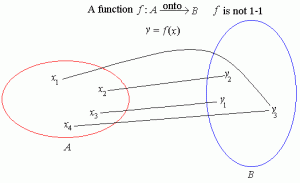 One of the most attractive, problematic, and astonishing features of Badiou’s ontology is his strictly extensional understanding of sets or multiplicities. A set is not defined by its members sharing a common predicate or quality, nor by the relations among members of the set. Rather, a set is defined strictly by its extension or the members that belong to that set. From the standpoint of 20th Century French and German Continental philosophy, this thesis cannot but be a heresy, for the predominant trend in Continental thought has been a relational conception of entities. Whether we are speaking of language as a diacritical set of negative oppositions as defended by the structuralists and the post-structuralists, or Heidegger’s being-in-the-world where entities, the ready-to-hand, are defined by the relational networks to which they belong, the predominant trend has been to treat beings as bundles of relations such that the entity is nothing apart…


